The journal.
Things I notice. Things I am still learning.
Opening the journal…
Things I notice. Things I am still learning.
Opening the journal…
Opening the note…
Oct 7, 2018 / Ritual / 11 min read
There is a café ninety seconds from my door. I make it myself anyway, badly, with a three-week-old boy on my shoulder. On why the point was never the coffee.
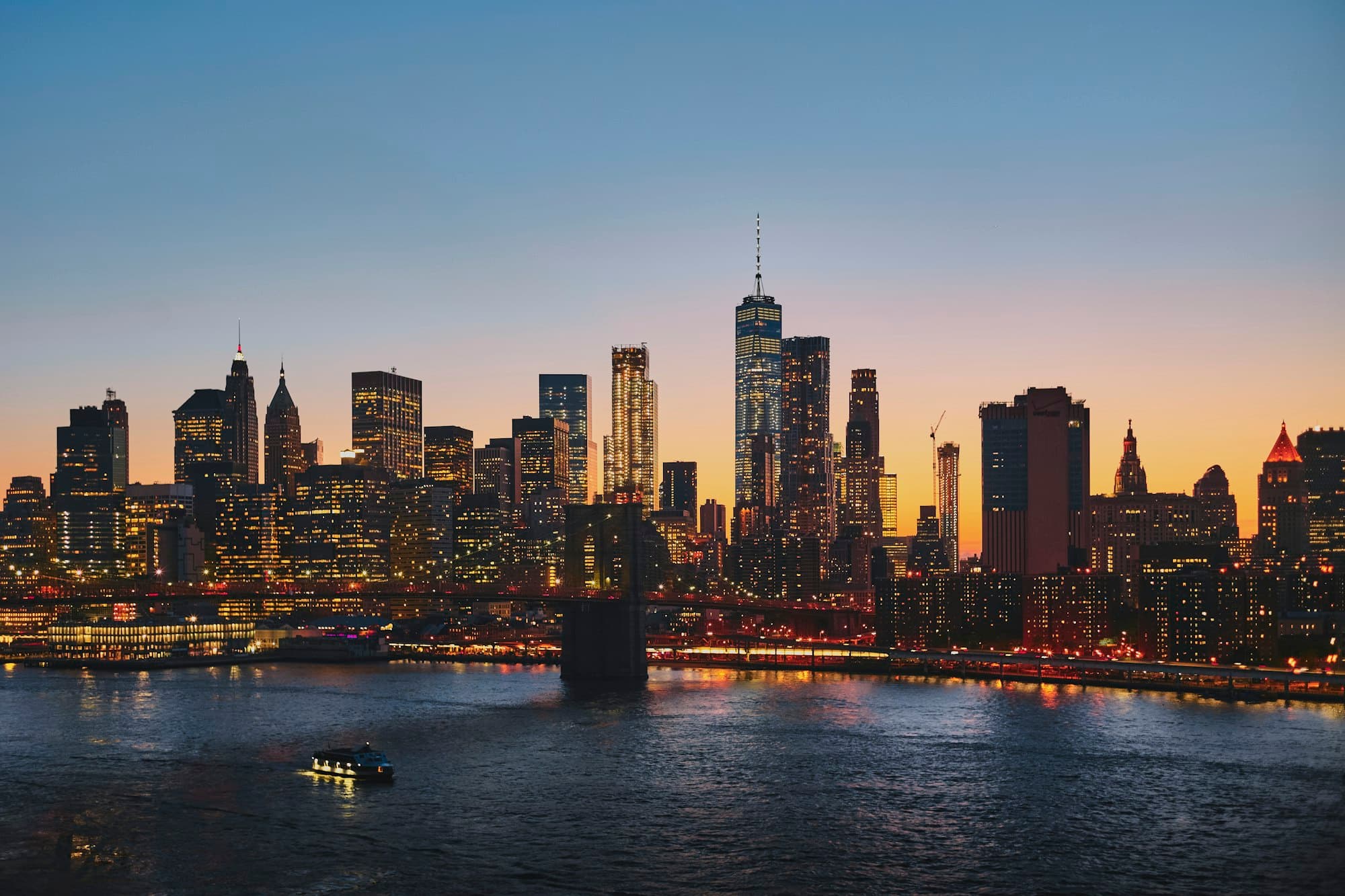
New York, October 2018
By Sayonsom Chanda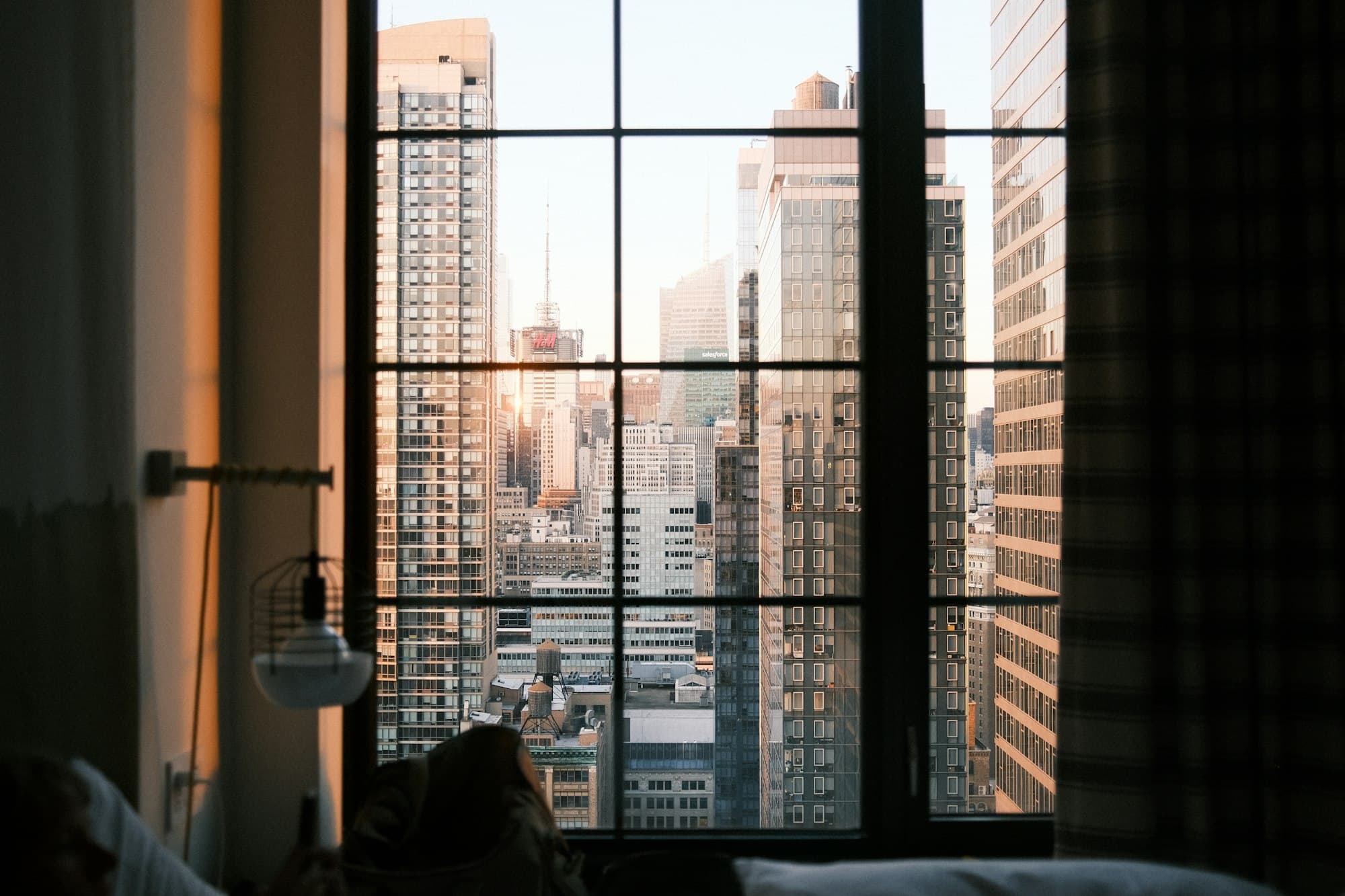
I am standing in the kitchen of a small apartment in New York at four in the morning, and the radiator under the window is ticking the way an old car ticks after a long drive, and there is a three-week-old boy asleep on my shoulder. He was born in the last week of September, when the city was still holding on to summer, and now the leaves in the park across the road have turned the colour of a good roast and the mornings have gone dark and cold. He is warm and heavier than he looks, and every few minutes he makes a small sound like a question that he has not finished asking. I am awake anyway. I am not going back to sleep. So I put the kettle on with one hand, and I make coffee, badly, and it is the first thing in eleven days that I have done slowly.
There is a café ninety seconds from the door of this building, and it opens at six, and the coffee there is better than anything I have ever made in this kitchen. So why am I doing this?
I have been asking myself that question for a while now, in the dark, with the kettle beginning to hum like a fridge that has just remembered its job, and I think I finally have an answer, and the answer is not really about coffee.
Coffee does not make me productive, and I am not asking it to. If anything I want the opposite of productive. I want ten minutes in which I am slower than the day, before the day starts, in which I can notice something small and ordinary, like the way the grounds swell and crack open when the water first hits them, the way a loaf rises under a cloth, before I have to notice anything large.
I am saying this once, here, at the very start of a long series, and then I am not going to say it again. Everything else I write about coffee is going to be about how to make it well, because that is what a person searching at four in the morning actually wants to know. But it felt dishonest to begin a series of notes about a drink without admitting, in the first one, that the drink was never the point.
I do not drink alcohol, and I never have. There was no dramatic reason for it and there is no story to tell about it. It simply never took, the way some people never take to cilantro or to the sea.
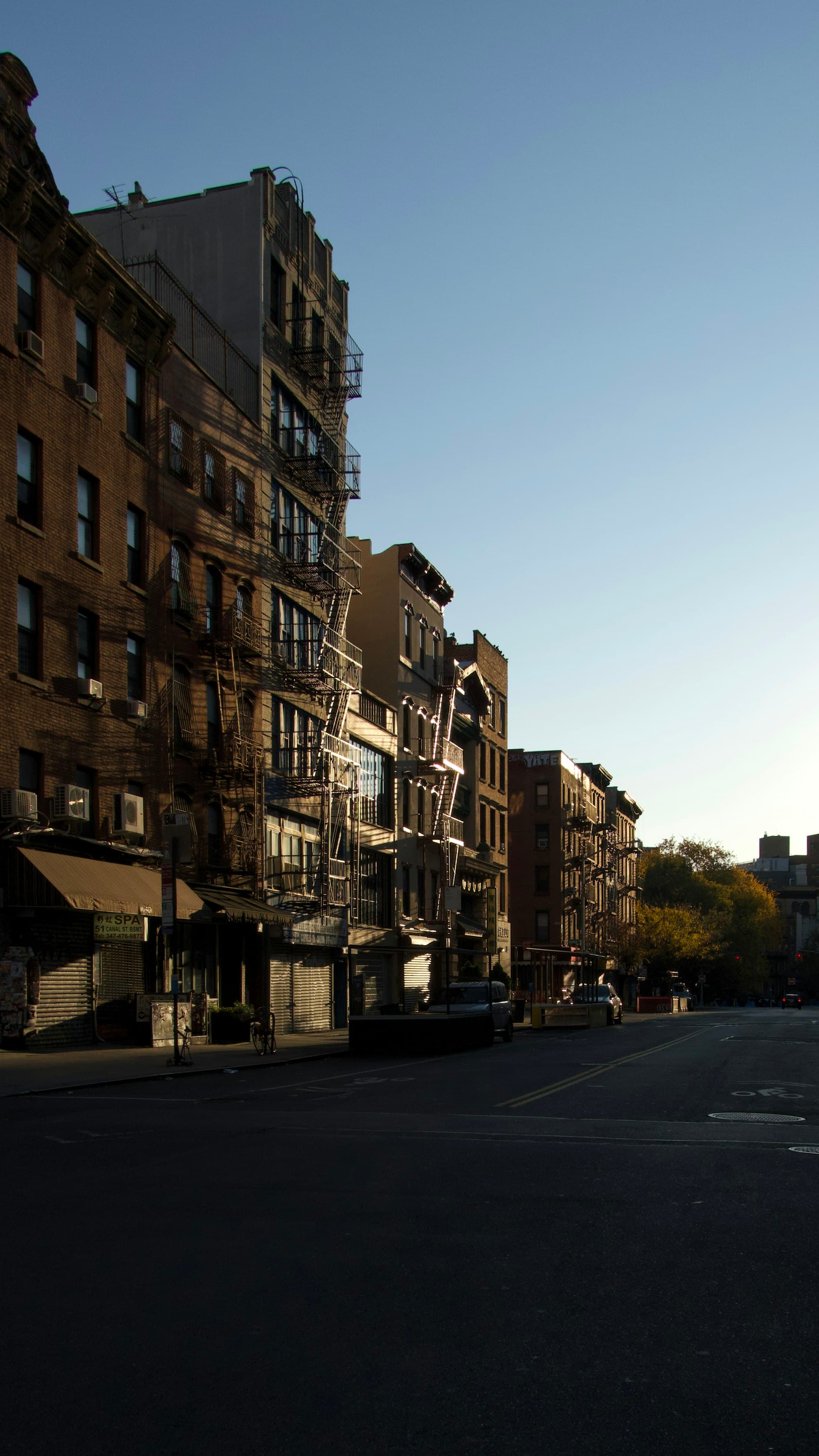
In the work I do, and in this city, a great deal of life happens in bars, under that amber light that makes everyone look like a photograph of themselves. Deals, friendships, the news of who is leaving and who is arriving, all of it is decided over a glass. If you do not drink, you are outside a lot of rooms, or you are standing in the corner of them holding a glass of water and pretending it is something else. I made my peace with that a long time ago, and I would not change it now.
Coffee became the substitute currency. A small part of it is social; someone says "let's get a coffee" and a door opens that would otherwise have stayed shut, and you find yourself across a small table from a person you would never have met over a spreadsheet. But most of it is not social at all. Most of it is me, alone, with my own head, for ten minutes, in a kitchen that smells of toast and warm dust from the radiator. I have come to think that this is what the drink has always been for.
Here is the idea that made me want to write this at all, and I found it in a history book that I read one page at a time, over many mornings, with the boy asleep on my chest.
Coffee has been banned many times in the last five hundred years. In Mecca, early in the sixteenth century, the drink was put on trial like a person, with witnesses and a verdict. The popular version of the story names the governor who ordered it, but the careful histories are less certain, so I will not name him either. In Constantinople a few decades later, sacks of beans were carried down to the water and thrown into the sea, and I like to imagine the smell of that, thousands of roasted beans going into the Bosphorus. Two sultans banned the drink in the second half of that century.
And then there is Murad IV, in the sixteen thirties, who banned the coffeehouses of his capital and drank coffee himself, at home, in his own rooms. Historians who have looked closely at his reign read the ban as politics and not as morals. His brother had been murdered by the palace soldiers, and his uncle had been deposed, and the coffeehouses were where men sat and talked, sober, late into the night, and remembered in the morning exactly what they had said. That was the danger. The story that he prowled the city in disguise with a sword, hunting coffee drinkers in the dark, is folklore, and I enjoy it, and I cannot stand behind it.
Forty years later the king of England tried the same thing and ordered the coffeehouses of London shut. The city protested so loudly that he gave up within a couple of weeks.
Read those stories together and a pattern comes up out of them like cream rising in a jug. In five hundred years, nobody has ever been frightened of a bean. They were frightened of the room, and of what people say in a room when they are awake enough to mean it.
The first coffeehouse in England opened in Oxford, and then one opened in London in a narrow lane off Cornhill, and within a single lifetime there were hundreds of them across the city, low rooms full of pipe smoke and newspapers and men shouting prices. People called them penny universities, because a penny bought a cup and the cup bought you a seat in the conversation.
The conversations hardened into institutions the way honey hardens in a cold cupboard. A coffeehouse called Jonathan's became the stock exchange. A coffeehouse run by a man named Edward Lloyd became the insurance market that still carries his name on buildings all over the world. Auctions held in the back rooms of coffeehouses became the auction houses that sell paintings today for the price of a hospital. Three of the great financial institutions of London were founded in rooms where nobody was drinking anything stronger than something hot and bitter and brown.
Much later, an American sociologist gave this kind of room a name. Ray Oldenburg called it the third place, somewhere that is neither home nor work, where conversation is the main activity, where nobody needs an appointment and everyone stands on the same worn floorboards. He was writing about diners and corner bars in the twentieth century. He could have been writing about Cornhill in the seventeenth.
I have a newborn, a job that asks for most of my waking hours, and no time at all to sit in a café for three hours arguing about anything with anyone. The third place, for me, right now, has collapsed to ten minutes and a filter cone on a counter the width of a doormat.
I think it is the same instinct, compressed, the way a whole orchestra can be compressed into a pair of headphones. The room where you could sit and think has become a small piece of the kitchen and a ritual that takes as long as a song. What I do in those minutes is what people did in those rooms. I wake up, I pay attention, and I have one thought I would not otherwise have had.
There is one more thing I do in those minutes, and it is embarrassing to admit. I think about writing.
I have wanted to be a writer for as long as I can remember, and I have also believed, for just as long, that writers must first be readers, and I do not read enough. There is never time. There is a stack of books on the table by the bed, its spines gone soft and pale from the sun, and I move it to dust and I move it back. So I do not write either, because a person who has not read enough has no business writing, and that is the kind of logic that keeps a person from doing anything at all, and I am very good at it. I do not know yet how to get out of it. But I have noticed that the ten minutes with the kettle are the only minutes of the day when I do not feel behind, and I am beginning to suspect that this is where the writing will have to begin, if it begins anywhere.
Since I spend my working days in front of screens, I will tell you my favourite coffee story from that world, and it is a story about a picture the size of a postage stamp.
In the early nineties, a group of researchers at the computer laboratory in Cambridge shared one coffee pot, down a corridor, several rooms away, and it was a long walk to find the pot empty. So two of them pointed a small camera at the pot, wired it to a computer, and wrote a program that showed a tiny grey picture of the pot on everyone's screen, refreshed a few times a minute, grainy as a photocopy of a photocopy. When the web arrived they put the picture on it, and the first webcam in the world was born, and it was pointed at a coffee pot.
The pot stayed online for a decade. When it was finally switched off, a German magazine bought it at auction, and the maker's engineers repaired it for free, and it sits in a museum now with a camera pointed at it, which is the kind of joke only engineers find moving. One of the two men who built it said later that it made a better topic at dinner parties than network protocols, and I believe him.
Engineers have spent thirty years building things around a shared pot of coffee. It was never the coffee.
For fifteen years I have been the odd one at the bar, the one with the glass of water. Something is changing around me, and I did not expect it.
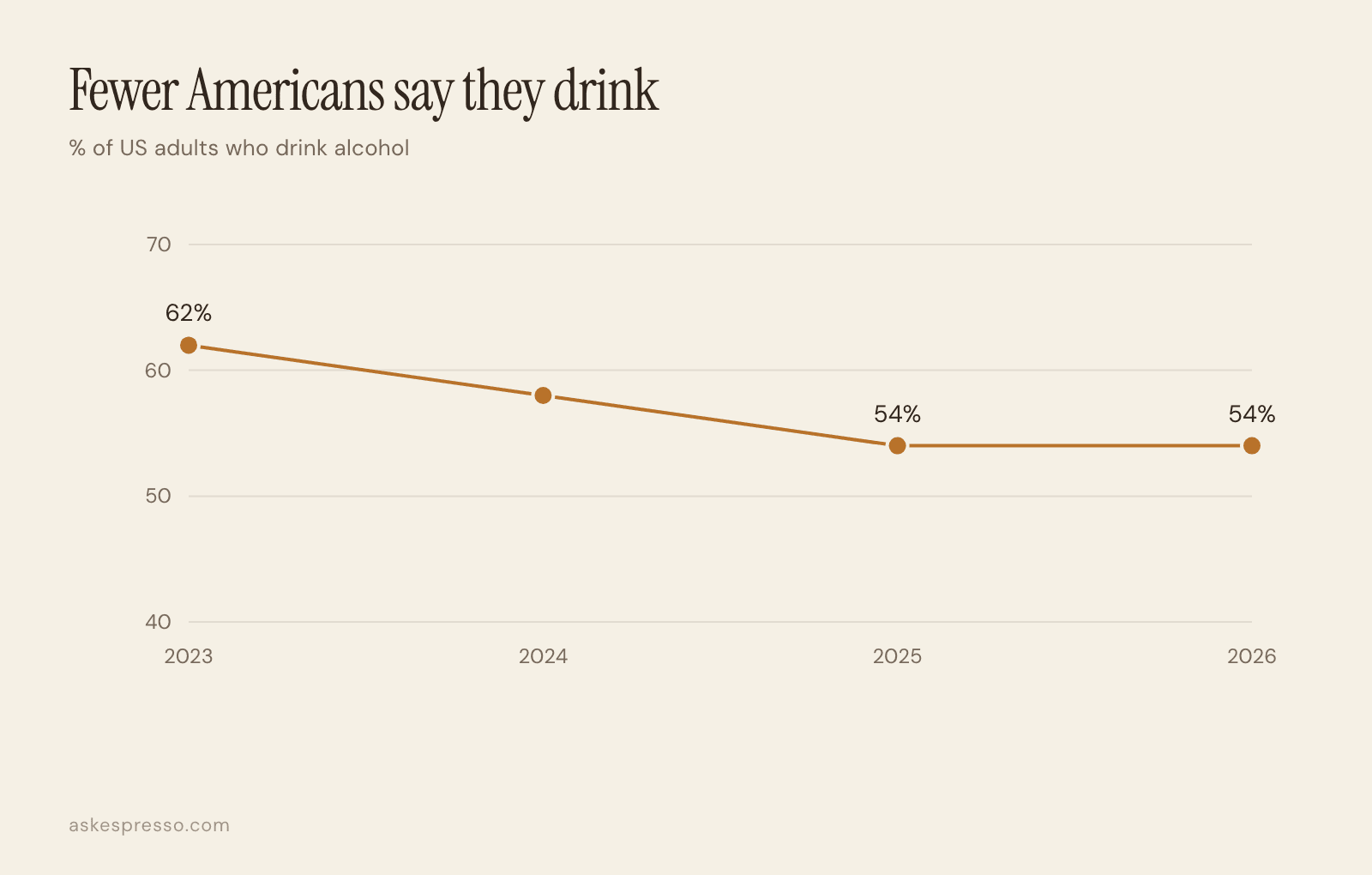
Every year, Gallup asks Americans whether they drink. This year the share who said yes was the lowest in the history of the survey, and among people my age and younger it was about half. For the first time, more people said that drinking even in moderation is bad for you than said it is fine. I do not know why this is happening. Health, money, phones, a generation that grew up watching its parents at the bar. Probably all of it at once.
What I notice is that the room I have been standing outside for years is beginning to fill with people holding cups. That is company, and I am glad of it.
I am going to write a dozen or so of these, and each one answers a question that a person making coffee at home actually asks, usually into a search bar, usually in the dark. Why is it sour today when it was fine yesterday. Which of the forty bags on the shelf. Whether the water matters. Whether you need a machine. What a roast date means. Why everyone says blueberry and you taste coffee.
I will tell you now, so that you can weigh everything that follows, that I love dark roast. I love the oils that come to the surface of a dark bean and catch the light like a wet stone, and I love the way they coat a cup and the tongue, and I have never understood the people who filter them out on purpose. You will hear this again. There will be no scores, no certificates, and no worship of equipment. I am a wanderer in this and not a professional, and the whole point of the series is that a wanderer can get very good at this if he pays attention for long enough. Where I do not know something, I will say so. Where the popular story turns out to be false, and it often does, I will say that too, because the coffee internet is full of quotations that nobody ever said.
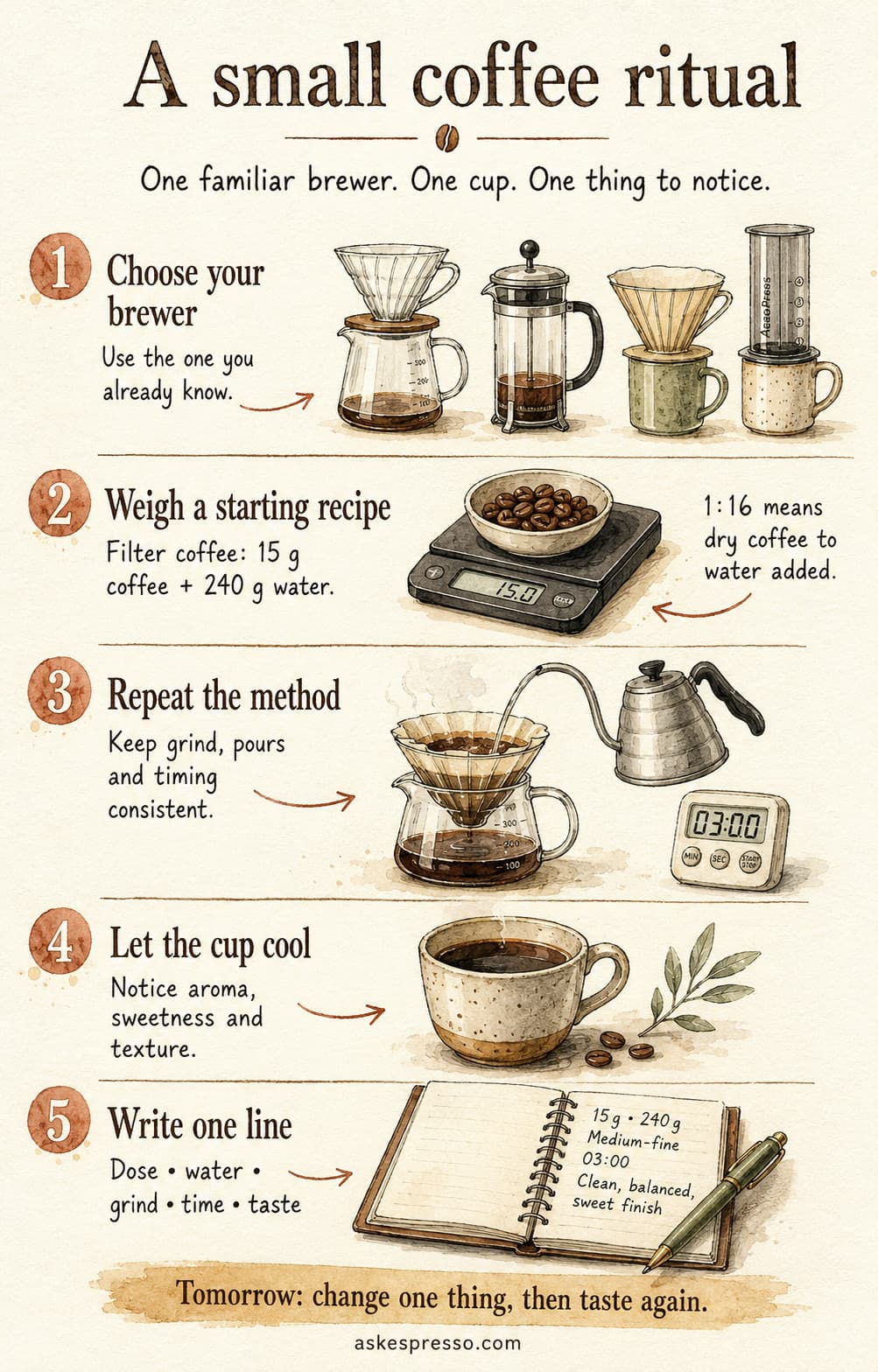
If you want to start this morning, here is the whole method in one sentence. Pick one brewer, weigh the coffee and the water, make it the same way every day, taste it as it cools, and write one line about it.
The first question, and the only idea you really need, is in the next note. If you would rather start with the brewing itself, the note on choosing one brewer is the practical one, and the note on reading a bag will save you money before you have brewed anything.
The boy on my shoulder has stopped asking questions. The coffee has gone cold in the cup, a dark ring drying on the porcelain like the tide going out. It was not good. It was the best part of the day.
Because the ten minutes of making it are the point. A café sells you the drink; making it yourself gives you a short, repeatable stretch of the morning that belongs to you. It is also cheaper, and in a year you get better at it.
Pick one brewer, weigh 15 grams of coffee and 240 grams of water, brew the same way every day, taste the cup as it cools, and write one line about it. Change one thing the next day.
Coffeehouses were banned several times, in Mecca in 1511, in Istanbul in the 1600s, and briefly in London in the 1670s. The rulers were worried about people gathering and talking, not about the drink. Sultan Murad IV banned coffeehouses and drank coffee at home.
Thank you for spending a little time here.
Back to the journal ↗