The journal.
Things I notice. Things I am still learning.
Opening the journal…
Things I notice. Things I am still learning.
Opening the journal…
Opening the note…
Dec 11, 2022 / Brewing / 10 min read
A sixty-centimetre counter, a boy of four, a boy of five weeks, and six brewers. I am keeping one. Which one, and why repetition matters more than equipment.
Boulder, Colorado, December 2022
By Sayonsom Chanda
The counter in this kitchen is sixty centimetres wide, about the width of a bath towel folded once. There are two children in the house now: a boy of four who can reach things, and a boy of five weeks who was born in the first week of November, with the first snow, and who sleeps in a basket by the radiator like a loaf proving. I own six brewers, and a capsule machine that is not a brewer and that stays, because there is a five-week-old in the house and I made my peace with that last spring. Of the six, I am going to keep one.
This is the December I gave up on the company. I made the decision in the autumn, in the hospital car park, and I have spent the weeks since doing what the decision required, which included a call to Bangalore at an hour that was morning for them and night for me, in which I told a team of people I had hired, and liked, and asked to believe in something, that there would be no more salaries after the end of the year. The line had that half-second delay that makes every sentence land twice. It was the hardest thing I have had to do in my working life. I do not have anything wise to say about it, and I am not going to try.
What I will say is that through all of it there was one constant, which is that every morning I have been grounded in coffee grounds. That is not a joke. I mean it literally. The ten minutes at the counter, with the snow blue in the window and the baby breathing in his basket, were the only part of the day whose outcome I could still control, and I held on to them the way you hold a railing on an icy step.
So: six brewers, one counter, and the most common question anyone asks me. Which one?
Here is the answer before the reasoning. Every brewer in this note makes good coffee. The thing that predicts your coffee getting better is not which one you own. It is how many mornings you have made it the same way and paid attention, the way a guitar player gets better from the same three chords played a thousand times and not from a fourth guitar. So the right brewer is whichever one you will actually use, every day, and then a year of not buying another one.
I know this is not what a person browsing a shop wants to hear. I did not want to hear it either. It is still true.
Coffee floats. That is the whole reason.
Tea sinks, which is why a teapot can be a stout jug with a spout and nothing else. Ground coffee ebbs and swirls and clouds the water like silt in a river after rain, and every brewer ever invented is a different answer to a single question: how do we get the liquid away from the grounds?
Once I saw it that way, the shelf of gadgets stopped looking like a shelf of gadgets and started looking like a row of answers.
Every brewer belongs to one of two families, and the real choice is between them.
Immersion. The coffee sits in the water for a time that you decide, and then you separate them. French press, Clever dripper, AeroPress, the cupping bowl, cold brew. Forgiving, like a slow cooker. Fuller in the body. You control time directly, with a clock.
Percolation. Water flows through a bed of coffee and extracts as it passes, like rain through a flowerbed. Pour-over cones, the flat-bottomed drippers, the moka pot, espresso. Cleaner, more aromatic, more variable. Here grind, time and ratio are all tangled together, because the bed of coffee is itself the resistance the water has to get through.
A bath or a shower. One soaks, one rinses.
People argue about the shape of the cone. The material of the filter matters more, and this is where I will tell you what I think.
Paper traps oils and the finest particles. The cleanest cup, the most clarity, the least body, coffee you can see the bottom of the cup through. Rinse the paper with hot water first, or you will taste it, like licking an envelope. I respect paper. I do not love it, because it takes the oils, and the oils are the part I want.
Cloth lets the oils through and holds the grit back. The body of a press without the mud. It clogs, it needs care, and it has to be kept wet in the fridge between uses like a sourdough starter. Grind a little finer than for paper, because water runs through cloth faster.
Metal and nylon add no taste and make no waste, but the holes are large, so fines get through and there is little resistance. The fix is not what you would guess. Use more coffee. A deeper bed slows the water down, and you avoid grinding too fine. Metal keeps every drop of oil, and a dark roast through a metal filter, with that slick on the surface catching the light, is my idea of a good morning.
Wet the grounds with about twice their weight in water and wait half a minute. Fresh coffee gives off gas and the bed swells and bubbles and sighs like a sponge cake coming out of the oven. That gas holds water away from the coffee; letting it out first gives you an even bed and an even extraction.
In immersion brewing, where you stir anyway, blooming does much less. I mention this because everyone blooms everything now out of habit, and it is fine, but it is not doing what they think in a French press.
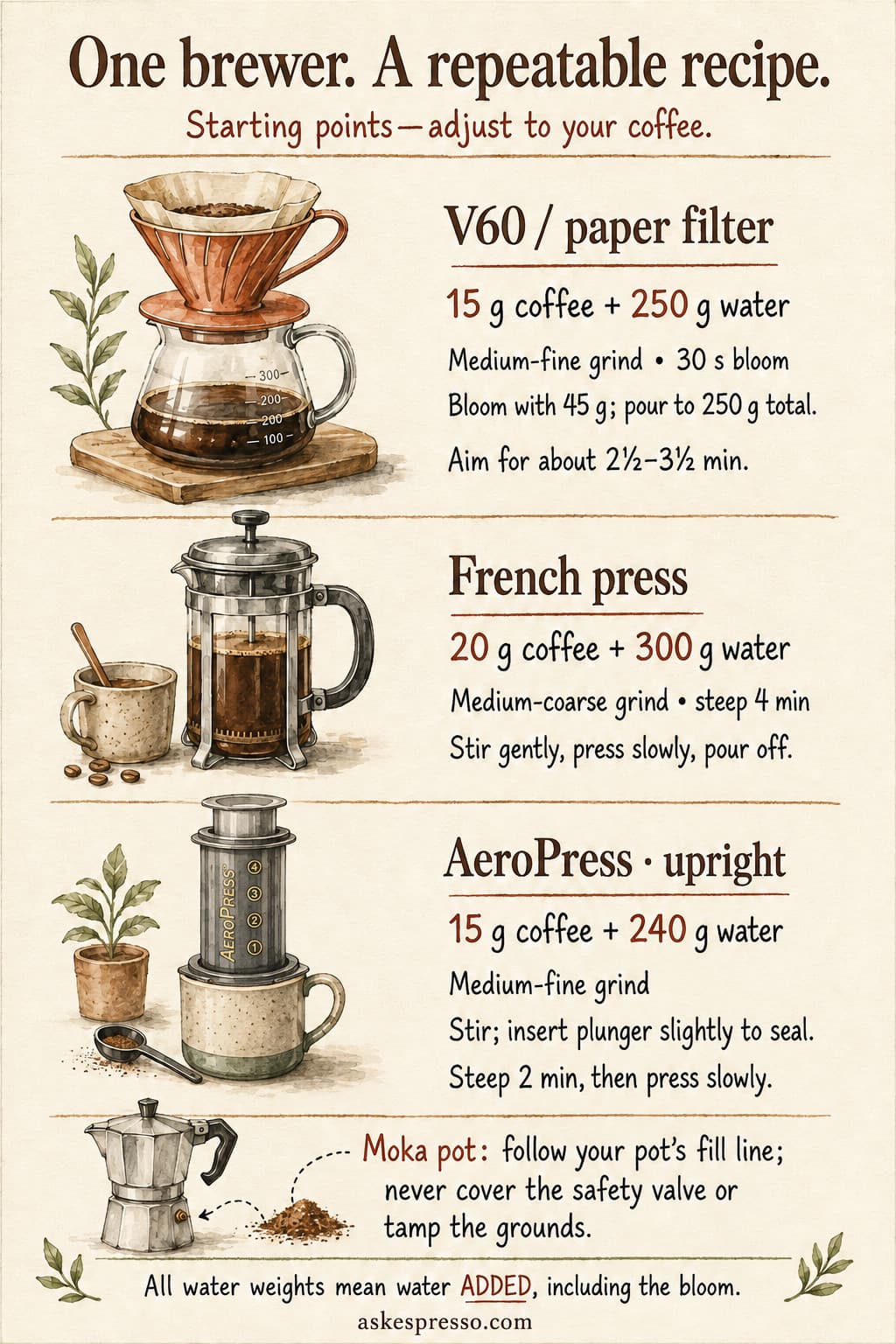
These are starting points, tested at this counter over a year of mornings. Weigh everything. Let the cup cool for four or five minutes before you judge it; most people taste their coffee at a temperature at which they cannot taste anything, the way you cannot hear a song over a hairdryer. And remember from the extraction note that the grounds keep some of the water, so the numbers below are water added, not coffee in the cup.
Brewer | Coffee to water | Grind | Method |
|---|---|---|---|
French press | 1 to 15 | Coarse | Pour, wait 30 seconds, skim the foam, plunge slowly, rest 5 minutes |
Pour-over cone, paper | 1 to 15 | Medium | Bloom 30 seconds, then pour in slow circles; finish in 2 to 3 minutes |
Clever dripper | 1 to 15 | Medium-coarse | Pour, stir at 30 seconds, steep 90 seconds, stir, drain |
AeroPress, upright | 1 to 15 | Medium | Pour, stir, seat the plunger to seal, steep 2 minutes, press gently for 20 seconds |
Cloth, Tokyo style | 1 to 12 | Fine-medium | Bloom, then a slow spiral pour; finish in 1 to 2 minutes |
Metal or nylon, big batch | 1 to 15 | Medium | Use more coffee than you think; bloom, pour, let it settle |
Moka pot | 1 to 5 | Fine-medium | Hot water in the base to the line, grounds level and untamped, medium heat, off at the first bubbling |
Cold brew | 1 to 5 | Coarse | Steep 12 to 24 hours, strain, keep for a week |
French press. The most common home brewer in Europe and unfairly maligned. Sludge comes from technique, and technique can be fixed. Skim the foam, plunge slowly, stand five minutes, pour a little into each cup and then top up so the sediment shares out evenly, and leave the last of the liquid in the pot. Buy the smallest pot you will use. It keeps the oils, which is why I keep coming back to it.
The pointed cone. Wide opening, fast flow. Fast means you compensate with a finer grind or more coffee. The most rewarding of the pour-overs and the least forgiving, like a bicycle with no gears.
The flat-bottomed dripper. Ribbed sides, slower drawdown. Better for small doses that would otherwise rush through a cone.
The glass hourglass with the thick paper. Remarkable clarity. It is in an art museum's collection and has been a cult object for seventy years. It also needs a lot of coffee to work well, and it strips a cup of its oils more thoroughly than anything else on this list, and a small counter does not love it.
The Clever dripper. A cone with a valve in the bottom. You get the control of immersion and the clarity of paper. Skip the bloom; you are steeping anyway. It is the best beginner brewer I know and it costs almost nothing.
The AeroPress. An accident. It was designed by a retired engineering lecturer who also invented a flying ring that holds the record for the farthest thrown object. He was trying to make a cheap espresso alternative in his garage and made something else: the only brewer nearly indifferent to grind size and time, because it combines immersion, paper and a little pressure. There is a world championship for it, started in Oslo with three competitors.
The moka pot. The single most misunderstood object in coffee, and one of my favourites. It is not an espresso maker, and treating it as one is why so many people burn it. Fill the base to the line, because less water means more headspace and a hotter, faster push. Use hot water in the base so the grounds are not being cooked while the pot heats. Do not tamp. Keep the heat moderate, watch it, and take it off the flame at the first gurgle, that sound like the last of the bathwater going down, then run cold water over the base to stop the brew. Medium and dark roasts suit it, and a dark roast in a moka, thick and oily and almost sweet, is the cup I would take to a desert island. I have written more about that in the note on espresso.
The siphon. Theatre, and I enjoy the theatre. It has one real technical advantage: it is the only common brewer that holds a steady temperature through the brew. A press cools throughout; a pour-over starts cool and climbs. It tends toward caramel and nut, and there is no room for it on this counter.
Cold brew. Different compounds come out cold, so the drink is low in acidity and keeps a week in the fridge. The good trick is to bloom the grounds with a splash of hot water first, then finish cold. You get some of the brightness back.
She deserves her paragraph. In Dresden, in 1908, a housewife named Melitta Bentz was tired of grit in her cup. She tore a sheet of blotting paper from her son's school notebook, put it in a brass pot with holes punched in the bottom, and poured. The patent office in Berlin gave her a small utility protection, not a full patent, that summer, and by the end of the year she had registered a company with starting capital that would not today buy a cup of coffee. The cone shape came decades later. Every pour-over you have ever made descends from a raid on a child's stationery.
Choose by your honest constraint, not by who you would like to be.
One cup, want control, have three minutes: the AeroPress.
One cup, want clarity, willing to practise: the pointed cone.
Coffee for three people while doing something else: the Clever or the press.
Want it to taste like childhood, or Italy: the moka pot, done properly.
Coffee for eight: a metal filter and a big batch, or a good machine.
I kept the Clever.
I kept it because it is the one I use when I am tired, and this year tired has been most days and most of the nights, and the brewer you reach for when you are tired is the one that will actually make you better at this. The other five went into a box in the garage, next to the boxes of company letterhead. One of them I gave to a neighbour. I do not miss them, though I will admit that the moka pot came back out of the box within a month, because a man has to have some oils in his life.
Is a year really necessary? I do not know. I know that every time I bought a new brewer, my coffee got worse for a month, because I had thrown away everything I had learned about the old one, like moving house and forgetting where the light switches are. A year is long enough to stop that happening.
If you want a single thing to do this morning, put every brewer you own except one in a cupboard. Then make coffee with the one that is left, tomorrow, and the day after, and write one line each time. The note on the grinder says where the money should go instead, and the note on water says what to put in the kettle. And the next one is about what happens when, with no company left to run and a baby asleep on your chest, you find yourself with a bag of green beans and a free Saturday.
The Clever dripper or a French press, because they are immersion brewers and forgive small mistakes. If you want one cup and have three minutes, the AeroPress. If you want the cleanest cup and are willing to practise, the V60.
About 22 grams of coarse coffee to 330 grams of water just off the boil. Wait thirty seconds, skim the foam, plunge slowly, and let it stand five minutes before pouring. Leave the last of the liquid in the pot.
No. It makes a strong, good drink of its own kind. Fill the base to capacity with hot water, use a medium-fine grind without tamping, keep the heat moderate, and take it off the flame at the first bubbling.
Thank you for spending a little time here.
Back to the journal ↗