The journal.
Things I notice. Things I am still learning.
Opening the journal…
Things I notice. Things I am still learning.
Opening the journal…
Opening the note…
Oct 13, 2019 / Brewing / 10 min read
Why is the same coffee sour one morning and bitter the next? Because you did not do the same thing. One idea, extraction, and the three dials that move it.
New York, October 2019
By Sayonsom Chanda
There is a kettle on top of a grey filing cabinet on the eighteenth floor of a building in Manhattan, and two people are arguing next to it, and outside the window the October light is the colour of weak tea.
Manish thinks the ratio is wrong. Mayank thinks the water is wrong. They have been having this argument, in different forms, since the week I joined the desk, and it has the rhythm of a song you know from the radio, the same two verses and the same chorus. Both of them are engineers. I model uncertain systems for a living, and I am standing here watching two clever people debate a system with three inputs and no instrumentation, which is exactly the situation I get paid to fix, and it has never once occurred to me to measure my own coffee.
That was a year ago, in the autumn my son was born. He is walking now, in the stiff-legged way of a wind-up toy, and he tastes everything he picks up before he decides what it is. This note is what happened after I started measuring, and what I learned from him about the order in which to do things.
Why is the same coffee sour on Tuesday and bitter on Thursday, when I did the same thing both days?
The honest answer is that you did not do the same thing. You did something close, and coffee is sensitive to close in the way a sleeping baby is sensitive to a floorboard. Coffee has one control variable that matters, and three dials that move it, and once you can see the variable most of the mystery drains out of the cup.
When hot water meets ground coffee, it dissolves some of the coffee and leaves the rest behind, the way tea leaves give up their colour to the pot and keep their shape. Only about a third of a roasted bean can dissolve at all. How much of that third ends up in your cup is called extraction.
That is the idea. That is the whole idea, and everything else in this series hangs from it like coats from one hook.
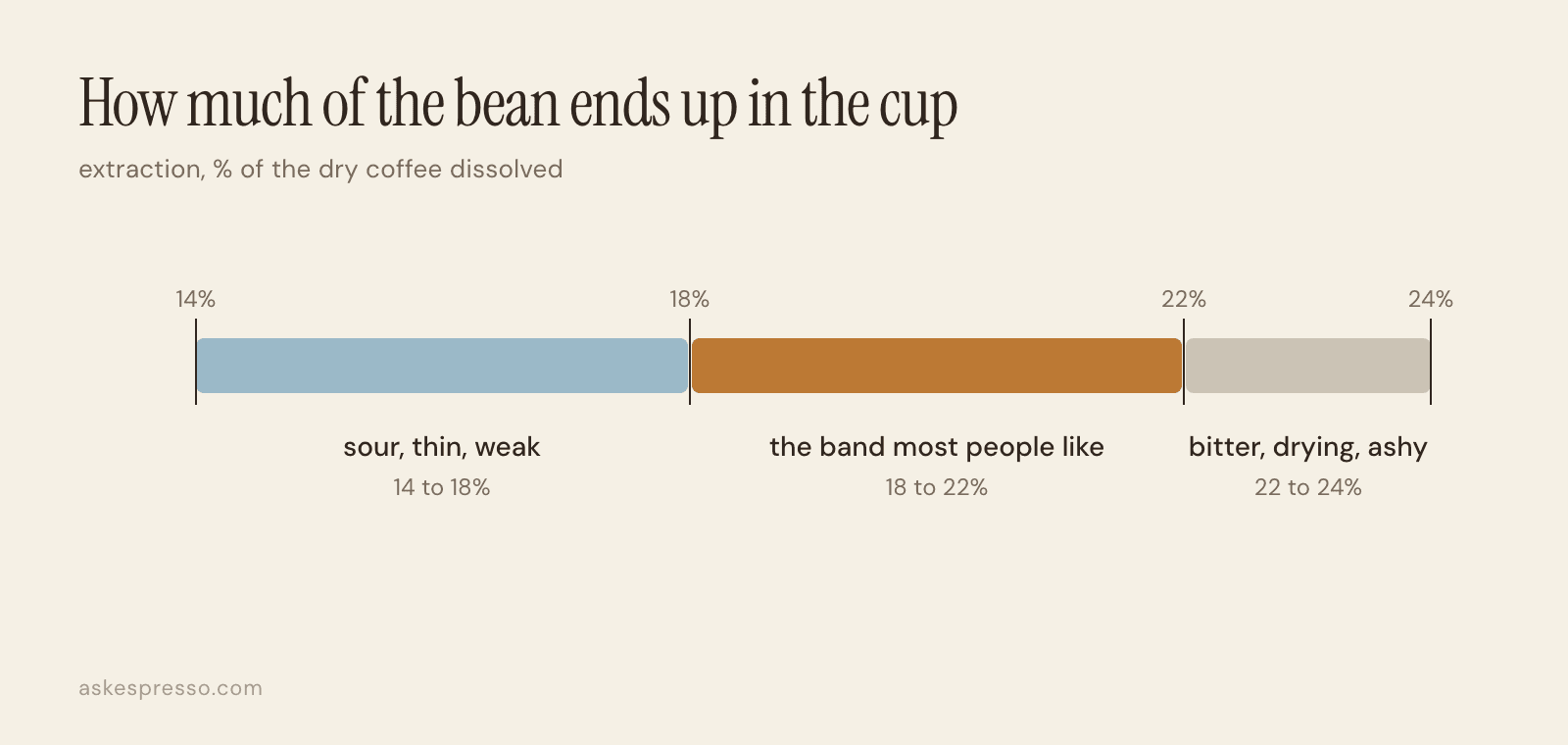
Pull too little out of the bean and the cup is sour, thin and weak, with the sharpness of an unripe plum and none of the sweetness. Pull too much and it is bitter and drying, a little like the black edge of burnt toast, and it leaves your tongue feeling like a wool sweater. There is a band in the middle where most people, most of the time, find the coffee tastes right. Sour means go further. Bitter means stop sooner. Everything else in this note is about how to go further or how to stop sooner.
Where does that band come from? It comes from a chart that home brewers and roasters have used since the fifties, drawn from work at a coffee institute in the United States, and I should say plainly that it is a convention and not a law, and that it does not appear in the current standards of the trade body that everyone cites for it. It is the chart everyone uses. That is a different thing from a standard, and it took me an embarrassingly long time to work that out.
Here is the part that confused me for years, and that confuses nearly everyone who has ever complained that a coffee was too strong.
Strength is how much of the finished drink is coffee rather than water. Extraction is how much of the dry coffee dissolved. They are not the same thing, and they move independently, the way the volume knob and the tone knob on an old stereo move independently.
A cup can be strong and under-extracted at the same time, and that is the sour, intense, unpleasant cup you get when you use too much coffee and grind it too coarse. A cup can be weak and over-extracted, and that is the thin, bitter cup from an office machine that dripped for too long over too little coffee, the cup that tastes like the smell of a photocopier.
An espresso and a filter coffee should end up with roughly the same extraction. The espresso simply has far less water in it, which is why it hits the tongue like a struck match and the filter coffee arrives like a warm bath. When I understood this, the two drinks stopped being different subjects and became the same subject with the water changed.
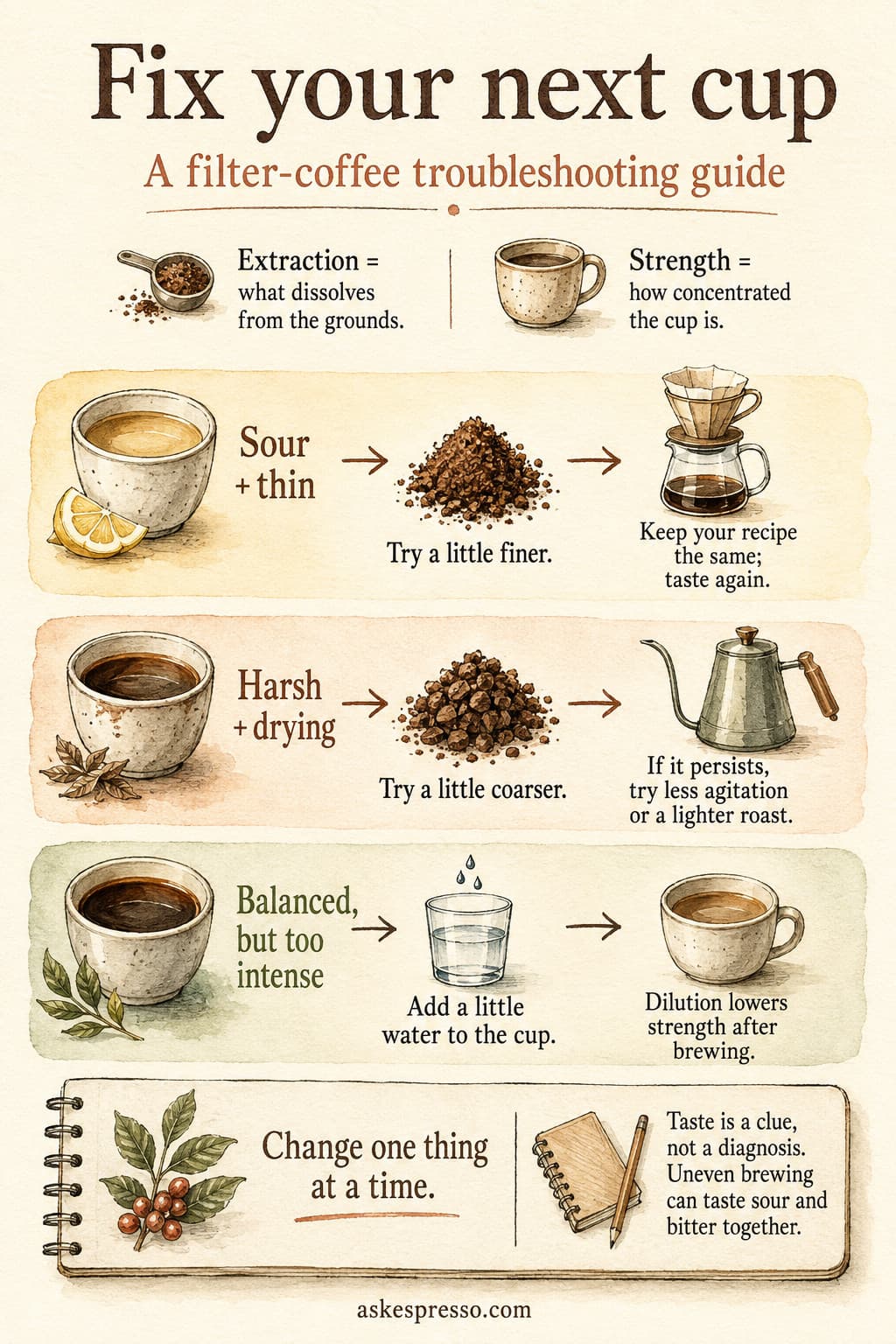
If extraction is the thing you are controlling, three dials move it, and they are not equal.
Grind size is the big one, and it is not close. Grinding finer exposes more surface, and extraction runs faster. Halving the size of the particles does not double the speed; it roughly quadruples it, the way a sugar cube takes an age to dissolve in tea and a spoon of caster sugar vanishes before you have stirred. This is why the grinder, and not the brewer, is the purchase that changes your coffee, which is a whole note of its own later in the series.
Contact time is the second. Longer contact, more extraction. In a French press you control this directly with a clock, and I love the French press for exactly that plainness, and for the oils it lets through. In a pour-over the water flows through a bed of coffee, and here the dials are tangled: a finer grind also slows the water down, so it extracts faster and for longer at once, the way a wet sponge both holds water and drips. This tangle is why pour-over feels unpredictable when you first start, and why it rewards a notebook more than any other brewer.
Temperature is the third. Hotter water works faster. Caffeine comes out even in lukewarm water. Some of the harsh, drying compounds only come out near the boil, which is why most advice keeps the water a few degrees under it. I would leave this dial alone until the other two are settled, and the note on water explains why the dial reads differently a mile above the sea.
After those three come the small ones. How much you stir. What is dissolved in your water, which is its own note. How fresh the coffee is, because very fresh beans give off enough gas to physically hold water away from the grounds, like a raincoat, which is another note.
I want to say something that gives you permission to trust your tongue over a chart.
Some coffees taste wonderful when extracted a little below the band, bright and clean and fruity, like biting into a cold green apple. The same coffees taste wonderful again a little above the middle of it, jammy and sweet, like the last spoonful at the bottom of a pot of stewed plums. And, strangely, they can taste flat and grey in between. Nobody I have read can fully explain this. The writer whose book I lean on for the chemistry compares it to a cocktail that is good dry and good sweet and dull halfway between.
I mention it because the band is a starting point and not a verdict. If your cup tastes good outside the band, your cup is right and the chart is a guide, and I will always take my own dark, oily, slightly-over-the-line cup over anyone's chart.
The other number people argue over is the ratio of coffee to water, and it is worth knowing the usual starting points, because they tell you how different the drinks really are.
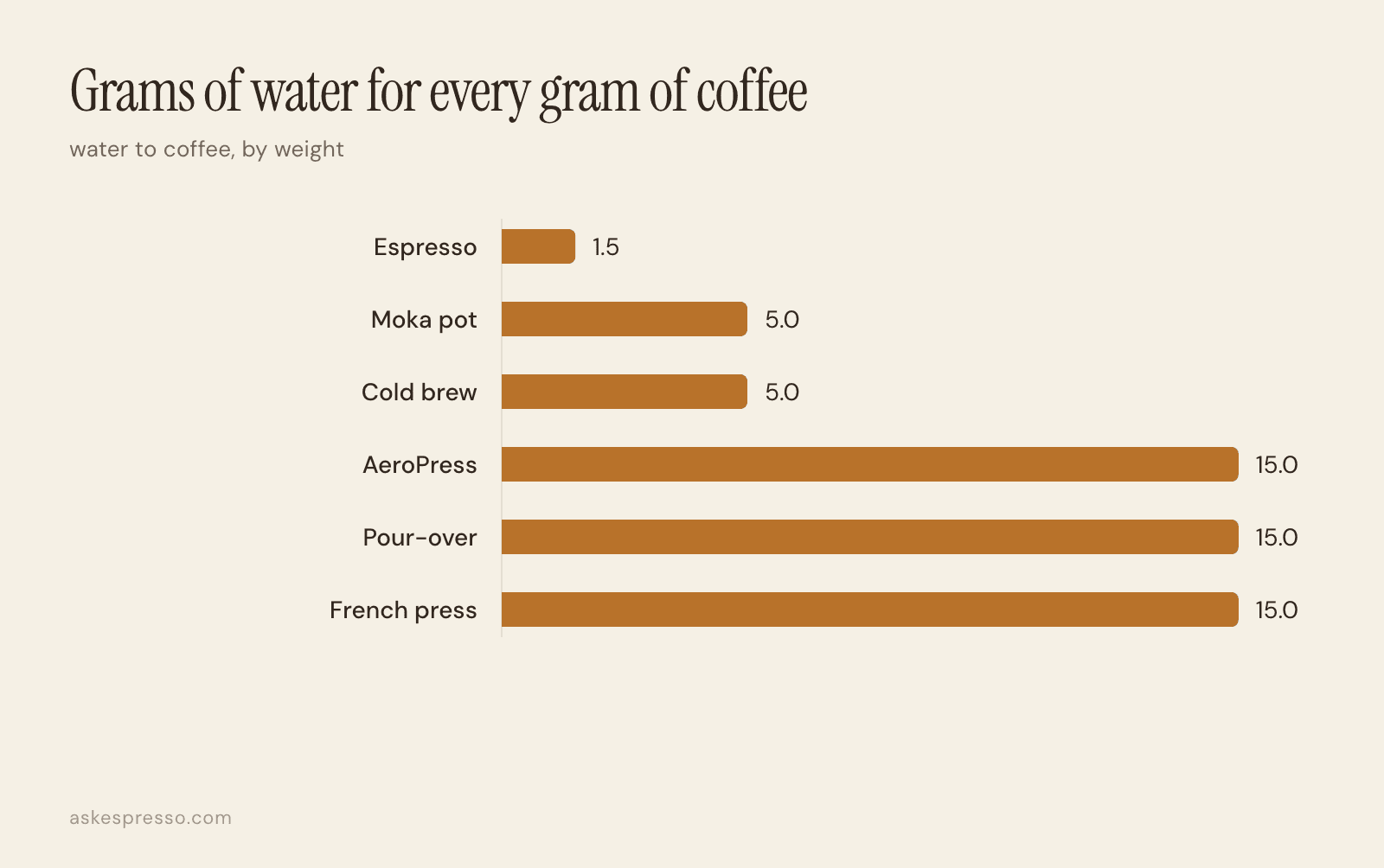
The trap is this. Ground coffee holds on to about twice its own weight in water and never gives it back, the way a bath sponge keeps the last of the bathwater however hard you squeeze. Pour three hundred grams of water over twenty grams of coffee and you do not get three hundred grams of coffee; you get less, and the missing part is sitting in the wet grounds. So when people compare ratios they are often comparing different things without knowing it. Weigh what ends up in the cup, or at least know that the two numbers differ, and half the internet arguments about ratio dissolve like sugar.
When I finally decided to measure, I assumed it would be expensive. It was not.
Two kitchen scales. One that reads to a tenth of a gram, for the coffee, and one that reads to a gram and goes up to a few kilos, for the water. A phone with a timer. That is the entire instrument upgrade. It costs less than a bag of good beans and it is the largest single improvement available for the money, after the grinder.
There is a device that measures strength properly, called a refractometer, and it costs several hundred dollars. You do not need one. I have never owned one. I am telling you this in a note about measurement because the instinct to buy the instrument is strong, and it is usually wrong, and it is usually a way of not tasting.
Since I work with numbers, I will tell you about the numbers people.
There is a line that every mathematician knows: a mathematician is a machine for turning coffee into theorems. Everyone attributes it to Paul Erdős. Erdős himself, in print, attributed it to his friend Alfréd Rényi, and Rényi had died the year before the paper came out, so he never saw his joke become famous under another man's name. A third mathematician, handed a weak cup, is supposed to have said that it was fit only for lemmas. I cannot verify that one and I do not want to, because it is perfect.
More usefully, a few years ago a group of chemists and mathematicians published a real mathematical model of espresso. Their theory said that grinding coarser should always lower extraction. Their experiments found something else: there is an optimum, and going finer past it makes things worse, because at very fine grinds the water finds channels through the bed instead of soaking it, the way rain finds the gutters instead of the garden. Their practical conclusion was that many cafés could use a little less coffee, ground a little coarser, and get a more repeatable shot. One of the authors said that solving the full physics of water moving through a bed of ground coffee would need more computing power than the largest technology company owns. I find that comforting. It means the notebook is not a lesser instrument. It is the only one that fits the problem.
I spent a year measuring everything. Dose, water, time, temperature, all of it written in a small black notebook in handwriting that got worse as the mornings got earlier. The coffee did not get better.
It got better when I started tasting first and writing second. I would drink the cup, decide with my mouth whether it was sour or bitter or right, and only then write down what I had done. The instrument, it turns out, is downstream of the tongue. Measure so that you can repeat what worked. Do not measure so that you can skip the tasting.
I should have known this. It is how I work when I am doing my job well, and I somehow forgot it in my own kitchen. My son, who is just past one, tastes everything he picks up before he decides what it is, the remote, a shoe, the edge of the table, and I have started to think he has the order right.
Here is what I would do this morning. Take one page of a notebook. Write the dose, the grind setting, the water weight, the time, and one word for how it tasted. Do it again tomorrow, and change one thing, and only one. After ten entries you will know more about your own kit than any review will ever tell you.
I still do not know which of Manish and Mayank was right. I suspect it was neither, and that the coffee on the eighteenth floor was bad for reasons that had nothing to do with the ratio or the water and everything to do with a bag that had been open since the spring and smelled, when you put your nose in it, like the inside of a cardboard box. That is the next question, and it has a note of its own.
Sour, thin coffee is usually under-extracted: not enough of the bean dissolved into the water. Grind finer, brew a little longer, or use hotter water, and change only one of those at a time.
Bitter, drying coffee is usually over-extracted: too much of the bean dissolved. Grind coarser, shorten the brew, or use slightly cooler water. If the cup is balanced but too intense, it is strong rather than over-extracted, and a splash of hot water fixes it.
Extraction is how much of the dry coffee dissolved into the cup, usually 18 to 22 percent. Strength is how much of the finished drink is coffee rather than water. An espresso and a filter coffee can have the same extraction; the espresso simply has far less water in it.
Thank you for spending a little time here.
Back to the journal ↗