The journal.
Things I notice. Things I am still learning.
Opening the journal…
Things I notice. Things I am still learning.
Opening the journal…
Opening the note…
Jul 17, 2022 / Brewing / 9 min read
A second boy on the way, a company on the way out, a capsule machine humming on the counter, and a hand grinder in a hallway at five in the morning because the electric one wakes the house. Where the money should go, and why.
Boulder, Colorado, July 2022
By Sayonsom Chanda
It is five in the morning in July and already light, the pale, washed light of a Colorado summer before the heat arrives, and I am grinding coffee by hand in a hallway with the door shut, because the electric grinder wakes everybody, and this is how I found out that a hand grinder is not a compromise.
Thirty seconds of resistance in the wrist. A sound like gravel under a boot, or like the old dial-up modem finding its voice. And a smell that arrives before I have done anything else at all, dark and sweet and a little like the inside of a bakery at closing time.
Everybody, this summer, is my son, who is nearly four and sleeps like a starfish, and my wife, who is pregnant with our second boy and sleeping badly in the heat. He is due in November. It is a strange season. I am happier about the baby than I have been about anything, and I know now that the tiredness passes, which I did not know the first time. But the company is not well. I keep putting money into it, my own, because we are so close, and because I have already put so much in that stopping feels like admitting the first money was wasted. I know the name of this mistake. I teach the name of this mistake. Next month we will spend more than we should on a show in Houston, and I am about ninety percent sure it will not change anything, and we are going to do it anyway. My wife was going to start a business degree this autumn, and with the baby coming she has withdrawn. There is also, since March, a capsule machine on the counter, which I wrote about with some shame and which makes the second cup of the day at my desk with a whirr like a small drone, while the hand grinder makes the first. Somewhere in all of this, the hallway, the grinder and the thirty seconds are the one part of the day that does exactly what I ask of it.
Here is the question this note answers, and it is the one I get asked most. I have a certain amount of money to spend on coffee equipment. Where does it go?
Into the grinder. Every time. It is not close, and I will argue with anyone who says otherwise.
I wrote in the note on extraction that one idea governs coffee: how much of the bean dissolves into the cup. Three dials move it, and grind size is the biggest by a distance you could measure in miles.
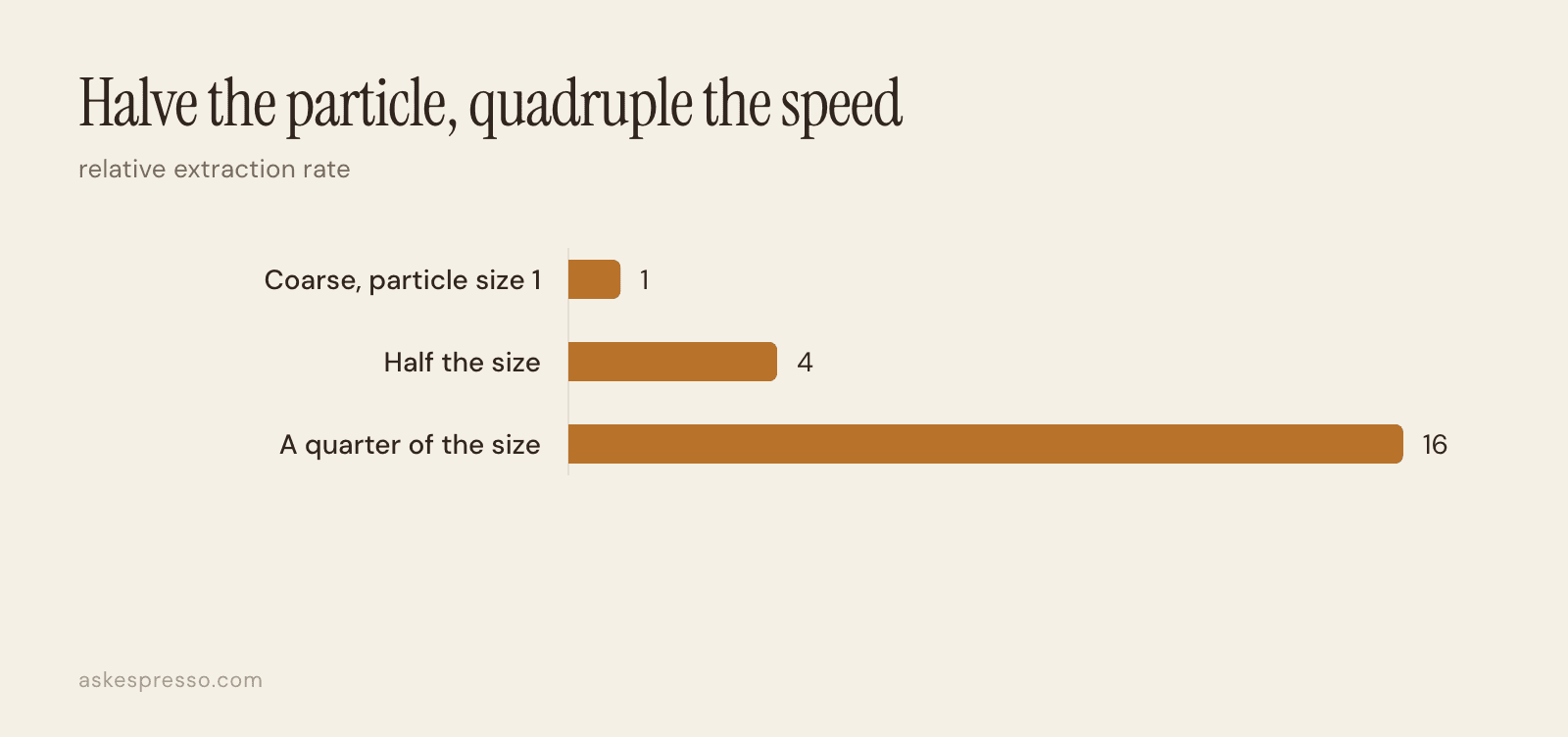
Surface area governs how fast water pulls things out of coffee, and surface area grows faster than the particle shrinks, the way a sheet of paper torn into confetti has far more edge than the sheet had. Halve the size of the pieces and extraction runs roughly four times as fast. Every other dial moves the same outcome by less.
There is a second, quieter reason. Ground coffee goes stale within minutes. It is all surface, all exposed, all oxidising, like a cut apple going brown on the counter. Grinding fresh, just before you brew, is by itself a bigger improvement than any brewer you could buy. The grinder gives you both.
A blade grinder does not grind. It smashes. It produces powder and boulders in the same batch, with a noise like a coin in a washing machine, and the powder over-extracts while the boulders under-extract, so you get sour and bitter in the same cup, permanently, whatever else you do.
The writer whose book I keep beside the kettle has the best picture of this. Boil a quail's egg, a hen's egg and an ostrich egg in the same pan for three minutes. Something will always be wrong.
A burr grinder crushes the beans between two hard surfaces set a fixed distance apart, so the pieces come out close to one size, like sand from a sieve. That is the whole difference, and it is the difference that matters.
Conical burrs are a cone inside a toothed ring. Big teeth break the bean and finer teeth further down slice and crunch it. They are forgiving, they make a little more fine dust, and they give more body, which is to say more of the oils and weight I want in a cup.
Flat burrs are two rings facing each other, and the beans are flung outward through the gap. It is more of a nibbling action than a chewing one. Cleaner separation, more clarity in the cup, usually more coffee left inside the machine.
One thing I have not seen written down often: the geometry changes how fine your adjustment is. On flat burrs, moving the burr a small distance changes the gap by that distance. On a cone, the same movement changes the gap by less, because the faces are angled. So a conical grinder gives you finer control for each click of the dial, the way a long lever gives you finer control than a short one. For someone grinding in a hallway in the half-dark, that is worth knowing.
Steel burrs and ceramic burrs both dull eventually, like kitchen knives. Replacing a worn set improves a cup more than most people expect. And on hand grinders, the single largest difference in daily life at any price is whether the adjustment is on the outside or the inside. Outside means you can switch from filter to espresso and back without losing your place, like a bookmark.
Coffee is brittle, like a biscuit. However good the grinder, some of it shatters into dust. Most grinders make about a tenth of their output as these fines. Fines over-extract, clog paper, make sludge in a press, and wreck the flow of an espresso. At the other end, oversized rubble under-extracts. Uniformity is the whole game, and the reason that a commercial grinder can cost as much as a small car is that it makes fewer fines and less rubble than anything else.
I read papers for a living, and two of them changed how I grind.
The first, from a few years ago, measured how ground coffee's particle sizes change with the temperature of the bean. The result was that the origin of the coffee did not matter, and the processing did not matter, but the temperature mattered a great deal: colder beans shatter into a narrower, finer range of sizes, the way cold chocolate snaps clean and warm chocolate smears. The biggest change happens between room temperature and the freezer. This is the scientific basis for freezing your beans, and it is a real effect and not a trick. I keep single portions in small sealed jars in the freezer now, next to the peas, and grind them straight from cold. The note on freshness says why that helps twice.
The second paper came out last winter. Breaking coffee beans transfers electric charge, and the resulting static makes the grounds clump and cling inside the grinder like a balloon rubbed on a jumper. A few drops of water on the beans before grinding suppress the charge: less clumping, less mess, and measurably stronger, more even espresso. The lead author is a volcanologist who studies charging in ash clouds. If your next espresso tastes a little better, you can thank the study of volcanoes. I put one drop of water on the beans with a fingertip now, every morning, in the hallway.
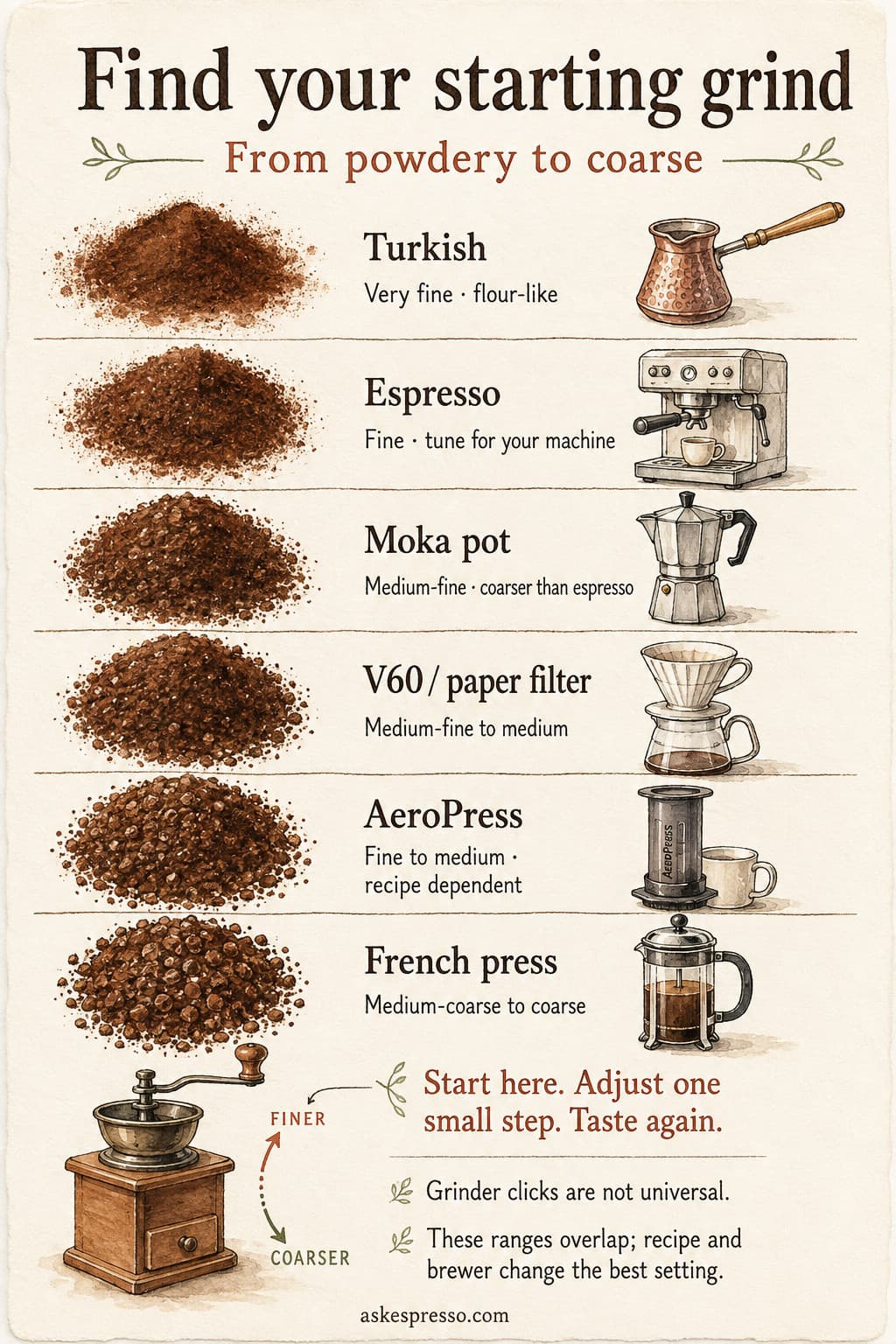
There is no universal scale. Two identical grinders from the same factory differ slightly. So anyone who tells you to grind at eighteen clicks is telling you about their machine, not yours, the way a friend's directions only work from their house. Use words and a notebook instead.
Grind | What it looks like | What it is for |
|---|---|---|
Finest, just before it clogs | Flour | Turkish coffee |
Fine, clumps a little | Fine sand | Espresso |
Fine-medium | Between the two above | Moka pot, cloth filter |
Medium | Caster sugar | Pour-over with paper |
Medium-coarse | Granulated sugar | Slower pour-overs, the Clever |
Coarse | Sea salt flakes | French press, immersion |
Very coarse | Rock salt | Long steeps, cold brew |
Start in the middle for whatever you brew, taste, and move one step. Sour, go finer. Bitter, go coarser. Then write it down, as the brewing note keeps asking you to.
Prices move and I am writing this in a particular summer, so take these as a shape rather than a list.
A good hand grinder with steel burrs, at the price of a few bags of coffee, is the best value in the whole of coffee equipment, and I would put it above any brewer, any kettle, and any machine. In India there is one obvious choice at that level. A step up buys smoother bearings and outside adjustment. The top of the hand-grinder range, at a few times the price, competes with electric grinders costing far more, and there is one model made only for filter coffee that produces fewer fines than anything I have used.
For electric, there is one honest default for filter coffee that has held that place for a decade, a version of it for espresso, and a more expensive flat-burr model for people who want maximum clarity and only brew filter. I am not one of those people. Clarity is a fine thing, but I would rather have the body.
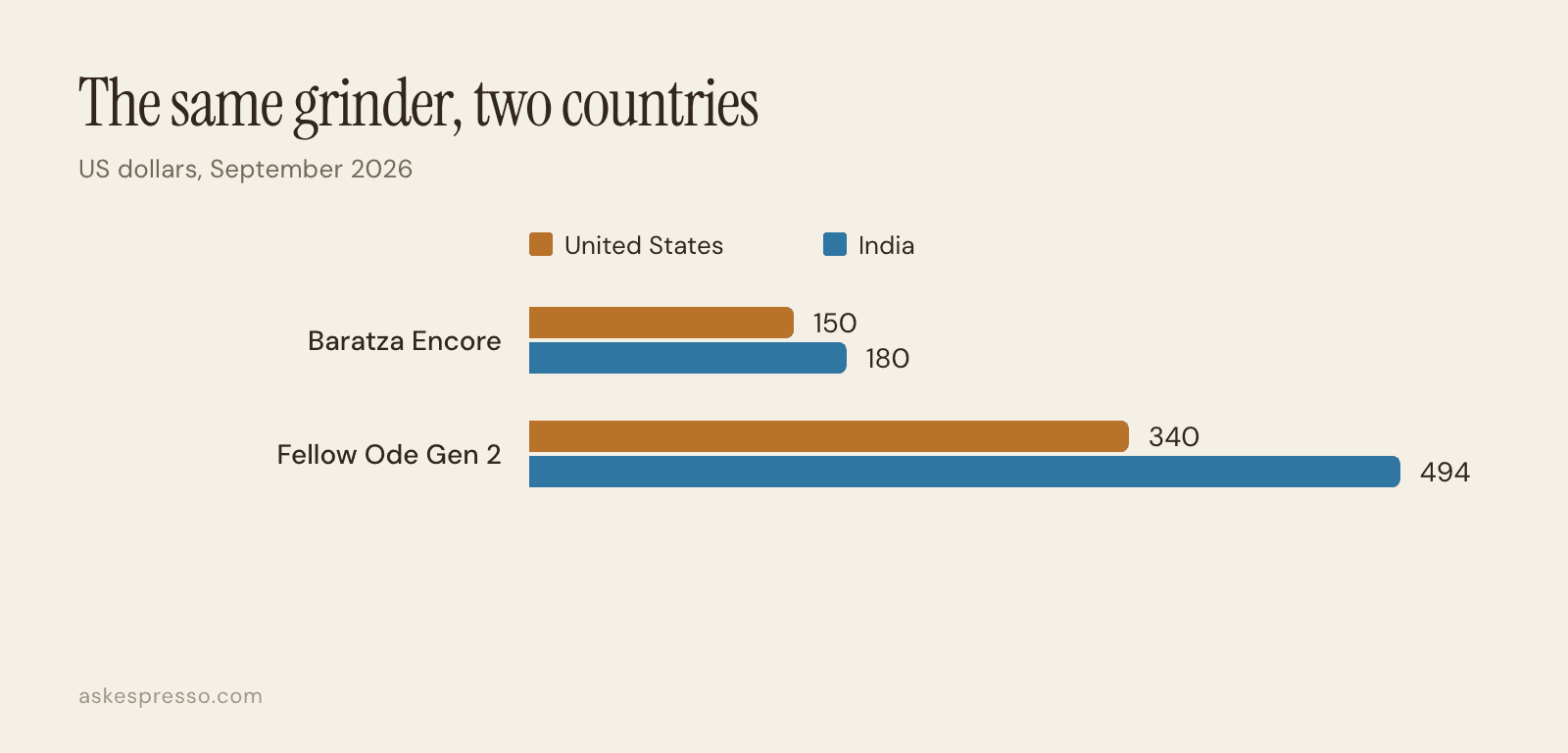
Here is the part I did not expect to write. When I priced the same grinders in India, the electric ones carried a heavy premium, and several of the best-known brands were not sold there at all through any retailer I could find. The hand grinders, being lighter and simpler to ship, suffer less. If you are buying in India, this tilts the decision even further toward a hand grinder, which was already the right answer.
Two things. Every few kilos of coffee, run grinder-cleaning pellets through, or a handful of rice if the maker allows it, and listen to the sound change from gravel to something cleaner. And every time you change the setting, grind a few grams and throw them away, because the path from the burrs to the spout holds the old grounds, and the first cup after an adjustment is a lie.
I have been thinking about why the hallway does not feel like a sacrifice.
It is thirty seconds in which I use my hands and my nose and nothing else. No screen, no meeting, no invoice, no decision about a company that I already know the answer to. My wife is asleep behind one door and my son behind another, and in a few months there will be a third door, and I will still be out here, turning a handle. I could buy a quieter electric grinder and I have looked at several. I am not going to. If I had to give up all the rest of the ritual, the scale and the kettle and the notebook, this is the part I would keep.
If you want a single thing to do this morning, find out whether your grinder has blades or burrs. If it has blades, you now know where your next purchase goes, and you can skip every other piece of equipment advice until you have made it. After that, the question is which brewer, and the answer is any of them, for a year.
Because grind size is the biggest dial you have. Halving the particle size roughly quadruples how fast coffee extracts. A cheap brewer with a good grinder makes better coffee than an expensive brewer with a blade grinder.
Yes. A steel-burr hand grinder in the range of five to ten thousand rupees, or about a hundred dollars, makes coffee that rivals electric grinders costing several times more. It takes about thirty seconds of turning for one cup.
You can, in sealed single portions, and grinding them from frozen gives a more even grind. Research in 2016 found colder beans shatter into a narrower range of particle sizes. Do not open and refreeze the same container repeatedly.
Thank you for spending a little time here.
Back to the journal ↗