The journal.
Things I notice. Things I am still learning.
Opening the journal…
Things I notice. Things I am still learning.
Opening the journal…
Opening the note…
Sep 17, 2023 / Buying / 8 min read
In Idaho Falls most of the people I worked with had never tasted coffee, and a man called Cliff told me the date on the bag is not the one printed on the front. How long beans last, and where to keep them.
Boulder, Colorado, September 2023
By Sayonsom Chanda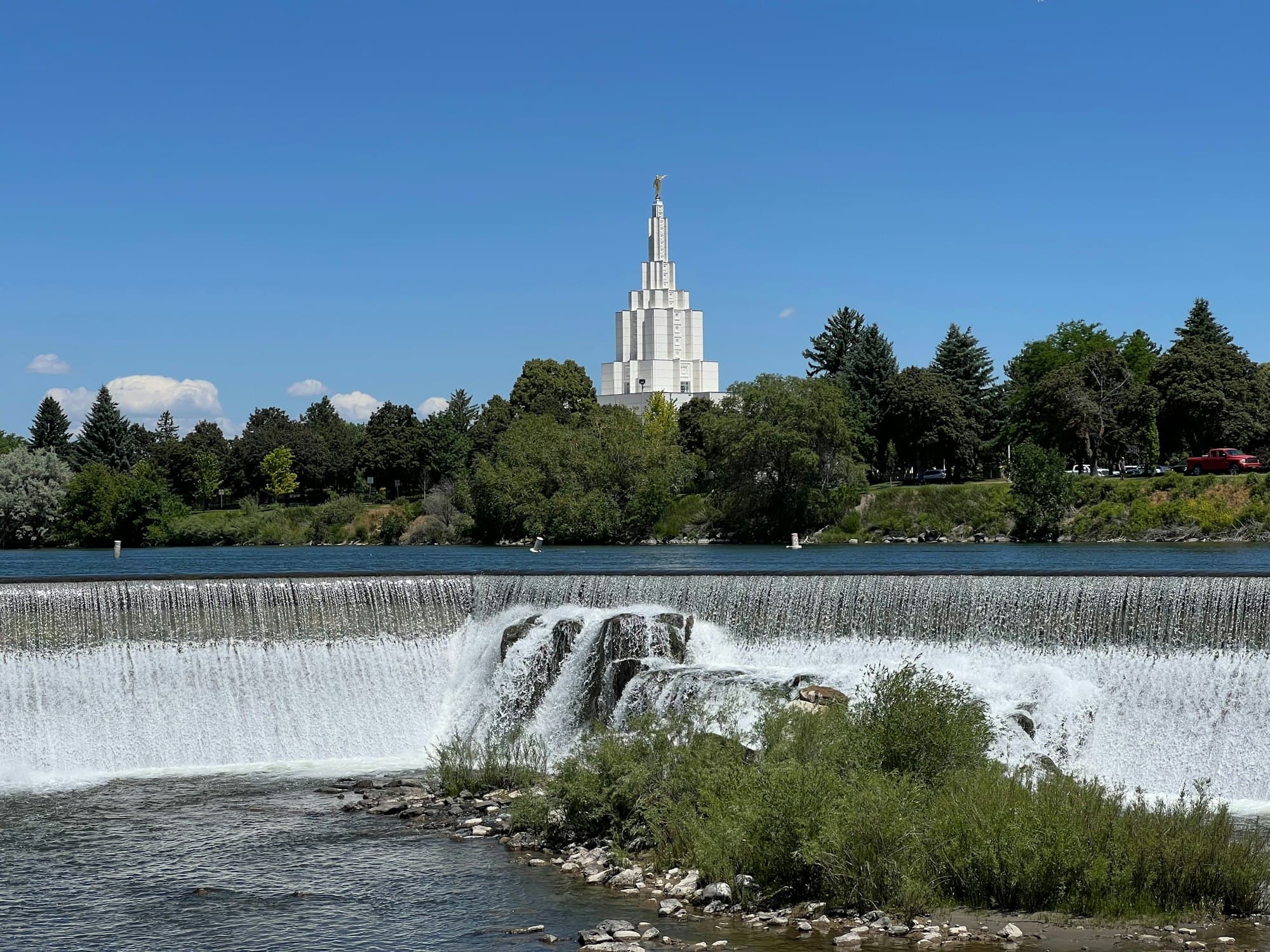
Eight years ago I lived in Idaho Falls, a small city on a wide green river in the high desert, working at the national laboratory out in the sagebrush, where the wind smelled of dust and sage and, in winter, of nothing at all. The nearest place to buy coffee that had been roasted in the same month was a drive. And most of the people I worked with had never tasted coffee at all.
Chad had not. It was doctrine, and he was completely relaxed about it, and I was the one who found it interesting. My wife was working at a company in town that makes household products, and there was a man there named Cliff whose job was to taste and smell things for a living, and once a week the four of us, Cliff and his wife and my wife and I, would have lunch together in a diner with vinyl booths the colour of ketchup. Cliff was the first person who told me that coffee has a date on it, and that the date is not the one printed on the front.
I am thinking about Idaho this September because we are planning another move, a much larger one, back to India, and the planning has the same quality that life in Idaho had: when there is nowhere to buy the thing you want, you plan. And when you plan, oddly, you end up better off than the people who can buy any time.
How long do coffee beans last? And should I keep them in the fridge?
The short answers are: less time than you think, and no. The longer answers are the rest of this note.
This surprises everyone. Coffee straight out of the roaster, still warm in the hand, tastes flat, ashy and lifeless, like the smell of a fireplace the morning after. The bean has just been through something violent, and it needs to rest.
What is happening is gas. A freshly roasted bean holds a surprising amount of carbon dioxide under pressure, and it leaks out over days, fast at first and then slower, the way a bicycle tyre with a slow puncture goes soft. In hot water, that gas dissolves and turns into a mild acid, the tang of flat cola, which one writer describes as the taste of licking a nine-volt battery. The gas also physically holds the water away from the coffee, like an umbrella, so the extraction is incomplete. This is why very fresh coffee can taste sharp and weak at the same time.
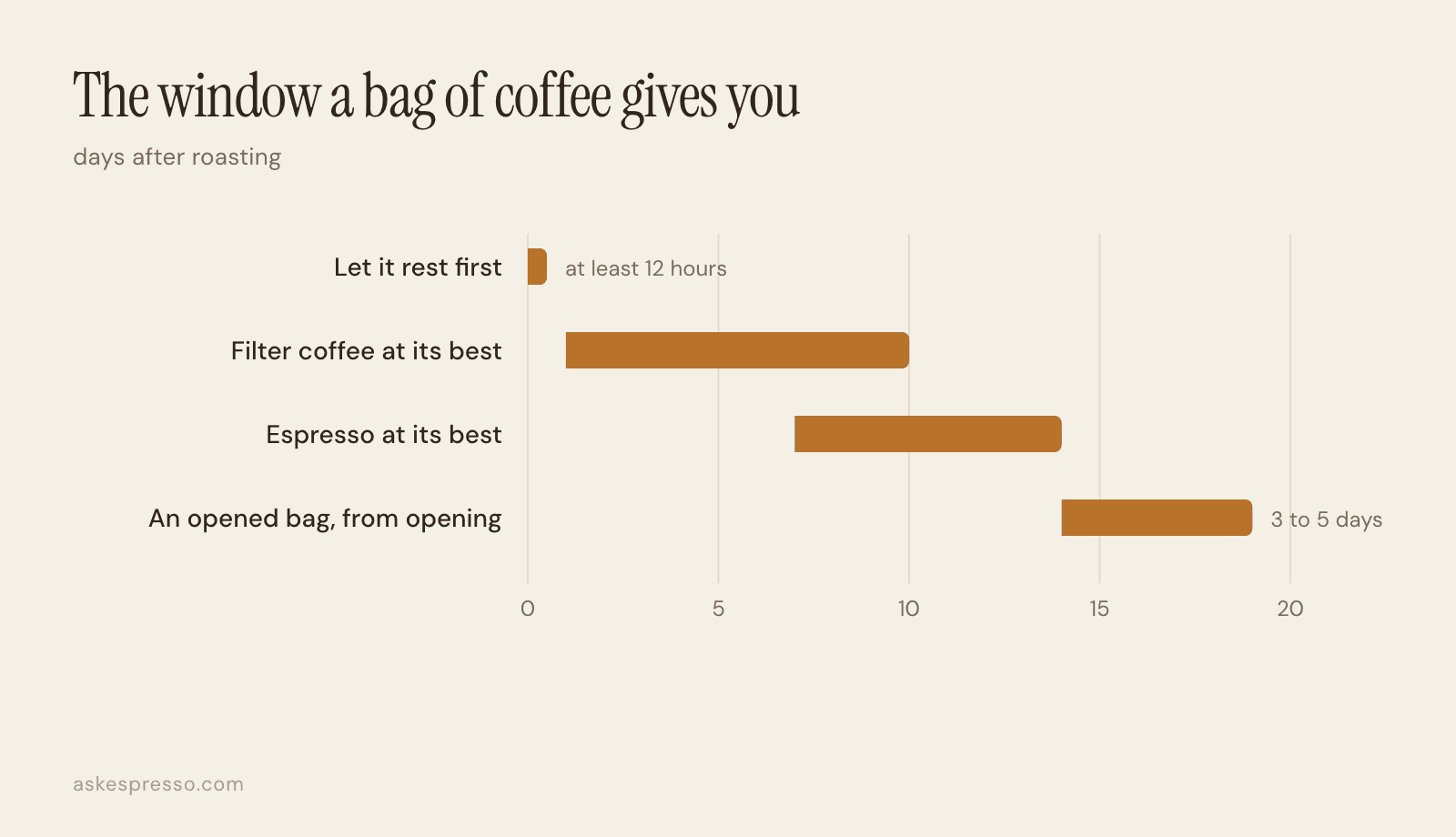
Give a bag at least half a day before it is worth brewing at all. Filter coffee is at its best in the first week or so after roasting, and still very good for a few days after that. Espresso wants more rest, because inside a pressurised basket the escaping gas fights the water and the water loses; give it most of a week before the first shot.
Darker, hotter roasts give off their gas faster and more completely, which is one more reason to love them: a dark roast is ready sooner, and its oils are already on the surface telling you so. Lighter roasts do it slowly, and a slower release also means a less porous bean, which stales more slowly too.
And once a bag is open: a few days, at the top of its form, however you store it. This is the number that should change how you buy.
The first is escape. The aromatic compounds that make coffee smell like coffee are volatile, which is a chemist's way of saying they leave, like guests after midnight. You smell them leaving every time you open a bag, and every time you walk past a roastery.
The second is oxidation. Oxygen finds the flavour compounds and turns them into duller ones, the way it turns a cut apple brown. The two processes are linked in a way I did not expect: very fresh coffee oxidises slowly, because the pressure of the gas inside keeps oxygen out. As the gas runs down, the oxygen gets in. Humidity speeds everything up.
That little plastic button on a good coffee bag is a one-way valve. It lets the gas out and keeps the air out, and if you press the bag gently you can smell the coffee breathe through it. Within minutes of a bag being filled, the space inside can be half carbon dioxide. Some roasters flush the bag with nitrogen as well.
The valve does not stop the gas from leaving. So a bag of three-week-old coffee, freshly opened, goes stale very fast, because there is no gas left inside to protect it. The valve buys time on the shelf. It does not buy time after you open it.
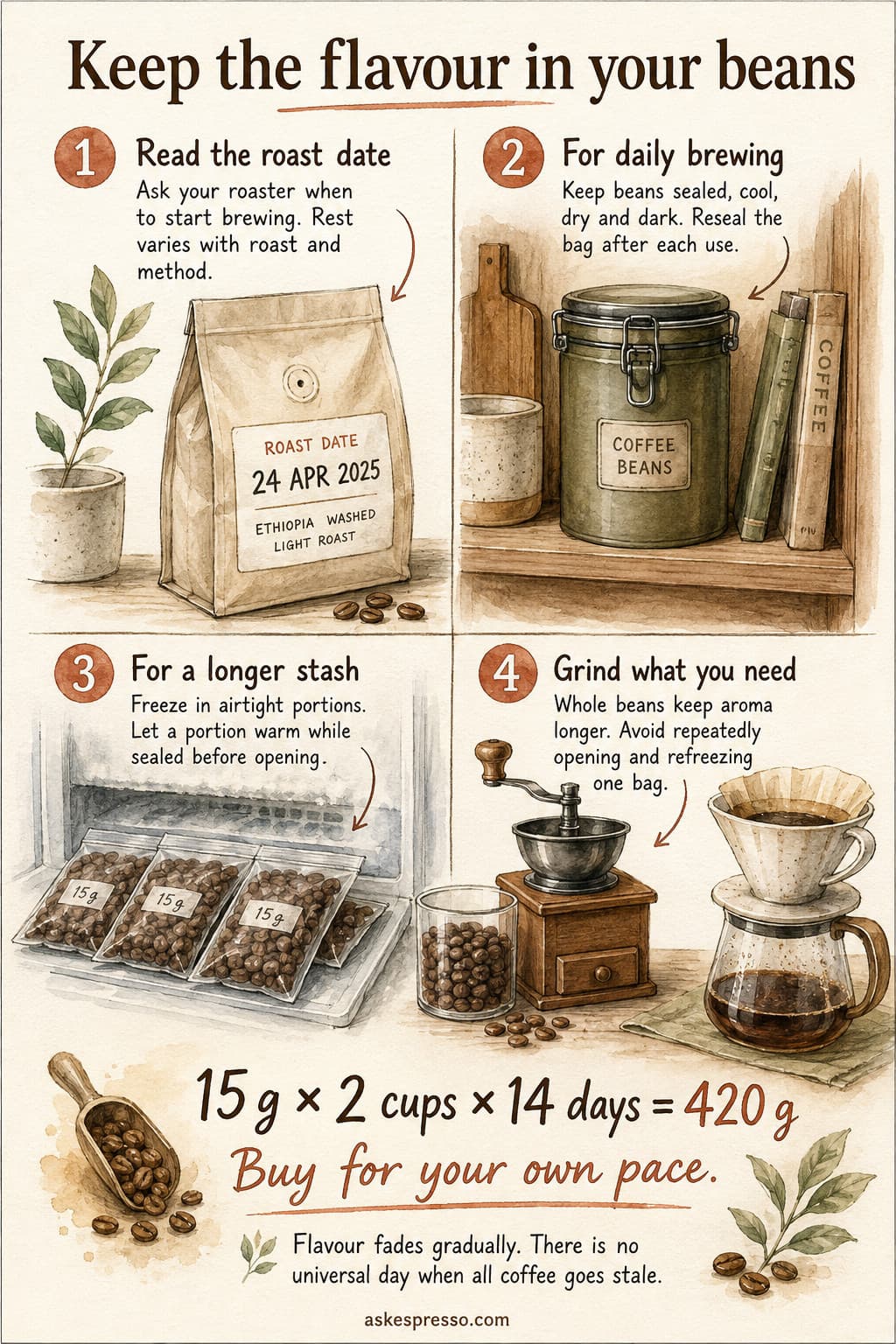
Cool, dry, dark, sealed, away from anything that smells. Not the fridge in an ordinary container, because a fridge is damp and full of other people's dinner, and coffee picks up smells the way a wool coat picks up cigarette smoke.
The freezer is different, and here the series pays off a cross-reference. In the note on grinders I described the research showing that cold beans grind more evenly. So if you freeze coffee in sealed portions of one dose each, and grind each portion straight from frozen, you get two things from one decision: the storage benefit, and a better grind. What you must not do is take a large container in and out of the freezer, because every trip brings moisture in with it, and frost on a coffee bean is the end of it.
And never buy pre-ground coffee. Ground coffee is all surface and it is stale within minutes. The only excuses are a broken grinder or a journey, and then it should be ground in front of you and finished within a day.
That is the whole note in four words. It is also the argument for subscriptions, and for buying from a roaster rather than a shelf, which I made in the note on buying.
Idaho taught me this by force. With nowhere to buy, I had to order, and to order I had to know how much I would drink in two weeks, and to know that I had to pay attention. Two cups a day, a modest dose each, for a fortnight, comes to a bag of a few hundred grams. I ordered that, every two weeks, and I drank better coffee in the sagebrush than I had in New York with a shop on every corner.
I want to write about Chad, and about the doctrine, without getting it wrong, because most writing about it does.
The rule his church follows comes from a text received in Ohio in 1833. It never mentions coffee. What it says is that hot drinks are not for the body, and within a few years the church's leaders had explained that hot drinks meant tea and coffee. The text describes itself as counsel and not commandment, and it was nearly ninety years before keeping it became a requirement for entering a temple. I find that gap genuinely interesting, as a fact about how a practice hardens over a lifetime into a rule, the way a footpath across a field hardens into a road.
A few years ago the church clarified, for its young people, that a drink is coffee if it has café or mocha or latte or espresso in its name, or anything ending in a certain Italian syllable. It did not rule on coffee-flavoured things, which is exactly why the clarification produced so much conversation. It did not, despite what you may have read, say anything about ice cream.
What was it like to be the person in the room whose morning ritual is someone else's lifelong abstention? Quieter than you would think. Nobody minded. I made my coffee at home and drank it at my desk and Chad drank a large mug of hot water, every morning, with a smile. I have not found a better lesson in tolerance since.
And then there was Cliff, who was the other kind of lesson.
He sniffed coffee for a living, in a town where almost nobody drank it, which he found funny and I found stranger the longer I knew him. At those lunches in the ketchup-coloured booths, he would hold his cup under his nose before every sip, eyes half closed, the way a person listens for a phone in another room, and then say one word about it, usually a damning one. He was staunchly right-wing in a way that did not need company to sustain it, in a town that was already conservative to its bones, and he had an approach to equality that I have never quite been able to describe. He hired people of colour, deliberately, and spoke about it as a principle, and then he was derisive toward them across the table in a way that made my wife go quiet and study her plate. I did not know what to do with that at twenty-seven, and I do not entirely know what to do with it now. I have decided to write it down rather than tidy it up. He was generous with what he knew and ungenerous with people, and both of those things were true at the same lunch, and the coffee advice was good.
Here is a detail I only appreciated years later, in Boulder, after the note on water. Idaho Falls sits high enough that the kettle already boils inside the brewing range. The first town I ever lived in where the water came out of the kettle at the right temperature for free was a town where most people did not drink coffee.
His advice was one sentence, said over a plate of fries, and it is the one thing I would do this morning if I were you. Buy what you can drink in two weeks, and if the roaster did not print the date on the bag, write it there yourself with a marker.
I have a marker in the drawer under the grinder. It has been there through four kitchens, and it will go in a suitcase to a fifth. The next note is about the year I could not taste any of it.
Whole beans need at least twelve hours of rest, taste best from about one to ten days for filter and seven to fourteen for espresso, and slowly fade over a few weeks. Once a bag is opened you have three to five days at the top of its form, however you store it.
No. A fridge adds moisture and smells. Keep beans sealed, cool, dark and dry. If you need to keep coffee for longer than two weeks, the freezer is genuinely good, in sealed single portions ground straight from frozen.
It is still releasing carbon dioxide from the roast. The gas pushes water away from the grounds and turns into a sour, fizzy taste in the cup. A day or two of rest lets most of it out.
Thank you for spending a little time here.
Back to the journal ↗