The journal.
Things I notice. Things I am still learning.
Opening the journal…
Things I notice. Things I am still learning.
Opening the journal…
Opening the note…
Feb 11, 2024 / Tasting / 10 min read
Covid took my sense of smell, gave most of it back, and kept some. For a while coffee smelled like something scraped off a road. What I learned trying to get it back.
Leaving Boulder, February 2024
By Sayonsom Chanda
Covid took my sense of smell, gave most of it back, and kept some. I do not know how much. There is no instrument in the house that can tell me, and the only test I have is a cup of coffee, which for a while smelled like something scraped off a road after rain.
The house has started to become boxes, brown cardboard towers with the children's names on them in marker, and we fly in July, which is far enough away that the boxes still feel like a game to the boys. The older boy is five and has started to ask whether the new house will have snow, and the younger one is a year old and eats the packing tape. Two years ago I thought the hardest thing about leaving America would be the things I had to give away, and it turns out that the things fit in a truck and a few suitcases, and the hard part is the years, which do not pack. Coffee is one of the few habits that is coming with me whole. The grinder, the scale, the marker in the drawer, the moka pot. And, I hope, a nose.
One thing is staying behind, and I am surprised by how much that stings. The capsule machine I bought two springs ago, the one that reads a barcode and hums like a small drone, runs on the wrong voltage for India and is going to a neighbour in July, along with the last boxes of dark capsules. It carried me through a newborn, a company closing, and the year my nose was gone, and I will miss the ninety seconds it gave me every morning at my desk. I am also, quietly, glad to leave it. It was a shortcut, and I took it, and I do not regret it, and I have promised myself that the next kitchen will have no shortcuts in it at all: beans, a grinder, water I have measured, and the time it takes. That promise feels less like a rule than like growth, the way you outgrow a coat and feel both sad and taller.
This note is what I learned trying to get it back. It answers the question people ask me most shyly, which is: everyone says blueberry and jasmine, and I taste coffee. What am I missing?
Nothing is wrong with you. Most of what you call taste is smell.
The tongue can tell you five things. Sweet, salty, sour, bitter, and the savoury taste that the Japanese named, the taste of a good broth or the crust of a roast. That is the whole list. Telling an apple from a pear, or one coffee from another, requires the nose.
You will read that most of flavour is smell, with a confident percentage attached. I looked for the source of that number and could not find one, so I will not repeat it. The five-channel argument is true, sourced, and more striking anyway: if it is not one of those five things, you are smelling it.
There are two ways to smell. Breathing in, with the cup under your nose, is the one everyone knows. Breathing out, with the liquid in your mouth, sends the aroma up the back of the throat into the nose from behind, the way the smell of a kitchen reaches you up the stairs. Nearly everything you experience as the taste of coffee arrives by that second route.
This is why professional tasters slurp, with a noise like the last inch of a milkshake through a straw. Pulling in air with the liquid sprays it across the mouth and throws the aroma up the back passage. It looks absurd and it is entirely functional. I do it at home now, alone, and the children copy me, and the older one has started slurping his milk.
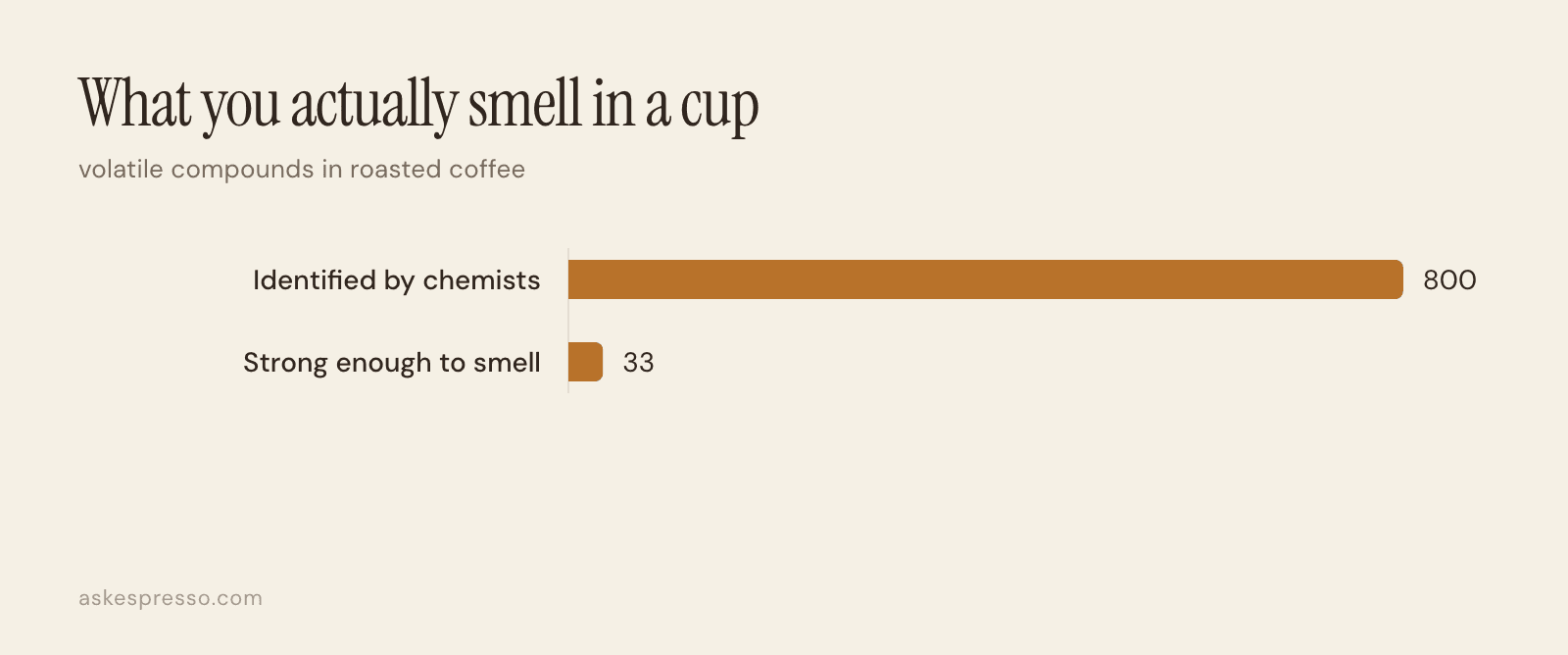
Chemists have identified hundreds of volatile compounds in roasted coffee. Only a few dozen are present in amounts large enough for a nose to notice, and of those a handful do most of the work. The most important one, the molecule that makes coffee smell roasted rather than merely brown, is a small sulphur compound with a long name that I will shorten to coffee's signature. It is the smell that comes out of a bag of dark roast when you open it, and the smell that a light roast, to my nose, never quite manages.
I mention it because of what happened next.
Two years ago, a group of chemists studying distorted smell after the virus, the condition where familiar things smell rotten, did something clever. They used coffee as the test substance, because it is one of the most common triggers of the distortion and because it carries such a wide range of molecules. They passed coffee's aroma through an instrument that separates the compounds one by one, and asked people with and without the condition to sniff each one as it came out of a small port, like sniffing the keyhole of a locked room.
They found a small set of molecules that triggered the distortion. And the single worst offender, the one most of the affected people described as disgusting, was coffee's signature. People with a normal nose called the same molecule roasty, smoky, like popcorn. People with the condition had no words for it and reached for dirty and repulsive.
The researchers' suggestion is that these molecules have extremely low thresholds, so they may be the first ones a regenerating nose picks up, before the rest of the picture is back, like the first pixels of a photograph loading on a slow connection. In plain words: the thing that makes coffee smell like coffee is the thing that breaks first.
That sentence is the reason I could not drink coffee for a season, and the reason my beloved dark roasts, with more of that molecule than anything else on the shelf, were the worst of all. It was also, strangely, the first thing that made me feel better, because it meant the road was in the cup and not in my head.
There is a treatment, of a kind. Fifteen years ago a group of doctors asked people who had lost their smell to sniff four scents, twice a day, for twelve weeks: rose, eucalyptus, lemon and clove. About a quarter of those who trained improved meaningfully. A much smaller share of those who did not train improved on their own.
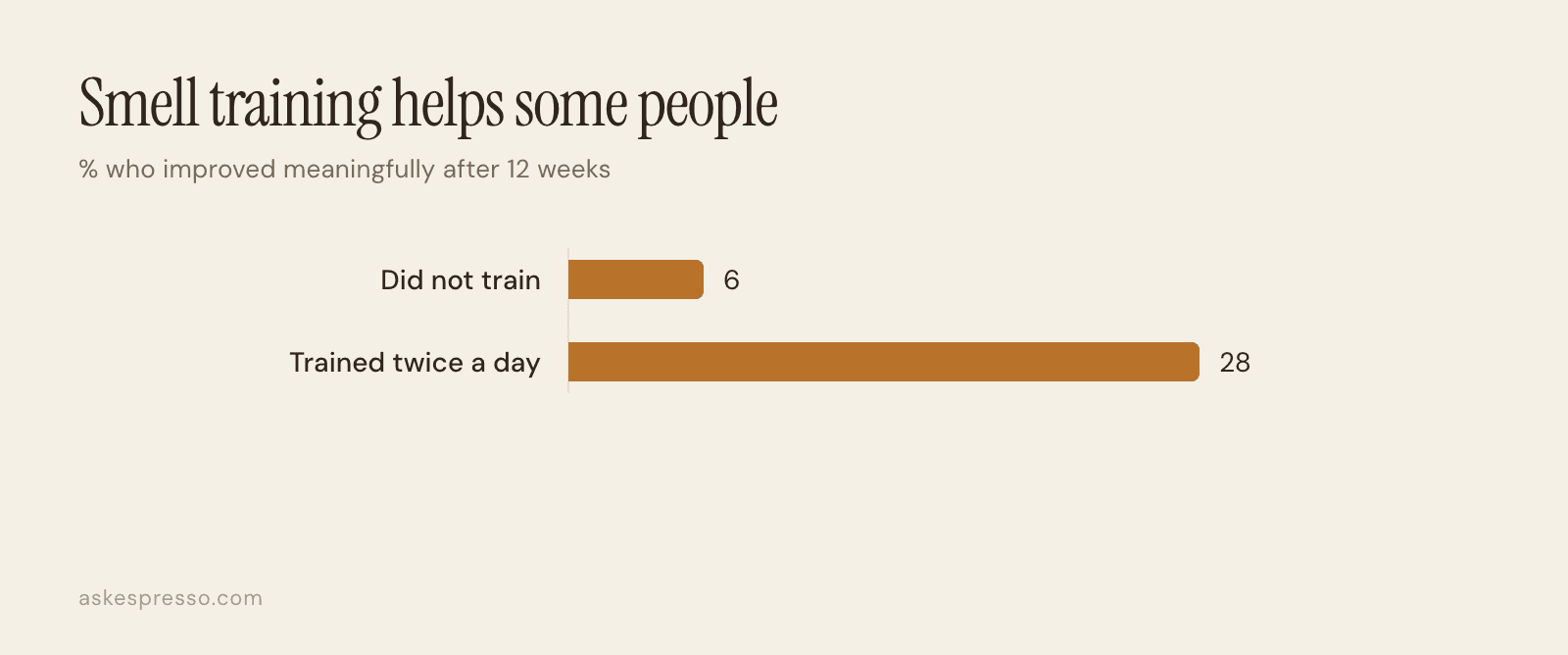
A real effect, and a modest one, and I want to be careful not to oversell it. The charities that support people with smell loss now recommend longer sessions over more months, which tells you the protocol has learned patience.
Here is what I found when I looked into where the four scents came from, and I have not seen it written anywhere else. The four are drawn from an old classification of smells into six families: flowery, fruity, spicy, resinous, burned, and foul. The training kit keeps four. It dropped foul, obviously. It also dropped burned. Rose is the flower, lemon the fruit, clove the spice, eucalyptus the resin. Nobody's training kit contains the smell of a roast.
So the one classical family of smell that the standard protocol leaves out is the one that coffee lives in, and coffee's signature is the most common trigger of disgust in recovery. The people who run the charities say plainly that you may train with whatever makes you happy. So I trained with coffee. Twice a day, twenty seconds, a bag of dark beans held under my nose like a prayer, for a winter. I do not know whether it helped. I know that one morning in December the bag smelled like a bag of coffee, warm and sweet and a little like burnt sugar, and I sat down on the kitchen floor.
Is there research on training with coffee specifically? I could not find any. A whole profession built on the nose has, for the most part, not talked about losing it. One trade magazine ran a piece on it last year and said as much.
Now the useful part, which works whether or not you have lost anything.
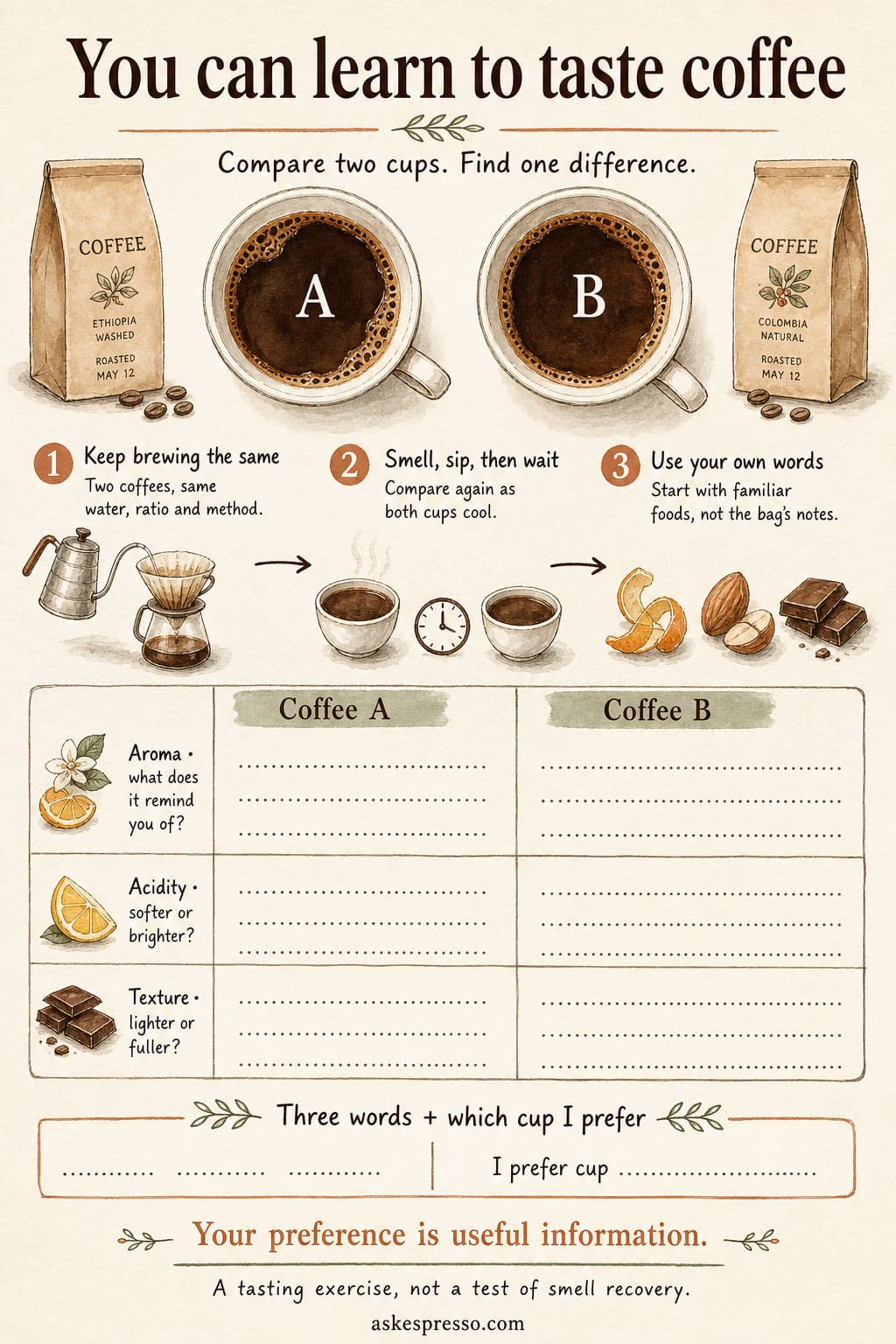
Cup at home. You need no equipment. Take several wide cups. Put a small, equal dose of coarse-ground coffee in each, about a gram for every seventeen millilitres the cup holds. Smell the dry grounds. Pour water just off the boil to the rim, start a clock, and put your nose over the cup. At four minutes, push the crust of grounds back with a spoon and smell again; this is the moment cuppers live for, the smell rising like steam off a pavement after a summer storm. Skim the foam. From about ten minutes, taste with a spoon, slurping, and keep tasting as it cools for another ten. Cold coffee shows defects that hot coffee hides.
Always two, never one. This is the highest-leverage tasting habit I know. Taste a coffee alone and you have nothing to compare it with. Taste two side by side and the differences are obvious, even to a damaged nose, the way two shades of white paint look identical on the chart and different on the wall. Difference is easy. Absolutes are hard.
Three words. Write three words and a score for how much you liked it. Not a paragraph. Adjectives you would use for anything: bright, heavy, thin, sweet, sharp, round. The fruit names come later, or never, and it does not matter.
Then triangulate. Three cups, two the same, one different, and find the odd one. This is a real module in the professional tasting exam, and it is humbling, and it is the fastest way I know to find out how much you can actually perceive.
The words on the bag are not poetry, though they sound like it. They have a history.
In the seventies, a chemist at a university in California joined the wine faculty, the first woman on it, and found that tasters had no shared framework. She built a wheel of aroma terms, and then, crucially, a set of physical reference samples, so that when two people said blackcurrant they were smelling the same blackcurrant.
Coffee did the same thing a generation later. A research institute built a lexicon of over a hundred flavour, aroma and texture terms, each tied to a reference you can buy and smell. The famous flavour wheel was then redrawn on that lexicon, and here is the part almost nobody knows: its shape is not a designer's opinion. Dozens of experts were asked to sort the terms by similarity, and the geometry of the wheel was computed from their sorting. Two terms that sit next to each other on the wheel are terms that trained people perceive as close.
The professional coffee tasting qualification, incidentally, expires after three years. A palate is treated as an instrument that drifts out of calibration, like the pressure gauge on a boiler. No wine qualification works like that, and I think coffee has it right.
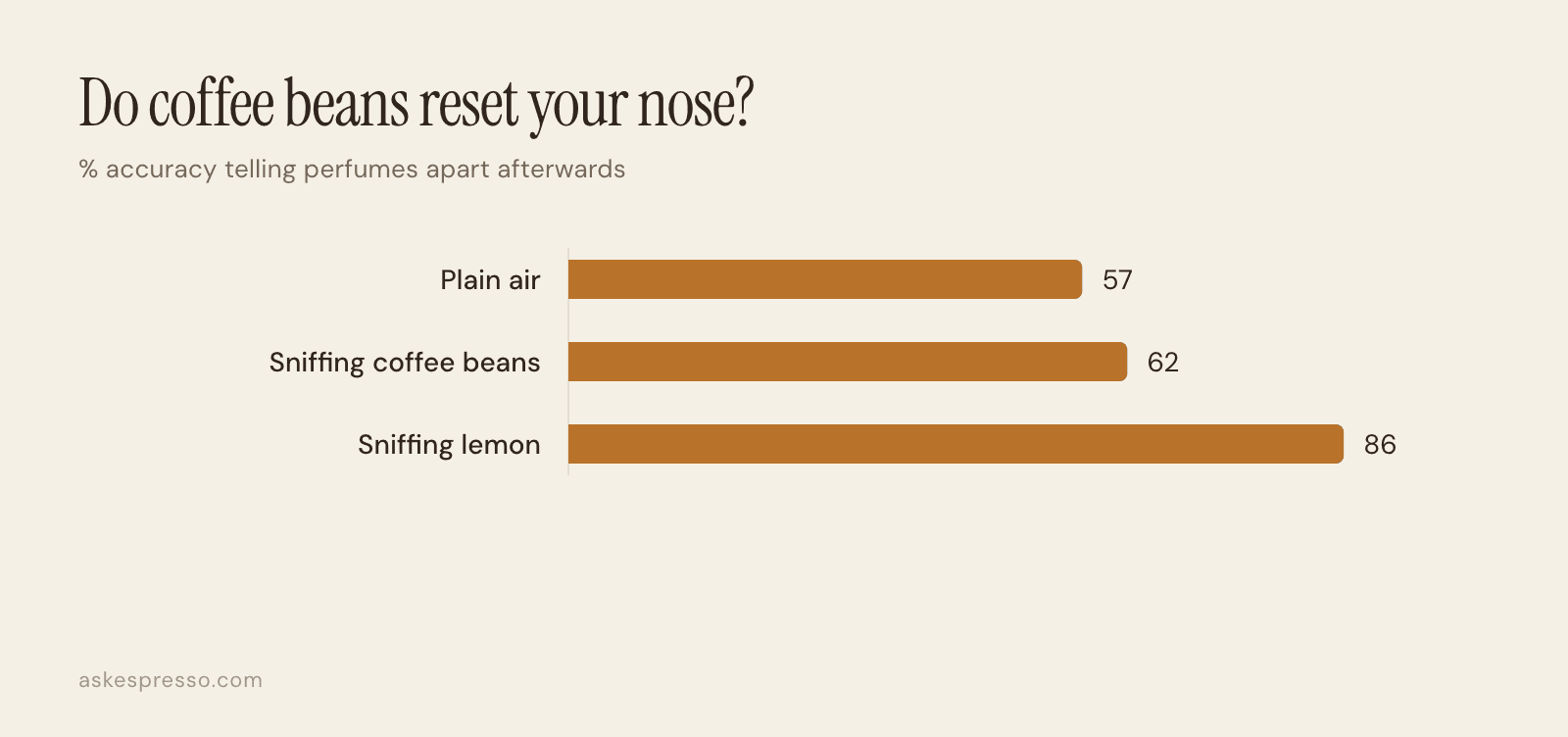
The jar of coffee beans on the perfume counter, offered to reset your nose between scents. One small study tested it directly, asking people to tell perfumes apart after sniffing coffee, after sniffing lemon, and after plain air. Coffee barely beat air. Lemon beat both. It is one small study, so I will not call it settled. But it is the only direct test I could find, and it found nothing.
I find the irony hard to leave alone. The perfume trade uses coffee to reset a nose. The researchers who study damaged noses use coffee as the hardest thing for a nose to get right. Both cannot be true.
I will never know exactly how much came back. There is no meter for it.
What I know is that this month I could tell two Ethiopian coffees apart, side by side, in the cupping bowls on a counter surrounded by boxes, one of them bright as a lemon and the other heavy as plum jam, and I could not have done that before I lost anything. The loss was what made me pay attention. I am not going to tidy that into a lesson, because it was not one. It is just what happened.
If you want one thing to do this morning, make two coffees instead of one, from two bags, and drink them side by side as they cool, and write three words for each. You will find that you can taste more than you thought. The note on buying will tell you which two bags, and the note on roasting will tell you why they smell the way they do.
The next note is written in another country, in a kitchen with a steel filter that has been in the family longer than I have.
Taste two coffees side by side rather than one alone, keep tasting as they cool, slurp so the aroma reaches the back of your nose, and write three words and a score. Differences are easy to notice; absolutes are not.
A 2022 study found that the molecule which gives coffee its roasted smell is the most common trigger of distorted smell in people recovering from the virus. Their noses pick it up first and misread it. Most people improve over months.
For some people. In the original study about a quarter of those who trained twice a day for twelve weeks improved meaningfully, against a small share of those who did not train. The standard four scents leave out roasted smells, so training with coffee is a reasonable addition.
Thank you for spending a little time here.
Back to the journal ↗