The journal.
Things I notice. Things I am still learning.
Opening the journal…
Things I notice. Things I am still learning.
Opening the journal…
Opening the note…
Aug 10, 2025 / Espresso and milk / 10 min read
Back in India after twelve years, there is a steel filter on the counter older than I am. No pump, no pressure, no timer. What espresso actually is, why milk goes wrong, and what you can have without a machine.
Bengaluru, August 2025
By Sayonsom Chanda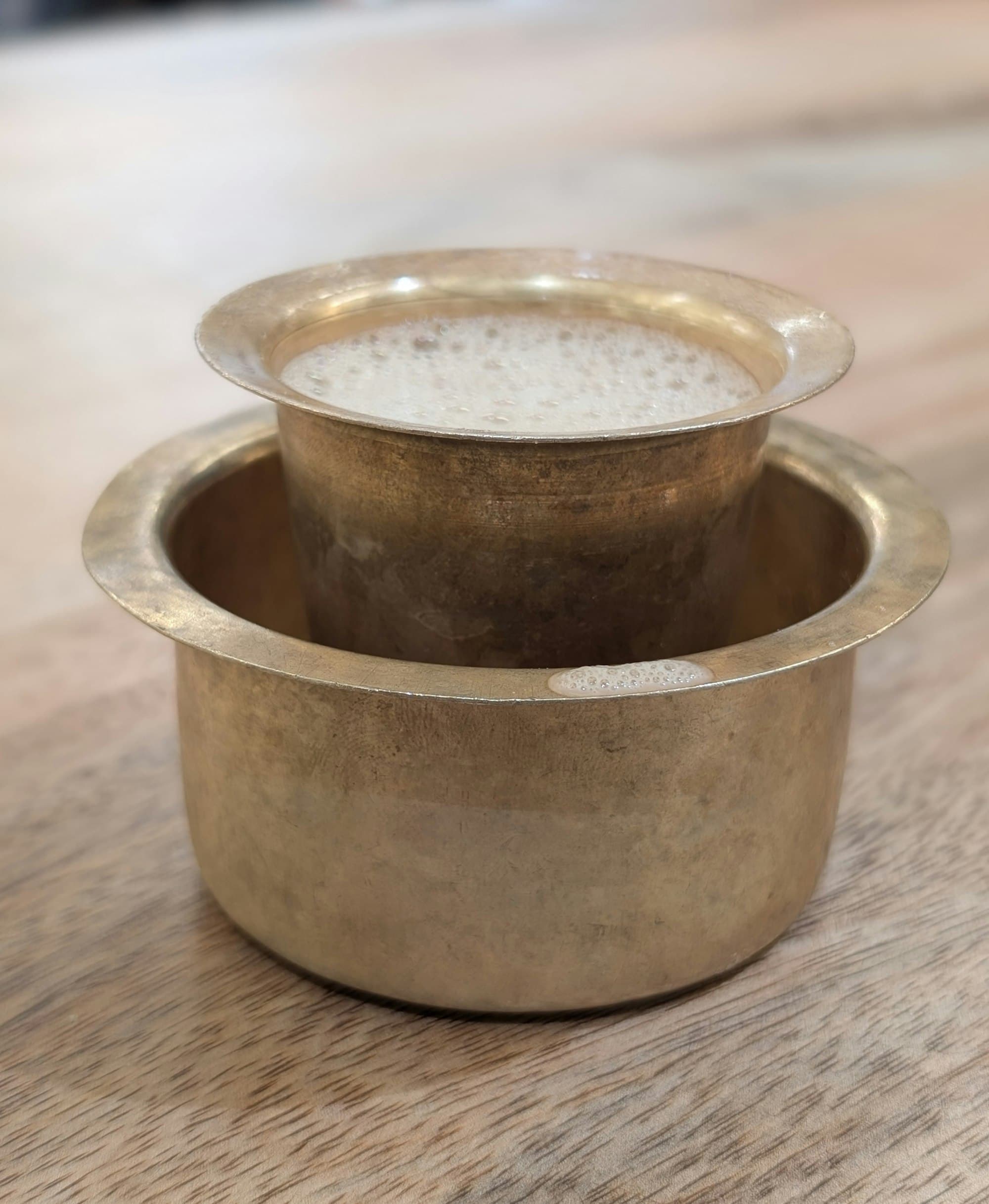
I am back in India after twelve years, and there is a steel filter on the counter that has been in the family longer than I have.
Two chambers, one on top of the other, dull silver and dented at the rim like an old lunchbox. A perforated cup. A loose disc that sits on the grounds. It has no pump, no pressure, no timer and no settings. It makes something closer to espresso than anything I made in Colorado, and it does it by being walked away from for fifteen minutes, while the August rain comes down on the balcony like applause.
We live in Whitefield now, on the eastern edge of Bengaluru, where the air smells of wet earth and diesel and, from somewhere, always, frying onions. I was here once before, for a few months in 2010, as an intern, and almost nothing I remember is still standing. I work for a large electronics company by day, on the machines that decide when your air conditioner should run, and in the evenings I am trying to build two things: a small council of researchers who want to work on hard problems without a corporation telling them which ones, and an open map of every piece of energy data this country produces, so that people here can build on it. The map is further along; you can see it at energymap.in. I do not know if either will work. The startup taught me what not knowing feels like, and I have decided to feel it anyway.
The filter sits between the laptop and the kettle. This note is about what it is doing, and about the machine that everyone asks me whether they should buy.
Do I need an espresso machine to make good coffee at home?
No.
I want to say that before the explanation, because espresso has a mystique, all that chrome and hiss, that leads people to spend a great deal of money before they understand what they are buying. Home espresso is expensive, messy, and unforgiving. If there is a good café near you, let them pull the shots. If there is not, buy a good grinder and brew another way, and I would point you at the grinder note and the moka pot before anything with a pump. The writer whose book I trust most says exactly this, in a chapter about espresso, and I think saying it out loud is what makes the rest of the chapter trustworthy.
That said, you should understand what a machine does, because two of the things it does can be had for almost nothing.
Percolation through a fine metal filter, driven by pressure instead of gravity.
Grind coffee fine enough, fine as flour, and the surface area is enormous, so extraction is fast. But grind it that fine and gravity cannot get water through the bed at all; it just sits there like water on a dry sponge. So you push. The standard pressure is about what you would feel at the bottom of a pipe of water as tall as a thirty-storey building. That is the whole invention.
The first attempts, in Italy at the turn of the last century, gave us the handle with the basket, the steam wand and the word itself, but not the pressure; they managed barely more than a pressure cooker. The real pressure arrived after the war, from a spring-driven lever pulled by a man's whole arm, and with it came a layer of brown foam that nobody had seen before, which its inventor named crema. Then an electric pump in the early sixties, and a design for keeping the water at a steady temperature, and everything since has been refinement.
If you ever do pull a shot, here is the whole recipe in one place. A dose that fits the basket. About one and a half times that weight of liquid out. Around half a minute from the moment you start. Water a little cooler for dark roasts and a little hotter for light. And the same target as everything else in this series, which is the extraction band from the second note: espresso simply has far less water in it.
The acids come out first, which is why a fast shot is sour, sharp as a squeeze of lime. Sweetness follows. Bitterness comes last, slowly, and dominates a shot that ran too long, until it tastes like the burnt edge of a pan.
Tamping is overrated. You press the coffee down to level the bed and remove air pockets, and that is all. The machine is about to push far harder than your arm ever could, so pressing harder changes nothing except your wrist.
Pre-infusion is underrated. A few seconds of gentle wetting before the pressure arrives evens out the bed, and, oddly, a longer gentle start makes the main extraction run faster. My best guess at why, borrowed from the book, is that the finest particles move around in the wet bed during the slow phase and clear a path, like people shuffling to the edges of a crowded train.
Crema is honestly mixed. It is gas forced out of solution by pressure, held in bubbles by the same browning compounds that hold the head on a dark beer. It tells you something about freshness. It tells you nothing about quality, and on its own it tastes bitter. A large food company's own research found that the foam speeds the aroma away from the drink rather than holding it in. Some people scrape it off. That is a step too far for me, because underneath the crema is where the oils are, and the oils are the whole reason I drink a dark roast in the first place. But the reverence is unearned.
Two things.
The first is the moka pot, done properly, which I wrote about in the note on brewers. It is not an espresso machine and never was, and treated as its own drink it is excellent, and treated with a dark roast it is close to perfect.
The second is milk, which is where most of the pleasure in most café drinks actually is. Steaming milk does not require an espresso machine. A small steam wand, a hand frother, or a pan and a whisk will get you most of the way. And nobody explains milk properly, so I will try.
Milk is fat droplets floating in water, held there by proteins. It looks white because the droplets scatter light, the way fog does.
The foam is held up by protein, not fat. Heat unravels the coiled proteins and they wrap around the bubbles like cling film. There is barely enough of them, which is why milk foam is thin and wet compared with whipped cream, and why it drains: a cappuccino left standing separates into froth on top and milky coffee below, like a snow globe settling.
Skimmed milk foams more easily and holds the foam worse. Whole milk is harder to start and better to drink, and I would not bother with anything else.
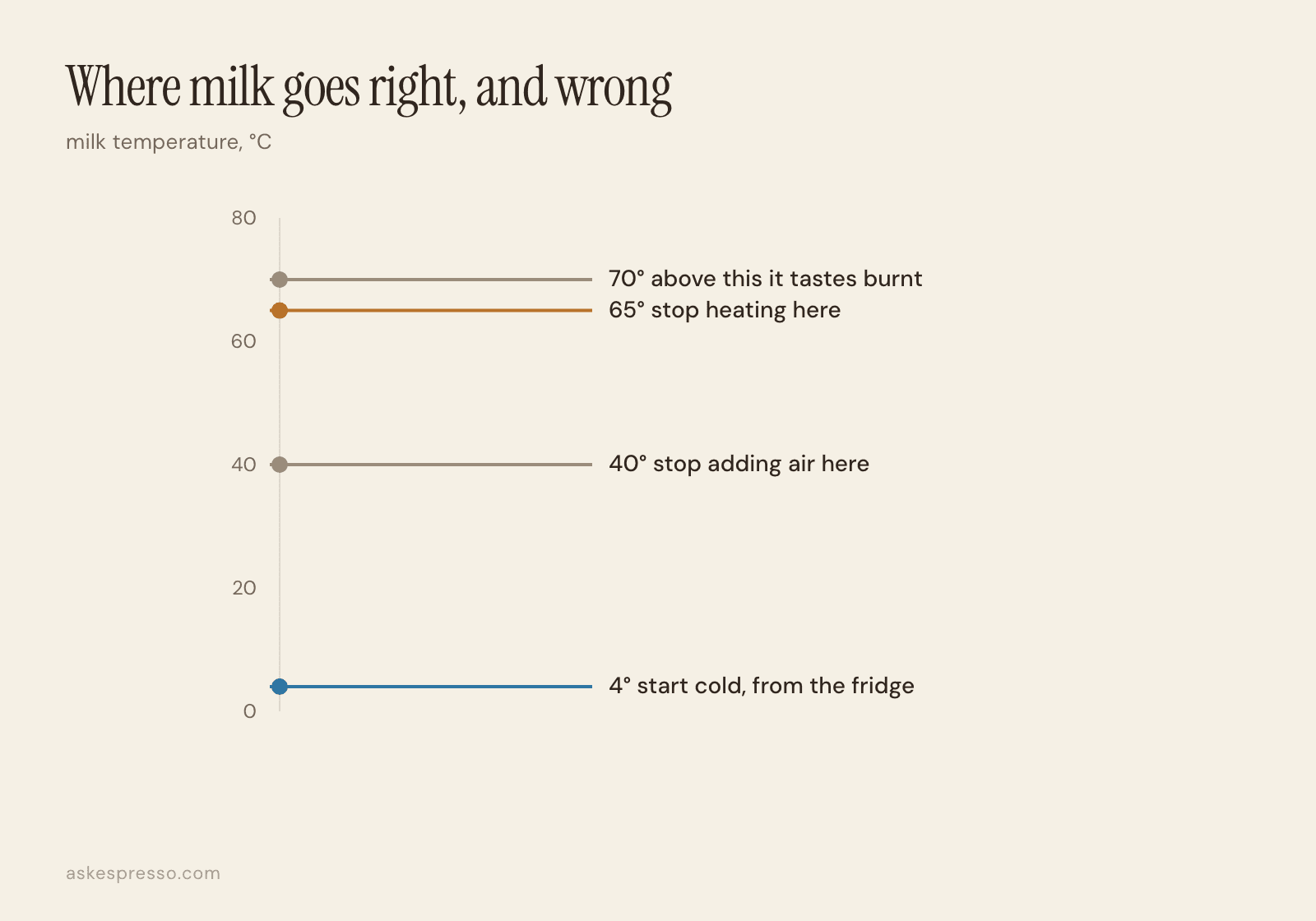
The temperature rule fixes almost every burnt-milk complaint I hear. Start with milk from the fridge, cold enough to sting the fingers, because cold milk buys you time to add air before it gets hot. Add air only until the milk is about blood warm; after that the fats loosen and the air will not stay in. Then keep the milk spinning and heat it until the jug is too hot to hold comfortably, and stop. Past that point the proteins break, the sugars scorch, and you get the bitterness that people blame on the espresso, a flavour like the skin on boiled milk. The sound of milk being ruined is a scream from the jug. Do not reheat steamed milk; the proteins do not work twice.
The result you want is foam so fine you cannot see the bubbles. The milk just looks thicker and glossier, like white paint fresh from the tin. That is all latte art is made of.

The names on the board are mostly a way of ordering how much milk you want on the same shot. A macchiato is marked with a spoonful. A cortado or a flat white is a small drink where some of the milk has been replaced with more coffee. A cappuccino has more air in the milk than the chart on the café wall suggests. A latte fills the cup. Order a latte in Italy and you get a glass of milk.
The most honest thing anyone in coffee has done with this was a café in London that simply sold its milk drink in three sizes. Same coffee, same milk, you choose how much. Everyone wanted the same drink and was arguing about volume.
Steamed milk floats on espresso. Good latte art exploits that, but only late.
Start pouring from high up, so the first stream punches through the crema into the bottom of the cup and mixes. Then bring the jug close to the surface and tip it forward, so the milk lands gently and the light foam floats and shows white against brown, like cream poured into a cup of tea. Move the jug side to side; the pattern comes from the rhythm. Lift at the end to draw a line back through it.
I will confess that I have never poured a good rosetta. There is a photograph of one on the front of this website, on small screens, and it is not mine. I can pour a heart, most mornings, on the days the milk is right and the boys are not shouting.
A footnote from my other life. Nearly twenty years ago, an engineer famous for building an early personal computer remarked that no robot would ever walk into an unfamiliar house and make a cup of coffee. Researchers in artificial intelligence took him up on it and named a test after him: enter an average home, find the machine, work out the buttons, find the coffee, make the cup.
Last year a company showed a humanoid robot making coffee after watching people do it for a few hours. It used a capsule machine, in a prepared setting, not an unfamiliar kitchen. The test as stated has still not been passed. Twenty years of progress, and the thing I do half asleep at five in the morning, on this counter, is still an open problem, which is a comfort to a man who spends his days teaching machines to switch air conditioners on and off.
There is a related and lovely piece of work in which two physicists and a computer scientist modelled cream mixing into coffee and measured how complicated the picture looked as it mixed. Disorder rises the whole time. Complexity does not: it rises while the tendrils of cream are forming, those pale curls that look like weather from a satellite, and then falls as everything goes uniformly brown. The interesting part is temporary. That is exactly what latte art is, and exactly why you drink it now. The paper, incidentally, has a bug in its code that its authors have never fixed, and one of them still says so on his website, a decade later. I find that a better lesson about science than the paper's result.

The steel filter on my counter is two chambers, a disc, and no operator. You spoon in the coffee, dark roasted and ground fine, set the disc, pour the water, and leave. Fifteen minutes later there is a decoction in the bottom chamber, black as a river at night and thick with oil, and you add hot milk and a spoon of sugar, and it tastes of childhood holidays in a house that was not mine.
It is a device that removes the human being from the process. That is the opposite of everything else in this series, where the whole argument has been for attention. And it makes the best milk coffee in the house. I have been thinking about that for a year, and I think I understand it now, and it is the subject of the last note.
If you want one thing to do this morning, heat a small jug of milk from the fridge, on the stove or with a frother, and stop the moment the jug is too hot to hold. Pour it on whatever coffee you have. Notice that it is not bitter.
No. Home espresso is expensive, messy and unforgiving, and a good grinder with any other brewer makes better coffee for less. If there is a good café near you, let them pull the shots. A moka pot and steamed milk cover most of what people want.
It went past about 70 degrees Celsius. Start with cold milk, add air only until it reaches about 40 degrees, keep it spinning, and stop heating at 65. Do not reheat milk that has already been steamed.
Mostly the amount of milk on the same espresso. A cortado or flat white has around 120 grams of lightly foamed milk on a double shot; a cappuccino around 110 grams of more aerated milk on a single; a latte fills the cup. Every café draws the lines differently.
Thank you for spending a little time here.
Back to the journal ↗