The journal.
Things I notice. Things I am still learning.
Opening the journal…
Things I notice. Things I am still learning.
Opening the journal…
Opening the note…
Dec 14, 2025 / Indian coffee / 13 min read
I was born into a tea family in a tea city, and the room I kept going back to as a student was called the Coffee House. What India grows, why the south drinks coffee and the north drinks tea, and what to buy.
Bengaluru, December 2025
By Sayonsom Chanda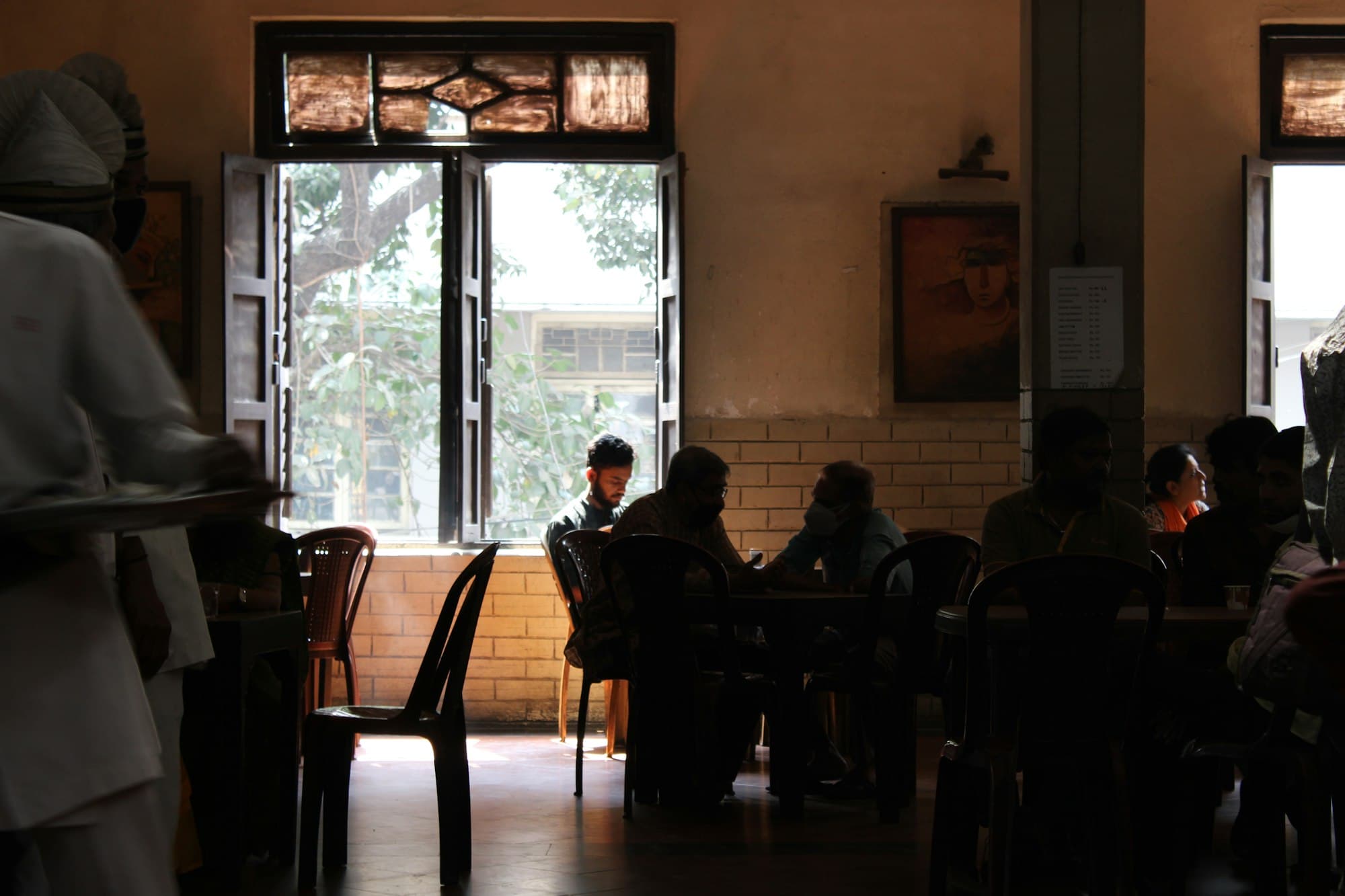
I was born in Calcutta into a family that drank tea, in a city that drank tea, in the state that made the tea. Summers meant Darjeeling, and hillsides of tea bushes pruned to waist height and green as a felt tablecloth, and my grandmother's kitchen, where the tea was brewed in a dented aluminium pan and smelled of smoke and sugar. I did not drink coffee until I was twenty-four and landed in Seattle in the rain.
And yet the room I kept going back to as a student was on College Street, and it was called the Coffee House, and almost nobody in it was drinking coffee either.
A year and a half back in Bengaluru now, and December here is the one kind month, cool in the mornings, with a thin mist over the lake that burns off by nine. The boys are at school and they have opinions about it. The day job continues. The two evening projects, the council and the energy map, are both alive, which is more than I could say for the last thing I built, and I have learned to count that as a result. The tap in Whitefield still reads high on the meter and the filter under the sink still brings it down, and I still write the number in the notebook every month, because I said I would in the water note and because I have become the kind of person who keeps a water log.
This is the last of the series, and it answers the question I am asked most often here: is Indian coffee any good, and what should I buy?
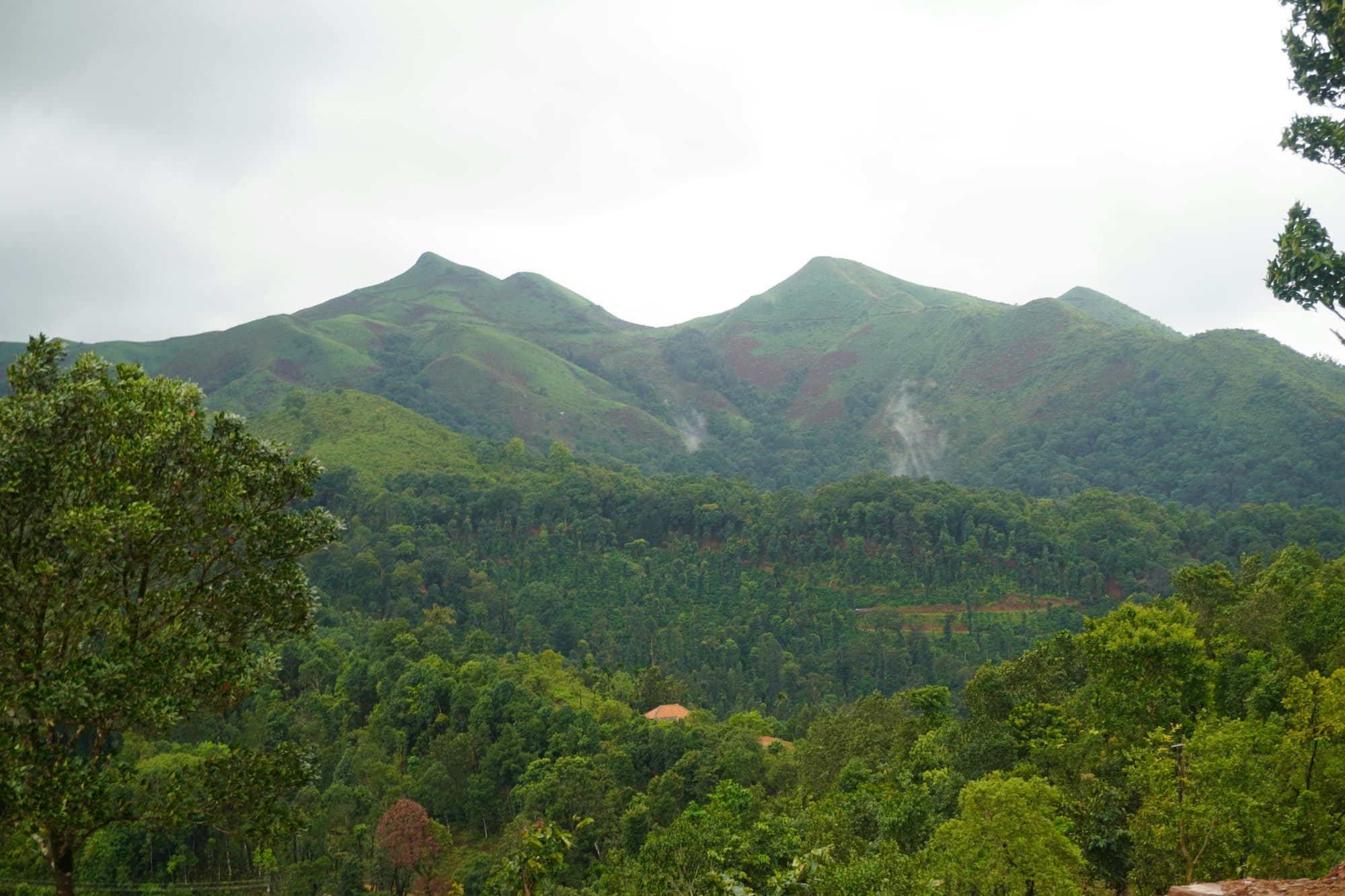
Every account of Indian coffee starts with a Sufi pilgrim named Baba Budan, who is said to have carried seven seeds from Mecca, strapped to his body, past an Ottoman export regime that scalded every bean so it could not sprout, and planted them in the hills above Chikmagalur, where the mist sits in the valleys like milk in a bowl. The range carries his name. Seven is a sacred number, and the story is told with the seeds in his beard, or his belt, and a date in the seventeenth century.
Here is the truth, which I find more interesting. The foundational English history of coffee, written a century ago, says only that Indian tradition relates that Baba Budan planted seeds near the hut he built for himself in those hills, and it gives two dates a century apart. It mentions no seven seeds and no beard. There is no contemporary document of the exploit at all. The founding story of Indian coffee is a legend in the technical sense, like Kaldi's goats in the history note. The shrine itself, sacred to Muslims and Hindus together, has been argued over in the courts for thirty years. The coffee story is the least contested thing about the place.
At the end of the seventeenth century, a Dutch official on the Malabar coast, prompted by a curious mayor of Amsterdam, shipped coffee plants from the port that is now Kannur to Java. That first shipment died. A second, a few years later, took. And Java is the source of the plants that went to Amsterdam, and then to Paris, and then, on the ship of the French officer who shared his water ration with a seedling, to the Caribbean, and from there across the Americas.
So the arabica in a bag of Colombian coffee has an Indian ancestor. It is in the old sources. It is defensible. I have never seen it on a bag, and I would like to.
I grew up believing this was culture. It is topography and marketing.
The south drinks coffee because the Western Ghats have what arabica needs: altitude, rain, cool nights, and shade. Almost nowhere else in India does, at scale.
The north drinks tea because, in the nineteen thirties, a marketing board sitting on a vast unsold surplus after the Depression sent motorised vans with giant kettles through the towns, gave away millions of free cups, sold tiny packets at the lowest price it could, put enamel instruction signs in railway stations, and sent teams to teach the English method. Indian vendors ignored the method, boiled the leaves with milk and sugar and spice until the kitchen smelled of cardamom and ginger, and invented chai.
One was pushed. The other grew. A Bengali tea family, run out of the capital of the tea trade, is quite literally a marketing success. I say this with love, and with a dark roast in my hand.
The Coffee Board built its chain of coffee houses in the thirties and forties for one purpose: to create a domestic market for Indian coffee. It failed at that and succeeded at everything else.
In the fifties the Board moved to close the outlets. The workers, led by a communist member of parliament, took the houses over and, after a long argument in which he wanted state ownership and the prime minister wanted cooperatives, settled on cooperatives. The one on College Street was shut a year later and reopened after the professors of the two colleges across the road petitioned the government. It was saved by its customers. It has now run for seventy years as a worker-owned cooperative, and I know of no more successful one in the country.
The main hall is nicknamed after the British parliament, and it sounds like one: a high room the colour of old newspaper, ceiling fans turning like slow propellers, a hundred conversations at once rising and falling like the sea. The signature drink is black coffee made by the south Indian filter method and called, simply, infusion. Filmmakers, economists, poets and an American beat poet on a long visit have sat at those tables. A song about the place, from the eighties, names seven friends who used to meet there and says where each of them ended up, and its refrain is that the conversation at the Coffee House is no more. The tune, in its opening bars, borrows from the Scottish song people sing at midnight on the last day of the year, and every Bengali of my parents' age can hum it.
The song is not about coffee. It is about adda, which is the Bengali word for long, unstructured, purposeless conversation, and which does not translate. Coffee was the pretext. That is the opposite of what the Board built the chain to do, and exactly why it worked. It is also the argument of the first note in this series, arriving from the other side of the world. Nobody was ever afraid of the bean.
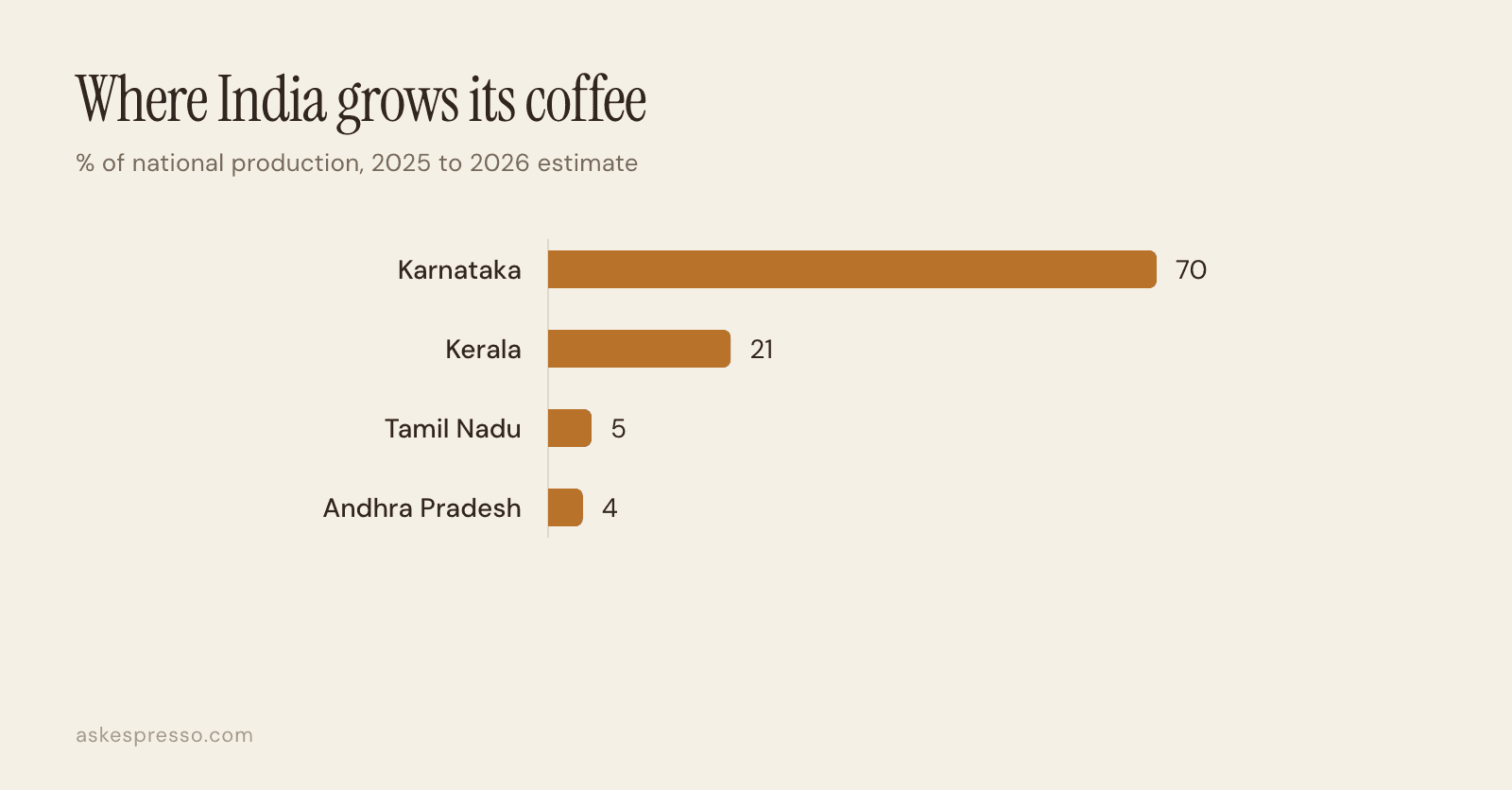
India is the seventh largest producer of coffee in the world and exports most of it, largely to Italy, where it disappears into espresso blends without a name. Nearly all of it is grown on smallholdings, and this year's crop is a record.
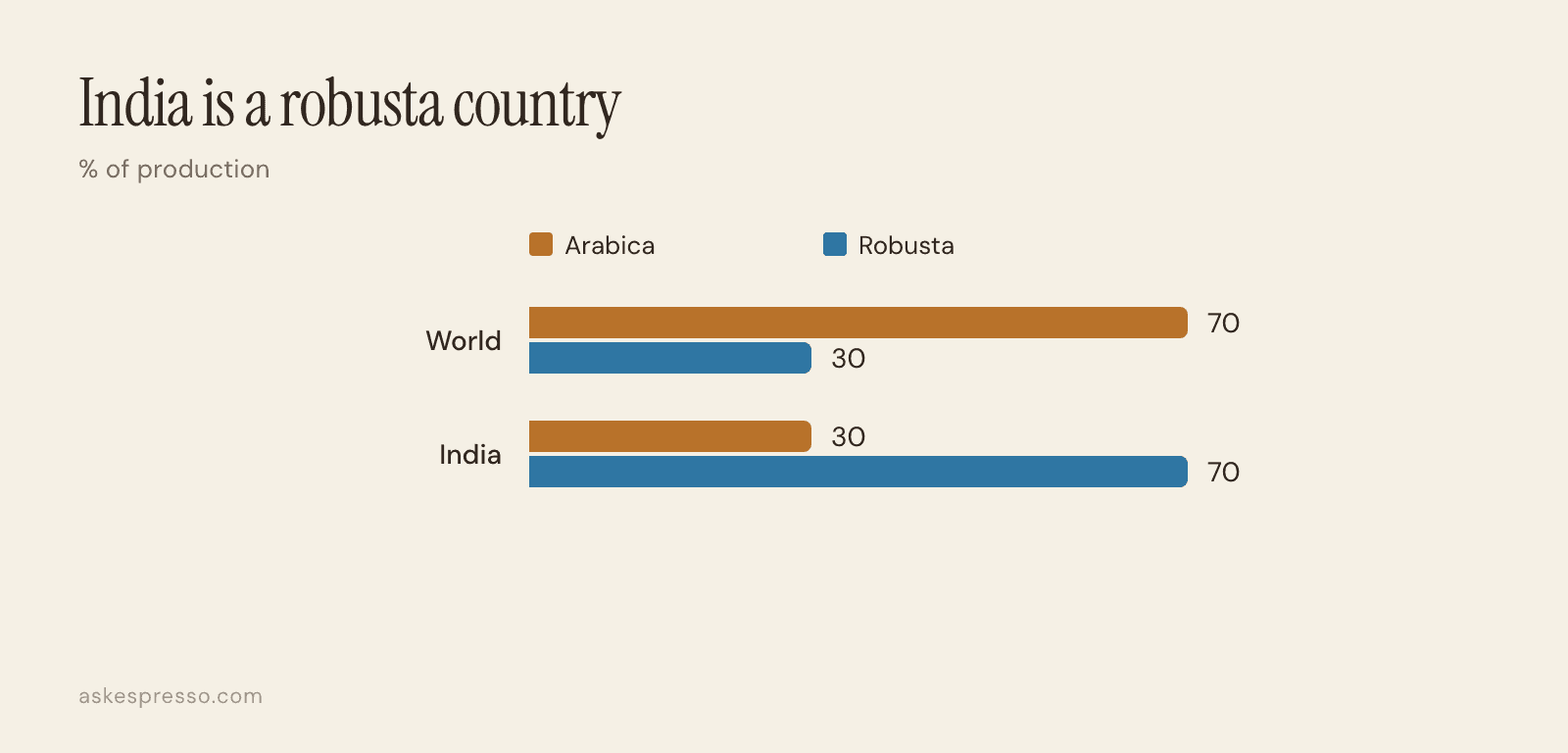
The fact that surprises everyone, including me, is that India is a robusta country. The world grows mostly arabica. India grows mostly robusta. The reason is a disease.
In 1869 a leaf rust reached Ceylon and killed its coffee industry inside twenty years, the leaves going orange and dropping like autumn; the island replanted with tea. India was hit and did not collapse, because of small farms, seasonal labour, and a home market Ceylon did not have. And India's answer was breeding, not retreat. A research station in the Chikmagalur hills, founded a century ago, has run one of the longest continuous programmes of rust-resistant breeding anywhere. Its most famous selection, from the forties, still covers a large share of Indian arabica and is planted across Indonesia, because unlike most rust-resistant coffee it tastes good. The robusta share is the fossil of that year.
Under British rule, green coffee crossed to Europe in sailing ships around the Cape, months in humid holds that smelled of tar and salt. It arrived swollen, pale, and stripped of acidity. That was Indian coffee to the European palate.
When steam shortened the voyage, the transformation stopped happening, and the buyers complained. So the curers rebuilt the voyage on land. Natural-processed green coffee is spread on the floors of open-sided warehouses on the Malabar coast through the monsoon months, raked and turned and re-bagged for weeks in air you could wring out like a cloth, until it swells to nearly double, loses much of its density, and turns from green to the gold of old brass. The result is among the lowest-acid coffees in the world.
It is a deliberate reconstruction of a shipping defect. It has protected geographical status. And, as the buying note's chart showed, it is the cheapest category in the Indian specialty market. India's most famous coffee is its least prestigious at home. I do not know what to make of that. I drink it in the filter, roasted dark, and it tastes like the inside of a wooden chest, and I like it.
Indian coffee is almost all grown under a two-layer canopy of trees, with black pepper trained up the trunks and cardamom and orange and jackfruit in between, so that walking through an estate smells like walking through a spice cupboard. This is the biodiversity argument for Indian coffee, and it is largely true: the estates hold hornbills and barbets and giant squirrels and civets.
The thing to watch is the drift toward a single fast-growing shade tree that yields timber and supports pepper. Where it takes over, the tree diversity collapses, the label still says shade-grown, and a study of robusta farms in Kodagu found smaller beans and more borer beetle where the shade was monotonous. The label is still true. It is thinning.
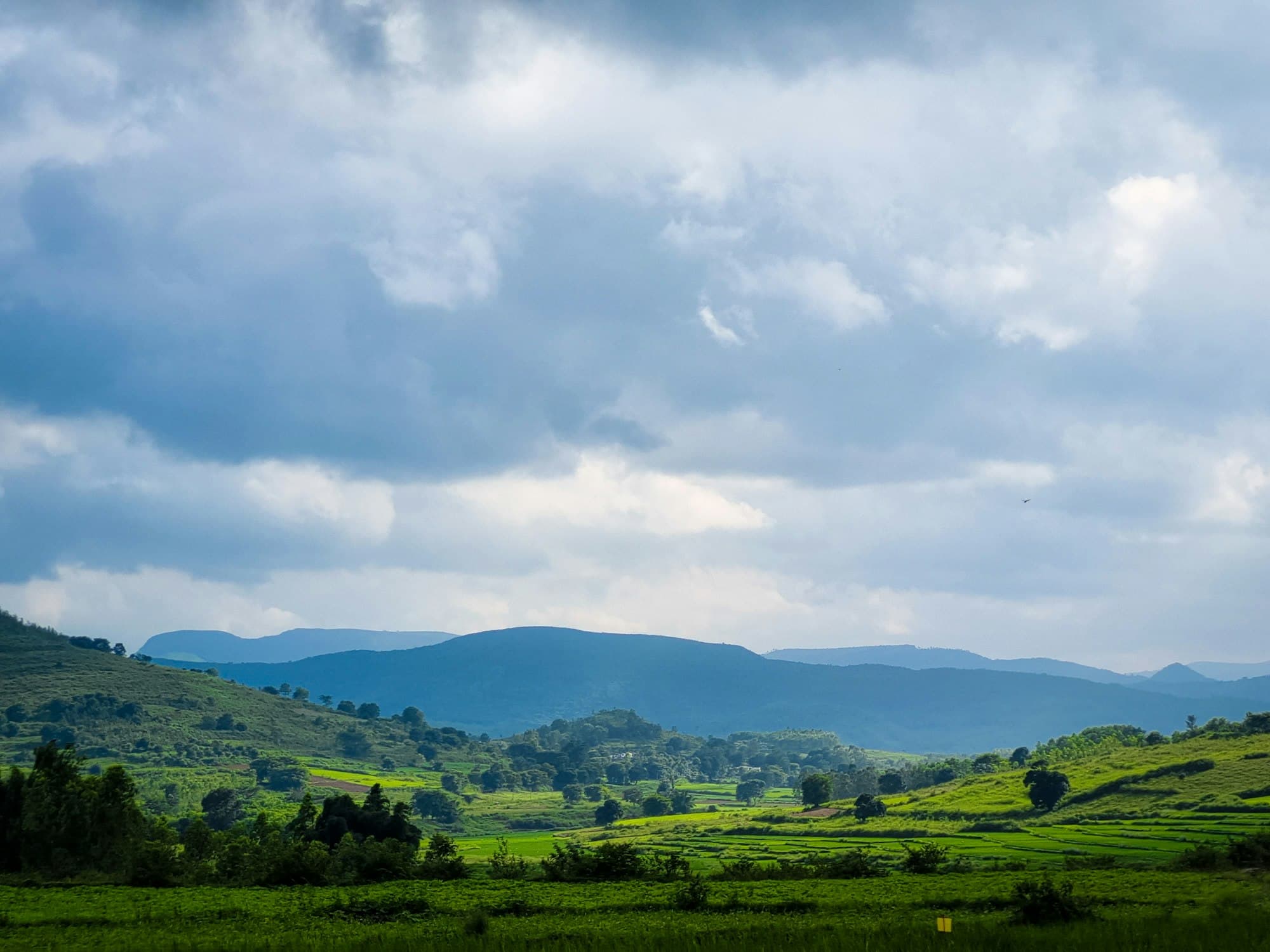
The most interesting institution in Indian coffee is a cooperative of tribal farmers in the hills where Andhra meets Odisha, built over twenty-five years by a foundation. Thousands of one-acre farms, organic and certified, with millions of trees planted, and a mapping of every plot by slope and soil and shade that borrows the vocabulary of wine on purpose. Its coffee won a gold medal in Paris in its first year there.
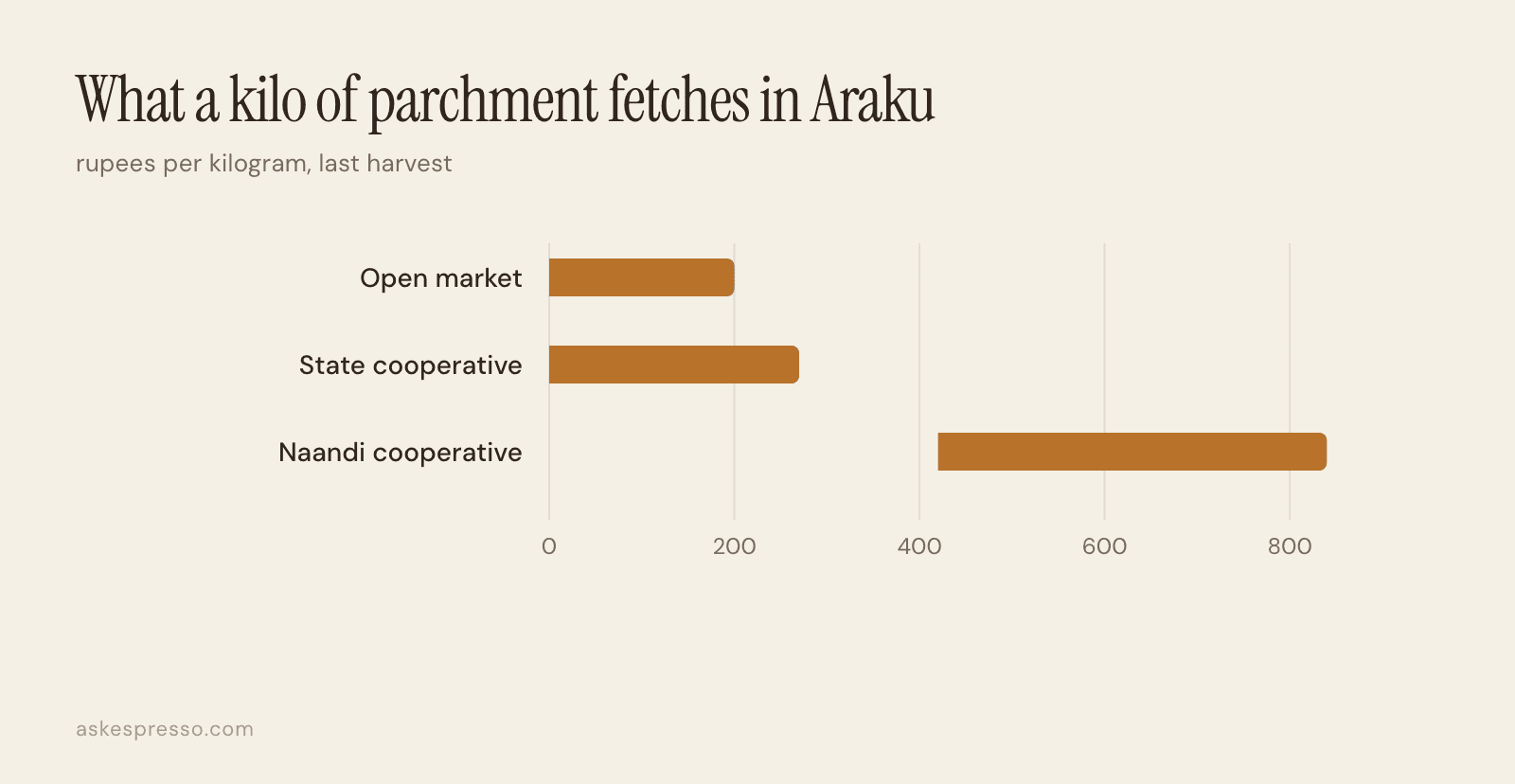
The price story is the point. A kilo of parchment coffee fetches far more through the cooperative than on the open market or through the state agency. And the honest caveat, which I will print: after all that time and money, the company behind it is reported still to be unprofitable, and the region had a very large number of days above thirty degrees last year. Both things are true. I say this as someone who spends his evenings on a map of exactly this kind of data, and who knows how rarely the two halves of a story like this appear on the same page.
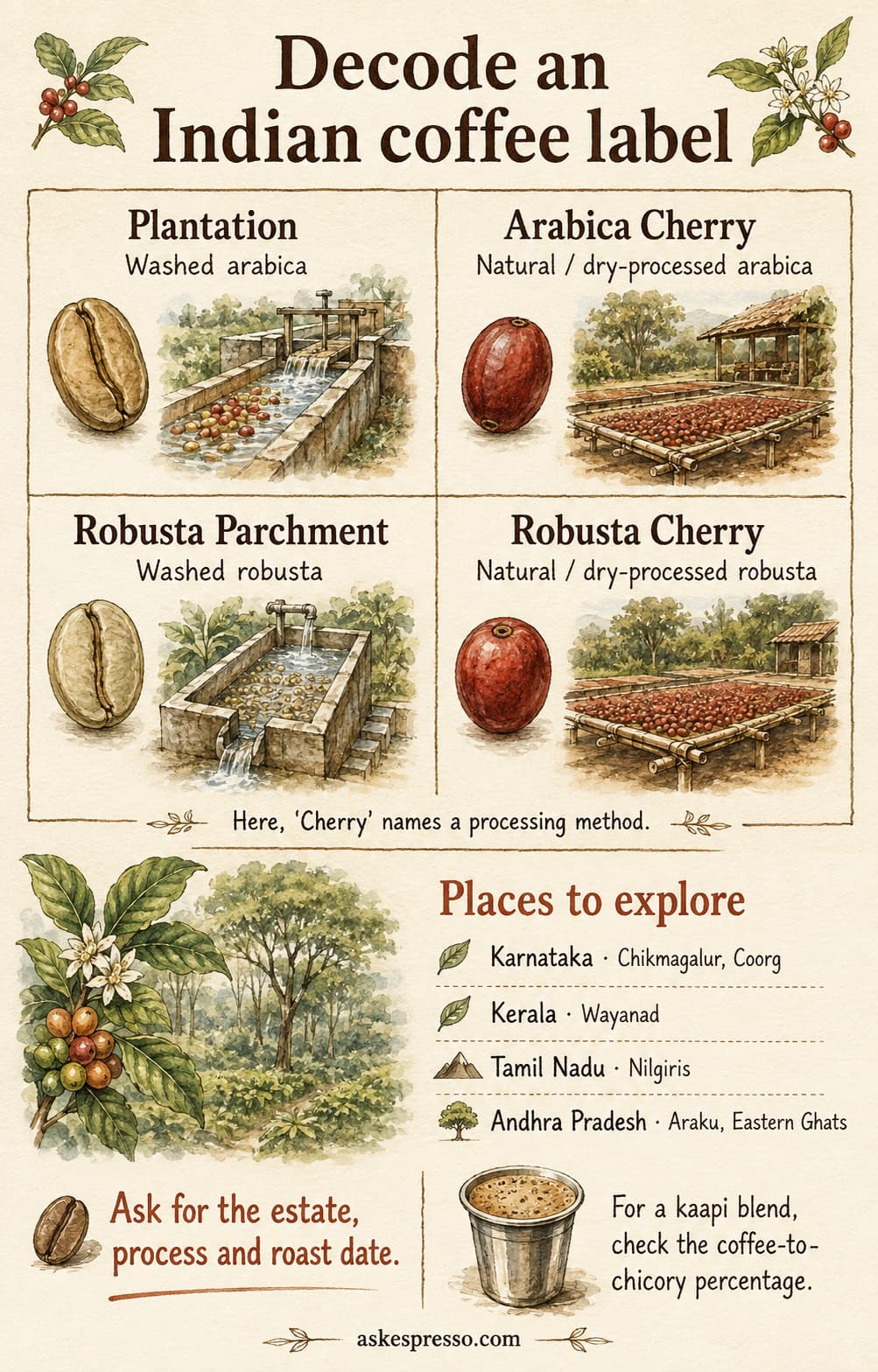
Here is the most practical thing in this note, and almost nobody explains it.
Plantation does not mean grown on a plantation. It means washed arabica.
Cherry does not mean fresh fruit. It means natural, dried in the fruit.
Robusta Parchment is washed robusta; the premium grade has a royal name.
Robusta Cherry is natural robusta.
The letters after those words are size grades.
A handful of regions now carry protected names: Coorg, Wayanad, Chikmagalur, Araku, and the Baba Budan hills themselves, described in the register as the birthplace of coffee in India.
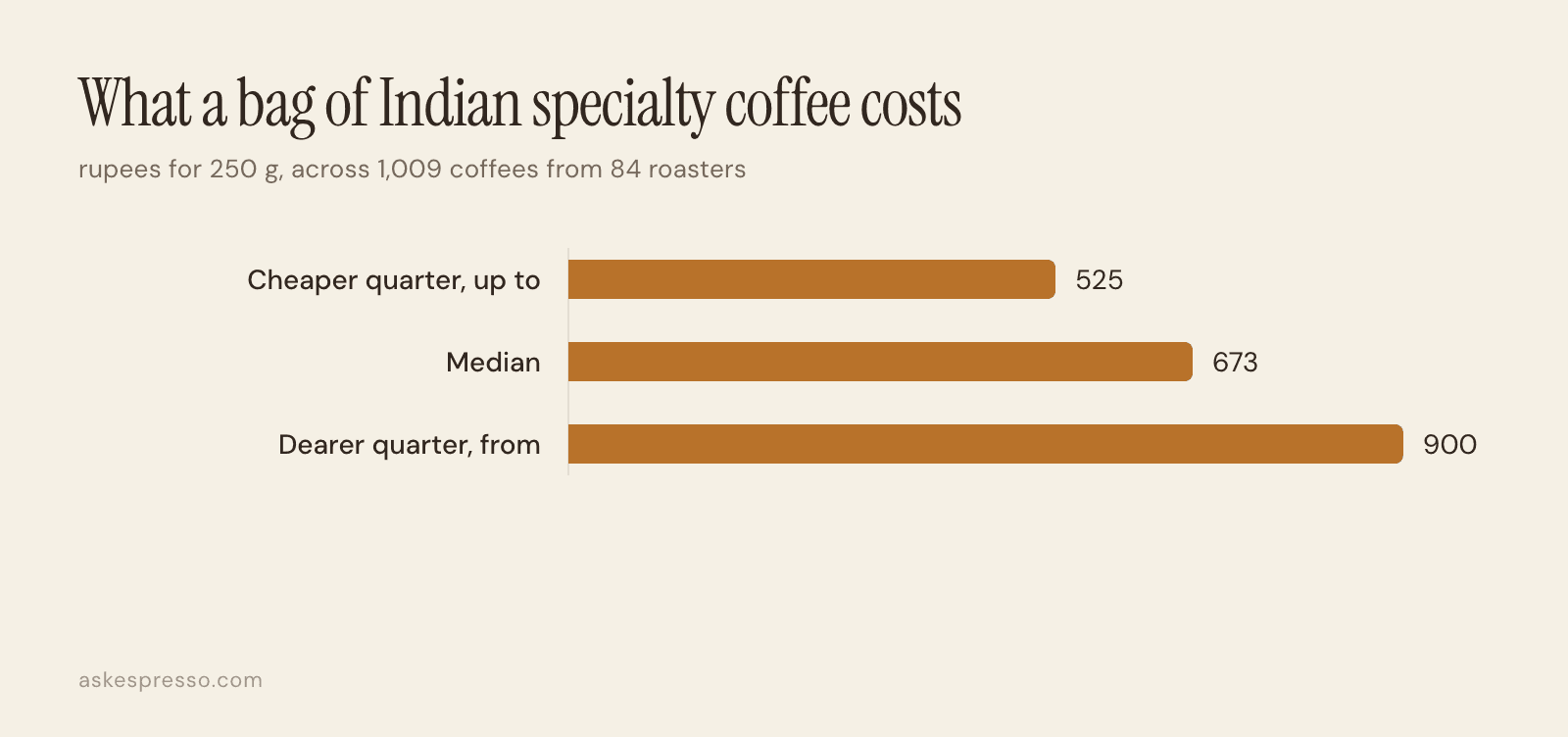
I went through a catalogue of the Indian specialty market this autumn: dozens of roasters, more than a thousand coffees. Half of them are Chikmagalur. Kodagu, the Baba Budan hills, the Shevaroys and Sakleshpur make up most of the rest.
And the palate is its own. Indian coffee tastes of chocolate and nuts and caramel far more often than of the flowers and berries that dominate the marketing of East African coffee, and I will say plainly that I prefer it, because chocolate and nuts and caramel are what a dark roast is for. If you want blueberries, buy Ethiopian. If you want a cup that tastes like the hills two hundred kilometres from here, with the oils sitting on top like varnish, buy this.
Roasters worth your time, in no order and with no arrangement between us: the one that started in a Delhi bedroom and now has outlets everywhere; the Bengaluru chain with a wave in its name; the Mumbai roaster chasing high scores; the one in Nagpur run by the country's first AeroPress champion; the conservation-minded roaster that sources by bird count; the Araku cooperative's own label; and a few dozen others, many of them in this city. And, since this is my own site, there is a roaster in Whitefield who buys a few kilos of green from one Karnataka farm, roasts it after you order, and leans dark, and you can find him in the shop.
The gaps to complain about, politely: only a third of listings name the estate, only a third name the variety, and very few publish a score. India's coffee sector is not yet living up to its own vocabulary, and the note on reading a bag will tell you which questions to ask until it does.
And the fact that should make somebody build something: until 1996, growers here could not sell to whom they chose; everything went through a pooled system run by the Board. The year that ended is the true founding date of Indian specialty coffee, and it is almost never written about.
This answers the question the espresso note left open.
The steel filter is a perforated cup on top, a pressing disc on the grounds, and a chamber below that collects the decoction. Fine grind, dark roast, often a fifth or so of roasted chicory. Boiling water on top. Then you walk away for fifteen minutes. Decoction to hot milk in whatever proportion your family argues about.
It is not a pour-over. A pour-over is water flowing through, each particle wet for seconds, the whole thing over in minutes and governed by how you pour. The Indian filter is slow immersion under a still head of water, governed by time and saturation, the way a stew is governed by the clock and not the spoon. The disc inverts the operator's role: in a pour-over the person controls the flow; here the disc and the packed bed control it, and the person leaves.
The chicory is doing hydraulic work, not only flavour. Its roasted root swells when wet and slows the water through the bed, lengthening the brew. It is also free of caffeine, which cuts the dose. Food law allows nearly half of a coffee-chicory blend to be chicory; most commercial blends use far less.
The pour from height between the tumbler and the saucer is functional, not theatre. It aerates, it froths, it mixes the milk fat into the decoction, and it cools the drink to where you can hold it, with a sound like a small waterfall. It is a hand-powered heat exchanger.
And degree coffee has nothing to do with temperature. The word refers to a reading on the instrument that certifies milk purity. First-degree milk, second-degree milk. Hence the famous coffee of a temple town in Tamil Nadu.
So here is what I understand now about the device that removes the operator. It is a machine for making the person available for the room. You set it, you leave it, and you sit down with someone, and the coffee comes when it comes. The Coffee House did not need good coffee. It needed a drink that would be ready without anyone watching it.
In the hills above my grandmother's summers, in Darjeeling and Kalimpong, there are now a few hundred acres of coffee, planted by small farmers and by a state department that was set up a century ago to grow the tree that quinine comes from. Nearly all of it is arabica, from seed grown in Karnataka. Meanwhile Darjeeling's tea output has fallen to its lowest in a century and a half, and the hills are warming.
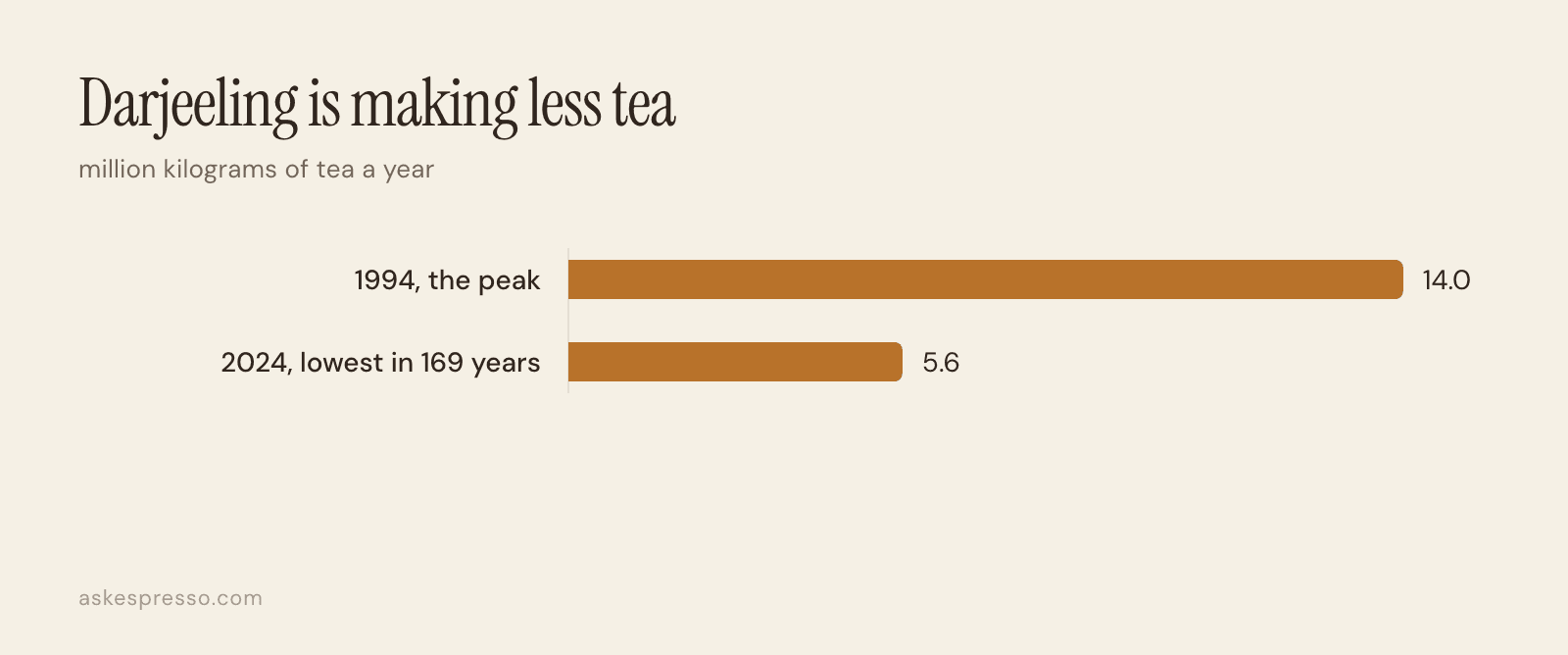
Against the tea gardens it is nothing, a few hundred acres against thousands. This is a symbol, not an economy. I am printing that so that nobody mistakes it for more.
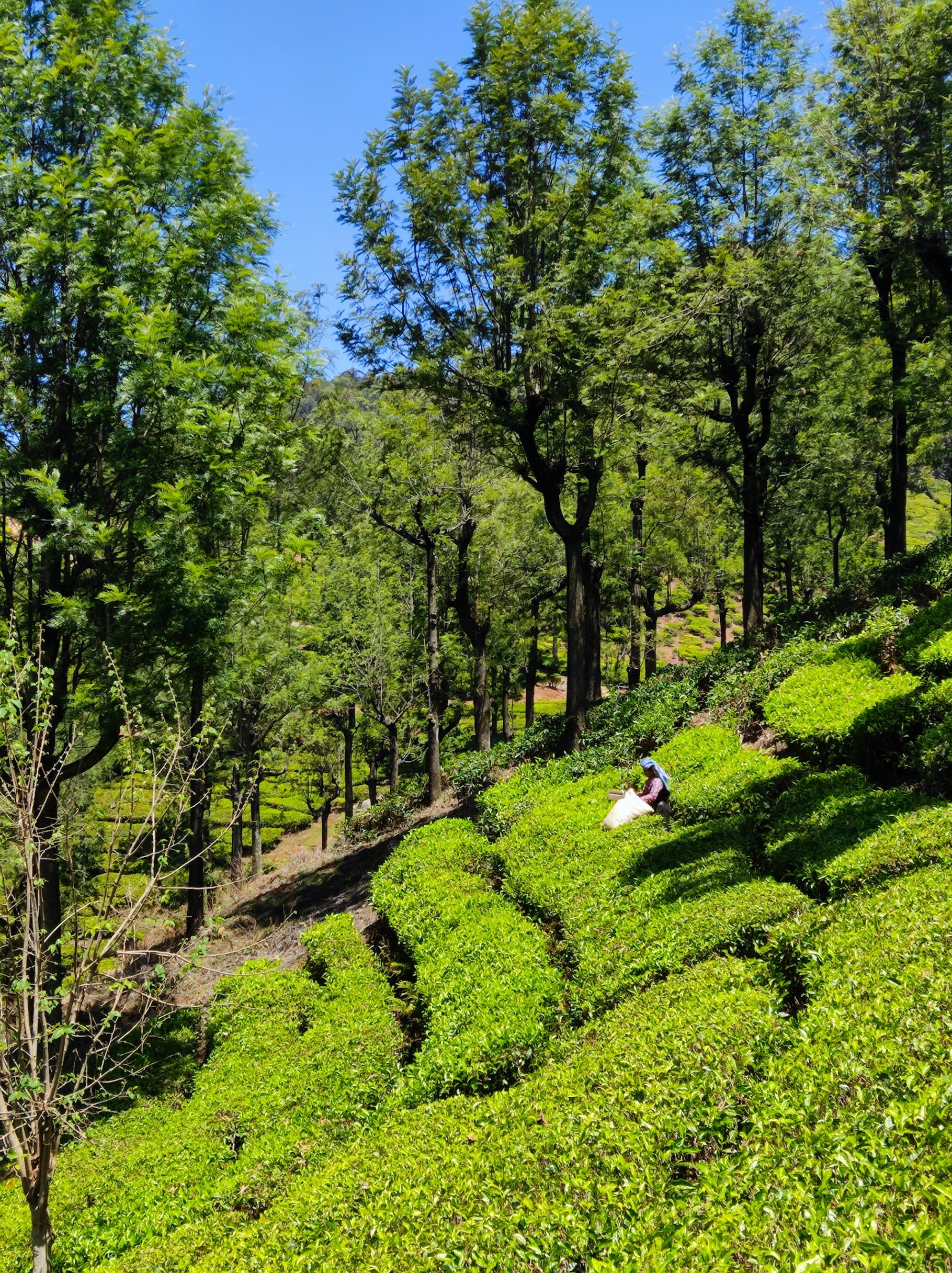
My grandmother's hills are learning to grow the thing I left the country to discover.
That is the end of the series. Here is the last instruction, and it is the only one that matters. Find an estate two hundred kilometres from wherever you are, buy a kilo, roast it dark if you can and buy it dark if you cannot, and find out what your own place tastes like.
Yes, and it tastes like itself: chocolate, nuts and caramel more often than the floral, fruity profile of East African coffee. Buy from a roaster who prints a roast date and names the estate. Chikmagalur, Kodagu and Araku are good places to start.
Plantation means washed arabica, not that it came from a plantation. Cherry means the coffee was dried inside the fruit, the natural process, not fresh fruit. Robusta Parchment is washed robusta and Robusta Cherry is natural robusta.
The south drinks coffee because the Western Ghats have the altitude, rain and shade arabica needs. The north drinks tea because a marketing board in the 1930s gave away millions of free cups to sell a surplus. One grew; the other was pushed.
Thank you for spending a little time here.
Back to the journal ↗