The journal.
Things I notice. Things I am still learning.
Opening the journal…
Things I notice. Things I am still learning.
Opening the journal…
Opening the note…
Nov 14, 2021 / Brewing / 9 min read
I moved a mile above the sea and my coffee went wrong in a way I could not name. It took two weeks and a thermometer to find out that the water had changed, not the recipe.
Boulder, Colorado, November 2021
By Sayonsom Chanda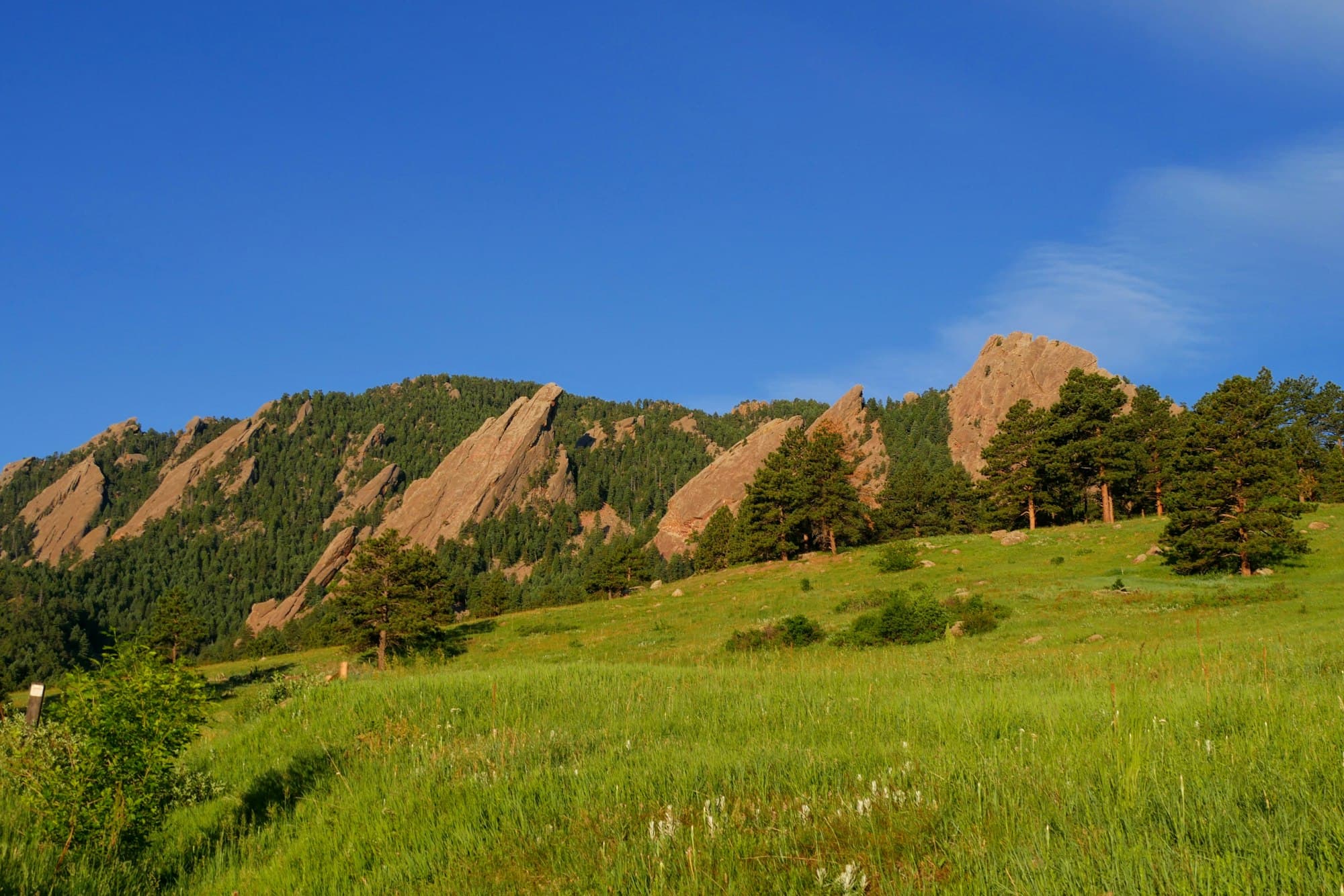
I have moved to a town a mile above the sea, and my coffee has gone wrong in a way I cannot name.
The recipe is the same. The beans are from the same roaster, shipped from the same place. The grinder came in the moving truck wrapped in a towel. Boulder sits at the foot of the Rocky Mountains, and in November the sky here is a hard, bright blue I did not know sky came in, like the blue of a gas flame, and the cold has a clean, dry smell like a freshly ironed shirt. And every cup I have made in the last two weeks has been thin and a little sour, like tea that has been dunked once and taken out.
Rob, who sits across from me at the laboratory where I now work, keeps a dented steel thermos on his desk and says the altitude will sort itself out. It does not sort itself out. It took me two weeks and a kitchen thermometer to work out that the kettle was not lying to me. The water was.
I should say where I am, since so much of this series is about where I am. I left the startup in Alabama in the summer, or rather I left the version of it that lived in Alabama, and took a job as a scientist at a national laboratory here, modelling the electricity grid on machines that fill a room and hum like a server farm in a film. The company continues, with a team in Bangalore and a smaller team of hopes. I have told myself this job is a bridge. I am not sure it is. I am sure that the water here boils at a temperature it did not boil at before, and that this is the kind of problem I can actually solve, so I am going to solve it.
The short version first, because it is most of the benefit.
Coffee is nearly all water. If your water tastes bad cold, it will taste bad hot, with coffee in it. Chlorine comes straight through, that swimming-pool sharpness. A stale, flat taste comes straight through. So filter it, or use bottled water with some minerals in it, and do not use water you would not happily drink on its own from a glass. That is the two-second version of this whole note, and if you stop reading here you will have most of what matters.
Here is the part that took me longer to understand. Water is not just the liquid in the cup. It is the thing that dissolves the coffee, the way warm water dissolves the sugar at the bottom of the mug and cold water leaves it sitting there, and how well it does that depends on what is already dissolved in it.
Very hard water is already carrying a heavy load of minerals. It is closer to full, like a bus at rush hour. It makes a poorer solvent and pulls less of the good things out of the grounds. But water with nothing in it at all is also wrong. Completely demineralised water makes flat, hollow coffee, coffee with the colour and none of the weight. Some minerals help the water do its job.
Which minerals? This is where a real chemist enters the story. A few years ago a young chemist whose day job is simulating materials with quantum mechanics sat down with two coffee professionals and computed how strongly the common ions in water bind to the acids and aromatic compounds in coffee. Their paper found that magnesium is the better extractor, that calcium is mostly what furs your kettle white, and that bicarbonate buffers the acidity away. They wrote a small book about it afterwards. The chemist's stated aim, which I have pinned above my desk between a photograph of my son and a printout of a feeder model, was that science is here to make coffee simpler.
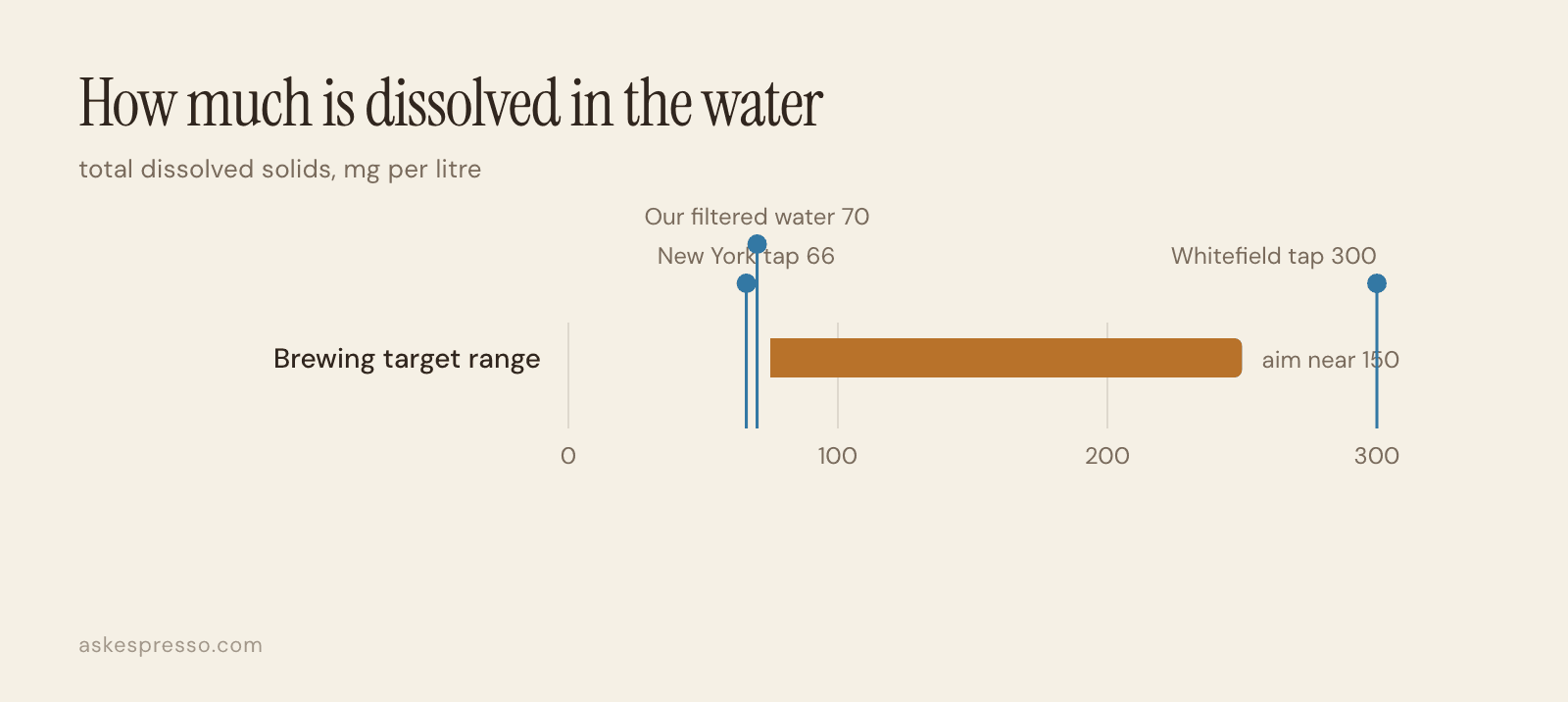
The trade body publishes targets for brewing water: a range for the total dissolved minerals, a range for hardness, a range for alkalinity, no chlorine, a pH near neutral. I have put the main one on the chart, with three readings from my own kitchens. Two things on the chart surprised me. New York's tap water, which everyone praises, is actually very soft, below the target, and so is Boulder's. Soft water is not automatically good water. And I will confess now that the two Indian readings are from a later kitchen, in a suburb of Bengaluru called Whitefield, where the tap water reads at the far right of the chart, hard as a hotel towel, and the filter under the sink brings it down to the far left. I did not have that meter yet, this winter. I wish I had.
A note on that meter. A device that reads total dissolved solids costs about as much as a takeaway dinner and is the cheapest diagnostic in coffee. But it reads one number, the total. It does not tell you the hardness or the alkalinity separately, which are different things. Use it to know roughly where you stand, not to know everything.
If your tap is very hard, or very soft, or simply unknown, you can make brewing water at home, and it is not difficult, only fiddly, like sewing on a button.
Start with distilled or reverse-osmosis water, never tap. Add two things: Epsom salt, which is magnesium sulphate and available at any chemist, and ordinary baking soda, which is sodium bicarbonate and is already in your cupboard. Both must be food grade.
The trouble is the quantities. The recipe I use calls for a fraction of a gram of each per litre, which is below what a kitchen scale can read, a pinch smaller than a pinch. There are two ways around this. Mix a large batch, four litres at a time, so the weights become readable. Or make a concentrate: dissolve the minerals in a small bottle of distilled water, and add a few millilitres of that to each litre you brew with. One small bottle treats a great deal of coffee, the way one bottle of vanilla essence lasts a family a year.
There are commercial sachets that do the same thing, sold in the United States. I could not find them in India, when I later looked. India is do-it-yourself territory for water, and in truth it is better that way, because a meter and a bottle of concentrate teach you what a sachet hides.
Most brewing advice says to use water a little below the boil, around ninety-three degrees, give or take a few. You will see a narrower range quoted everywhere. The wider one is what the trade body actually publishes, and it matters, because the width is where altitude lives. Darker roasts like the lower end, and I like darker roasts, so I live at the lower end. Lighter roasts like the upper end. And you should not touch this dial at all until grind, ratio, time and water quality are settled, as the extraction note explains.
Now here is what I did not know when I unpacked the kettle from its towel.
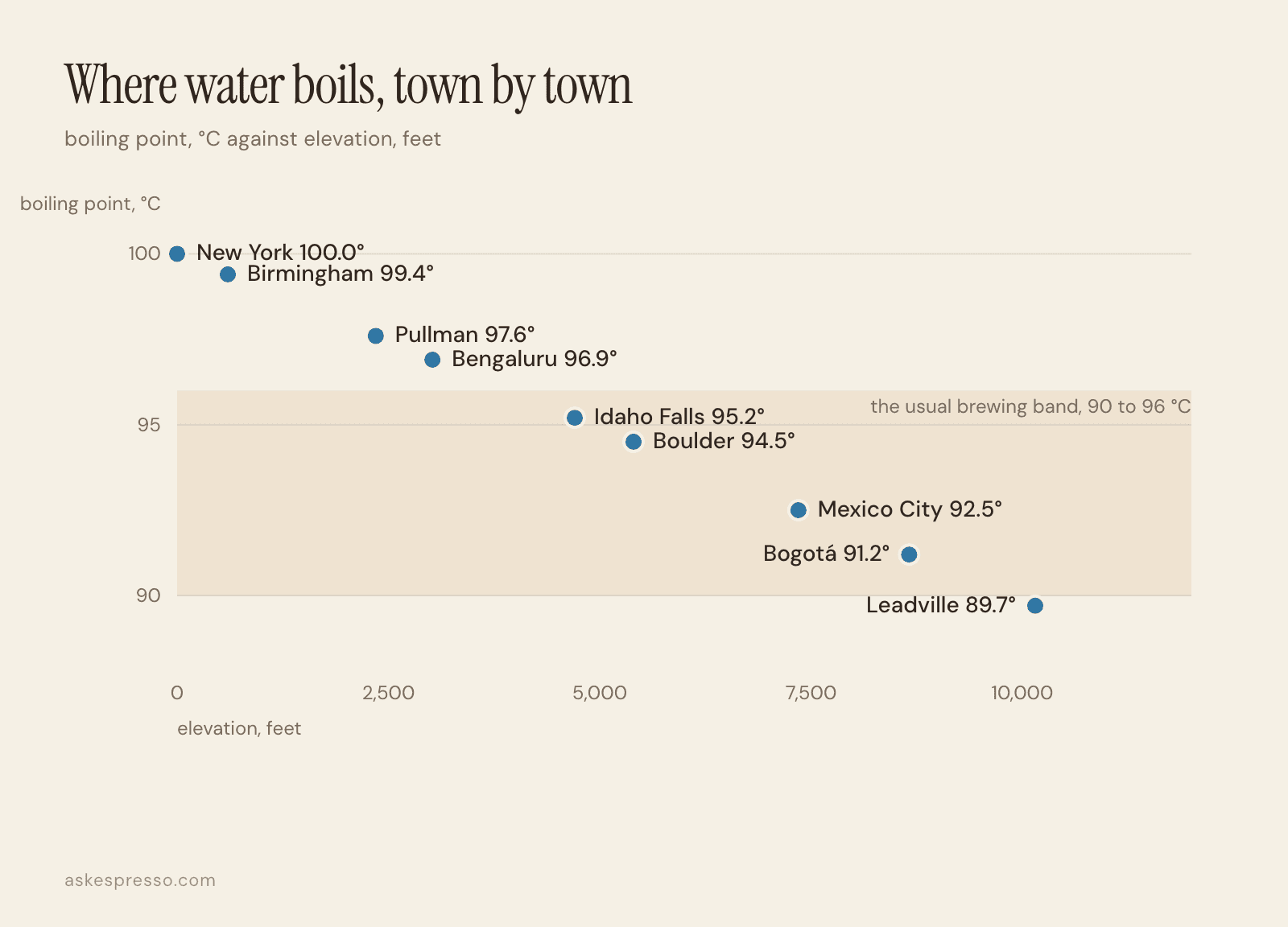
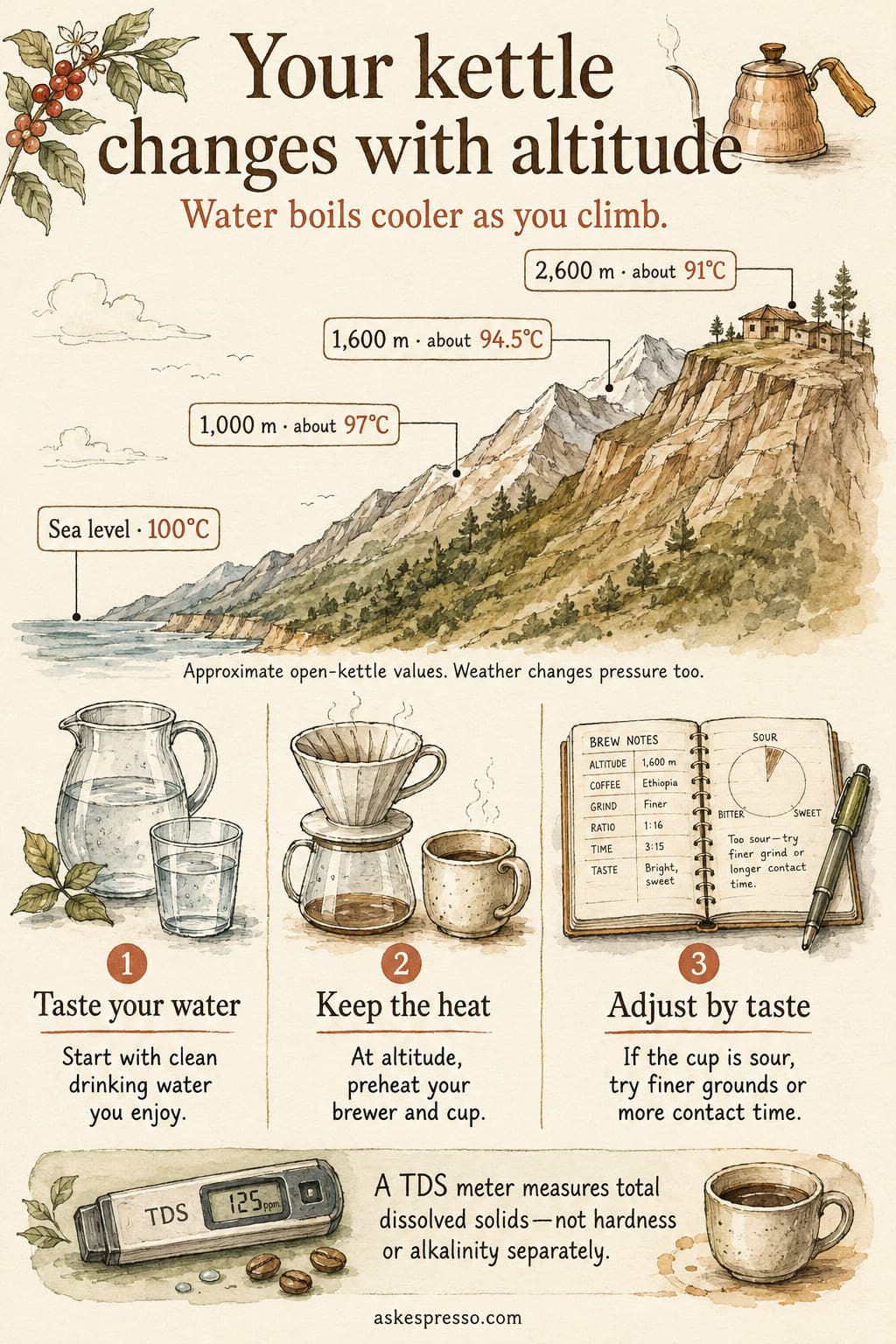
At sea level, water boils above the brewing range, so the standard advice is to boil and then wait half a minute for it to cool, the way you let a bath run before you get in. In Boulder, water off a rolling boil is already in the middle of the range. Wait half a minute in an open kettle and you are near the floor of it. Every degree lost to a cold ceramic cone or a cold mug is a degree you cannot get back.
So the advice inverts. Up here, pour straight off the boil, and preheat everything: the brewer, the filter, the cup, until they are warm to the palm like a plate out of the dishwasher. I had been doing the opposite, faithfully, for two weeks. A roastery in this town built an entire brewing method around exactly this, pulling their batch brews at a temperature that would ruin coffee at sea level and cooling them fast over ice, and one of their people calls the result indoor cowboy coffee. I find that funny and also correct, and I have a soft spot for cowboy coffee, black and boiled and oily, which is closer to what I drink than most of the trade would admit.
There is a second consequence. Cooler water extracts more slowly. So at altitude you grind a little finer, or extend the contact a little, or both, to get back to where you were. A brewer who works at a similar height told an interviewer that he favours a pressure brewer up here because you can make up for the low air pressure with a little pressure of your own. The batch machines sold nationally are calibrated at sea level, and someone who repairs them says they give a thin cup in the mountains. That was my cup. Thin.
Espresso is mostly exempt from all this, because a pressurised boiler sets its own boiling point regardless of the room. The exceptions are small. Steam is a little cooler at altitude for the same gauge reading, and the gas in fresh coffee comes out of solution faster in thinner air, which one local roaster describes as crema with the texture of popping candy on the tongue. I have not owned an espresso machine here, so I am repeating what people who have tell me, and the espresso note says why I probably never will.
I looked for a published figure for Bengaluru's water, because I knew I would want one someday. I could not find one that I trusted. People assert that the river water is soft and the borewell water is hard, and they are probably right, but nobody cites anything, and I have spent enough of my working life chasing uncited numbers about the Indian grid to know what that is worth. When I finally got there I bought the meter and took my own readings, which is what I would tell you to do wherever you live. Your kitchen is the only kitchen that matters.
Here they are, in order, as I now understand them. A roast date on the bag. A scale. A water meter. Water you mixed yourself. None of these is equipment in the way people mean the word. All of them are attention.
If you want to do one thing this morning, boil the kettle, put a thermometer in it, and find out what your own water does. Then decide whether you are waiting thirty seconds for a reason or out of habit.
The next dial is the biggest one, and it is the grinder. Rob still says the altitude sorts itself out. He drinks his coffee from the thermos, made at home before dawn, black and probably too hot, and he is happy, and I have decided not to tell him anything.
Yes, twice. You taste the water itself, so chlorine or a stale flavour comes straight through. And the minerals in the water decide how well it dissolves the coffee: very hard water extracts poorly, and fully demineralised water extracts poorly too.
Around 93 degrees Celsius, give or take three. At sea level that means boiling and waiting half a minute. Above about 1,500 metres the kettle already boils inside that range, so pour straight off the boil and preheat everything.
Yes. Start with distilled or reverse-osmosis water and add a little Epsom salt and baking soda, weighed on a scale. Mixing a concentrate in a small bottle and adding a few millilitres per litre is the easiest way to get the tiny amounts right.
Thank you for spending a little time here.
Back to the journal ↗