The journal.
Things I notice. Things I am still learning.
Opening the journal…
The Askespresso app is on Google PlayFree shipping across India
Things I notice. Things I am still learning.
Opening the journal…
The Askespresso app is on Google PlayFree shipping across India
Opening the note…
The Askespresso app is on Google PlayFree shipping across India
Jun 18, 2023 / Roasting / 12 min read
A machine on the back porch, a temperature probe, a stopwatch and my ears. Roasting is the same job I do all day: keep a curve decelerating without letting it stall.
Boulder, Colorado, June 2023
By Sayonsom Chanda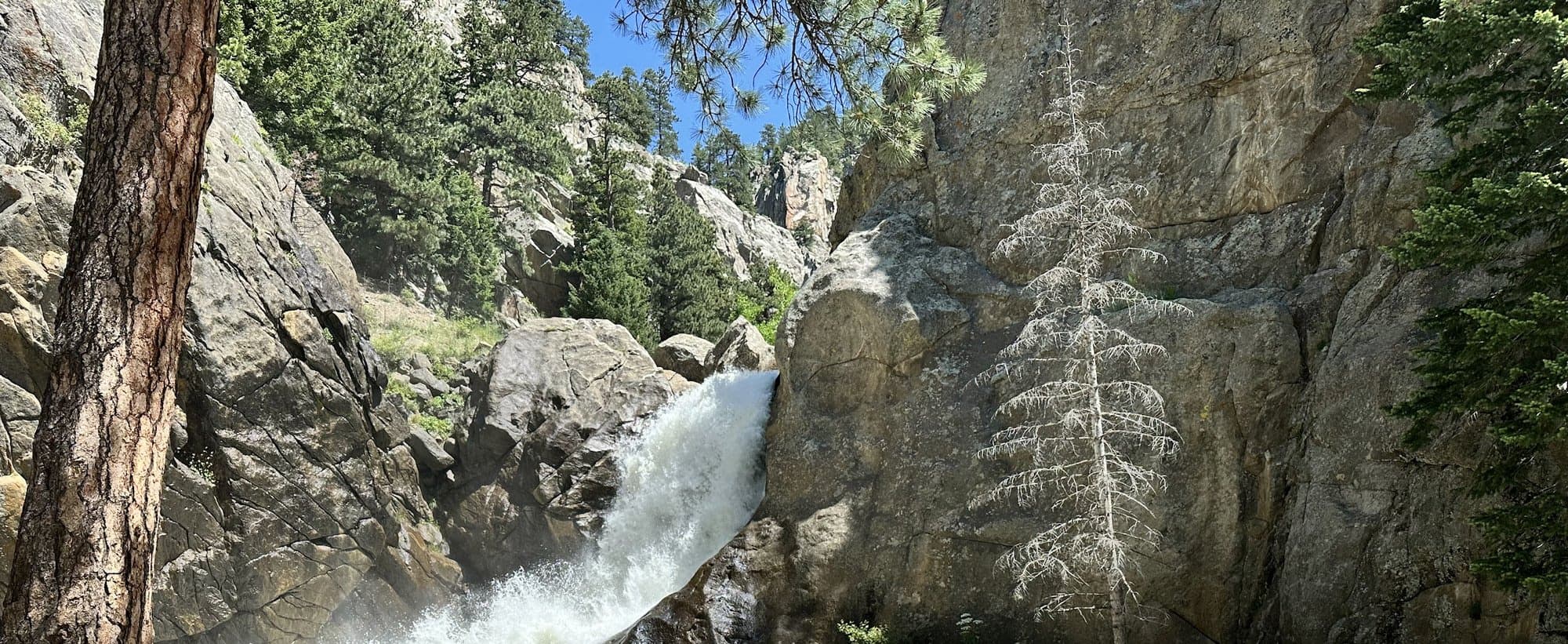
I spend my working days on systems whose state you cannot see until you measure it, and whose state the measuring changes, and then I come home and tip a small bag of green Ethiopian beans into a machine on the back porch and stand in the long June evening with a probe in one hand and a stopwatch in the other and my ears doing the rest, and it turns out to be the same job in an apron.
This is the summer we decided to go home to India, and my wife and I have begun to treat the year ahead the way a quartermaster treats a campaign, with what ships and what sells and which school and which visa written on a kitchen whiteboard in three colours of marker. There is a baby of seven months who does not sleep and a boy of four who does not stop and a job at the laboratory I still like, and the nights belong to a subject I fell into sideways, how you compute with quantum machines and how you might use them on the electricity grid, and I have started writing about it, the first writing I have finished in years, because I stopped waiting until I had read enough.
In the notebook where that writing happens there are two drawings, a map of every piece of energy data India produces, which would one day become the India Energy Atlas, and an older one, a small electric pod with nobody at the wheel, which I first drew as a boy in Howrah and found myself drawing again this spring, line for line, as if my hand had kept it for me. It would, much later, begin to take shape as Arceight, along with a good deal of power engineering hardware, but this summer both drawings are graphite and a hope.
Roasting fits into this summer because it is the one hobby I have that gets better when I treat it like work, and the one kind of work that leaves me rested, answering to no deadline and producing only a jar of beans and a quieter head.
Should you roast your own coffee, and what are you actually doing when you do?
You are running an open-loop thermal process, one batch at a time, with an audible checkpoint in the middle and a curve you are trying to keep slowing down without letting it stop, and if that sentence makes you happy you should roast, and if it makes you tired you should buy from someone it makes happy, without a flicker of shame.
My father, a professor of electrical engineering, taught me the opposite of open loop first, one evening in Howrah when I was small enough to sit on the table itself, drawing a box on an envelope with an arrow in and an arrow out and a third arrow curling back from output to input, and telling me it was called feedback, and that a system which hears its own result will steer itself. My roaster hears nothing, so on the porch the feedback is me, my ears and the probe making that third arrow and my hand on the heat dial the place it lands.
A green coffee bean is a dense little store of carbohydrate and protein and fat and acid, hard as a pebble and pale as a pistachio, about half of it carbohydrate and a portion of that sugar, the source of sweetness and caramel and much of the acidity, with a small amount of caffeine that barely changes in the roast and a good deal of a bitter-tasting acid that does.
Brew it green and you get a thin, grassy, faintly sour liquid like the water from a vase of flowers, and only roasting turns the bean into something water can pull flavour from.
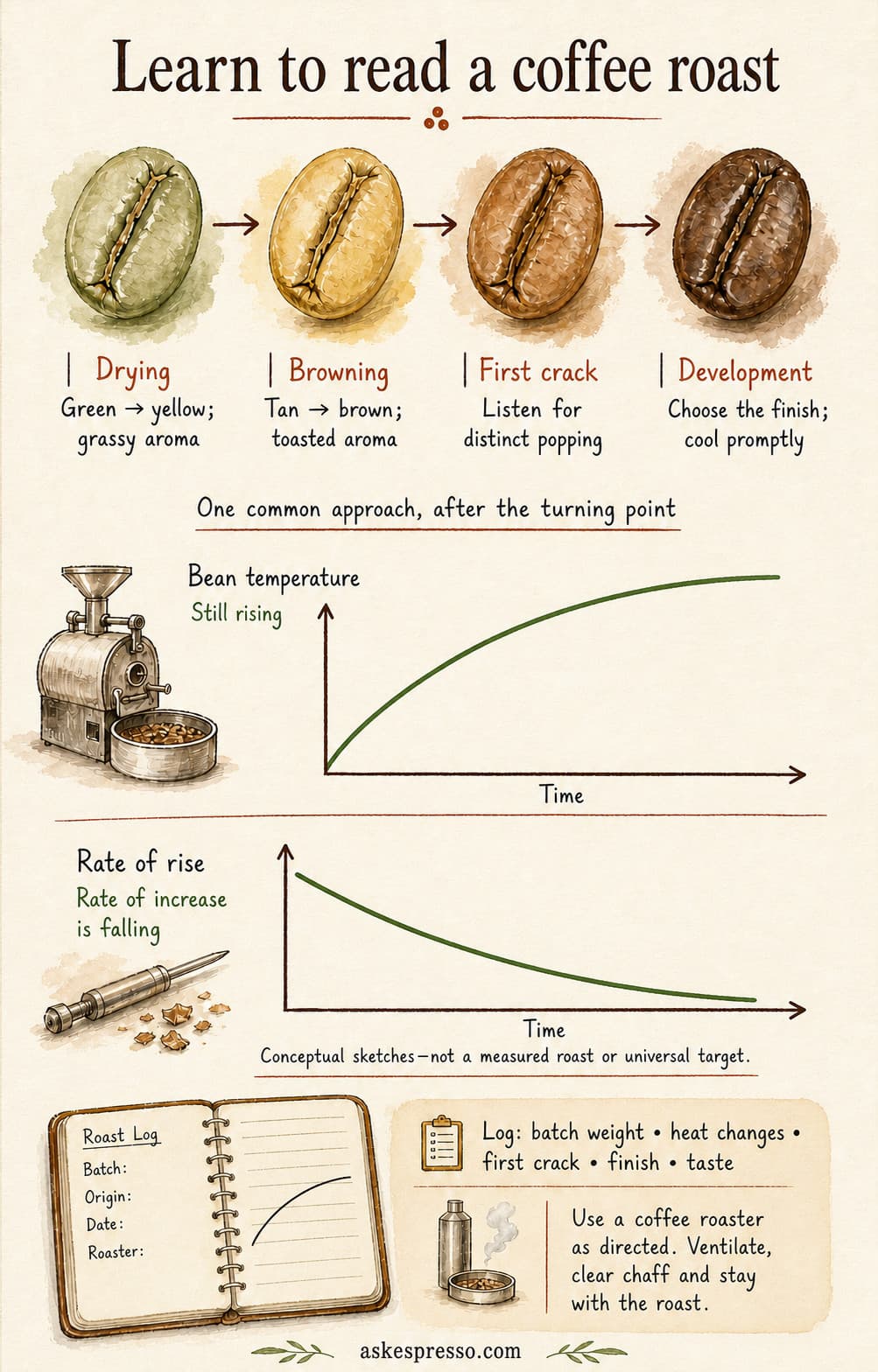
Drying. Over the first several minutes the bean's water falls from about a tenth of its weight to a few percent, and it smells of stale popcorn and wet hay and cold toast, which nobody tells you, since a roastery smells wonderful at the end and like a laundry room in between.
Browning. Above a certain temperature the sugars and the amino acids begin to react, and the bean turns from pale to tan to the brown of a walnut shell, and most of the flavour is made here; caramelisation follows and releases water and gas inside the bean, building pressure like a pressure cooker in a Bengali kitchen in the long minute before the whistle.
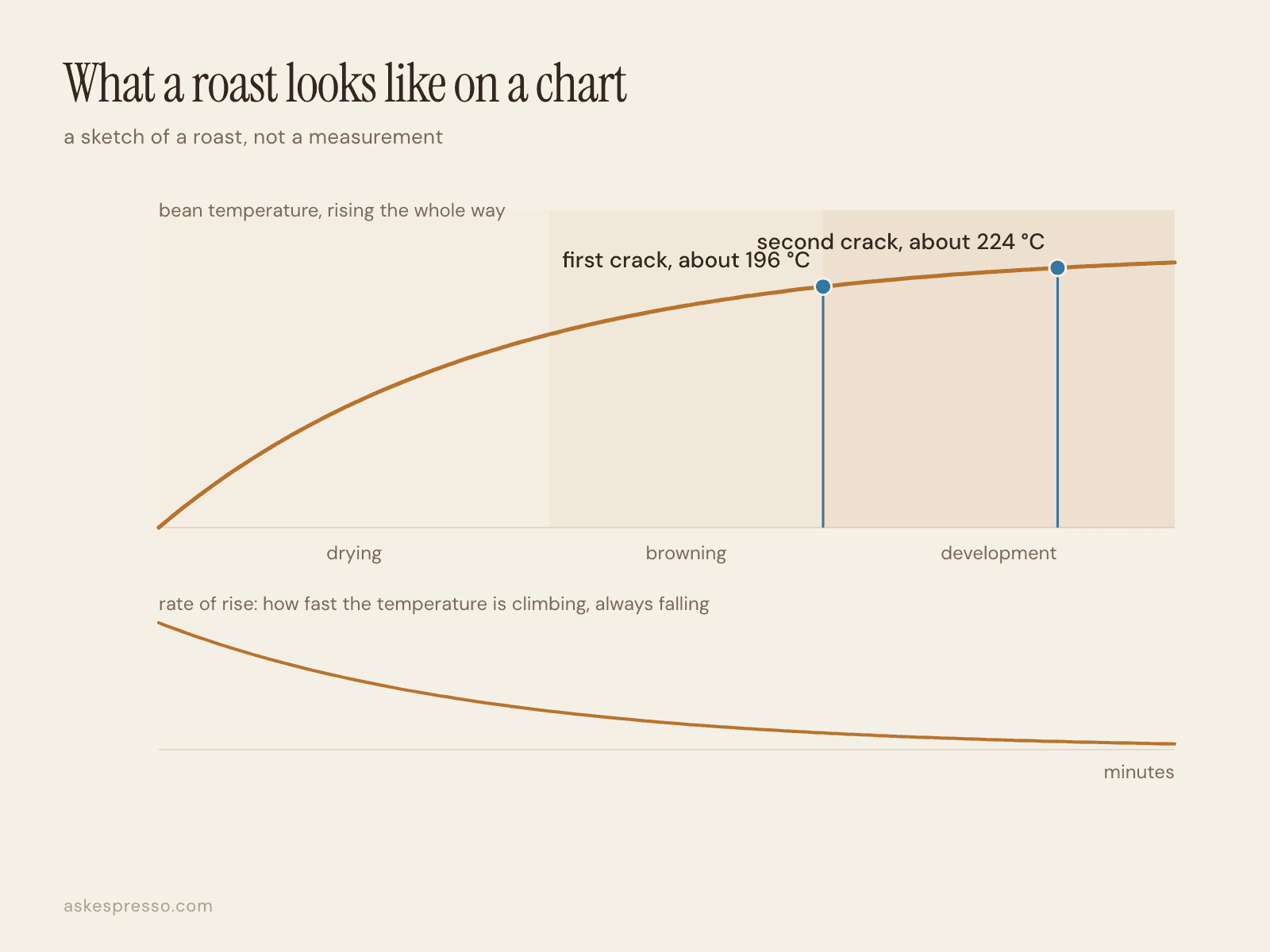
First crack. The pressure ruptures the cell walls with a sound like twigs snapping under a boot, somewhere between seven and nine minutes into a drum roast and lasting a minute or two, and the bean jumps in size, and for a moment the roast turns exothermic, the bean giving out heat instead of taking it in, which is why the process can run away here, or stall, and why this is the moment to anticipate above all, and I still misjudge it one time in five.
Development. After first crack the coffee is drinkable, and from here acidity falls steadily and bitterness rises faster and faster and body and sweetness rise and level off and then fall, so where you stop decides everything.
Second crack comes a few minutes later, quieter, a crackle like a vinyl record between songs, with almost no water left, and beyond it the woody structure of the bean breaks down into smoke and char and nut, and the bean grows fragile and oily, its surface going glossy like a pebble lifted out of a stream, and if you keep going the roaster catches fire, which I mean as plainly as I have ever meant anything, and which is why you never leave one alone.
By the end the beans have nearly doubled in size and lost a fifth of their weight and halved in density.
The temperature of the bean should always be climbing and the speed of the climb should always be falling, like a car coasting up to a red light, still rolling forward and forever slowing.
The reason is the inside of the bean, where heat arrives slowly, so you push hard early to get the core moving and then ease off so the outside does not race ahead, and a coffee tastes right when it is one colour all the way through, like a well-baked loaf.
So record the curve, because a process you cannot see is a process you are guessing at. My rig is a thermocouple probe in the bean mass and an amplifier board the size of a postage stamp and a microcontroller that cost about as much as a bag of the coffee it watches, running a few hundred lines of my own code that read the probe twice a second and feed a free logging program on an old laptop, and I was a little embarrassed to find that a bag of beans wanted exactly what I give much larger machines at work.
Those few hundred lines are what I think about most, because this is the year everyone I know began asking the new chatbots to write their software, and the chatbots oblige, a web page in a minute and a dashboard by lunch, and my conviction, hardening all summer, is that this sends programmers back down towards the metal, to code that must know how long an amplifier needs between readings and why the numbers jitter when a fan motor kicks in, where a wrong assumption scorches a batch or melts a wire. Engineers of my father's generation wrote that way because there was no other way, and I suspect my sons' generation will write that way again, once the machines have furnished the upper floors of the house and left the interesting work where it always was, in the basement with the wiring.
There is a conventional measure for the last phase, the time after first crack as a share of the whole roast, and the man who popularised it found that most of the coffees he loved sat between roughly a fifth and a quarter, though he calls it one indicator among many; my own rule is simpler, first crack at about four fifths of the way through and stop soon after.
Just after first crack. Bright, fruity, all the character of the farm, merciless about defects. Best for filter and the press; nearly always too sharp for espresso, and for me.
Between the cracks. Where most specialty coffee lives.
Into or after second crack. Darker, more soluble, more bitter, less of the place it came from, slick with the oils that have come up through the surface. Espresso blends live here, and historically so did all bad coffee.
The cup I love best lives in that last band too, and most evenings I aim at the very edge of second crack, when the beans have gone the brown of a conker and the first oils bead like ghee on a hot roti, and I am not going to apologise for it.
Boulder sits a mile up, and altitude matters: a roasting-software company had people from sea level to well above this town run the same profile on the same coffee in the same small roaster, and the higher the roaster the darker the result, on every profile, measured by instrument, because thin air carries less heat, so the machine works harder to reach the same exhaust temperature and the beans take more of it in. A roaster in Denver who brought his machine from Alaska had to cut his batch size by nearly a fifth and retune the airflow.
You will also read that first crack comes earlier and quieter at altitude, because the bean needs less internal pressure to burst against thinner air, and the physics is sound, but I found no controlled study that isolates it, and the test above measured colour and never timed the crack, so I believe it and cannot prove it, and you should know which is which.
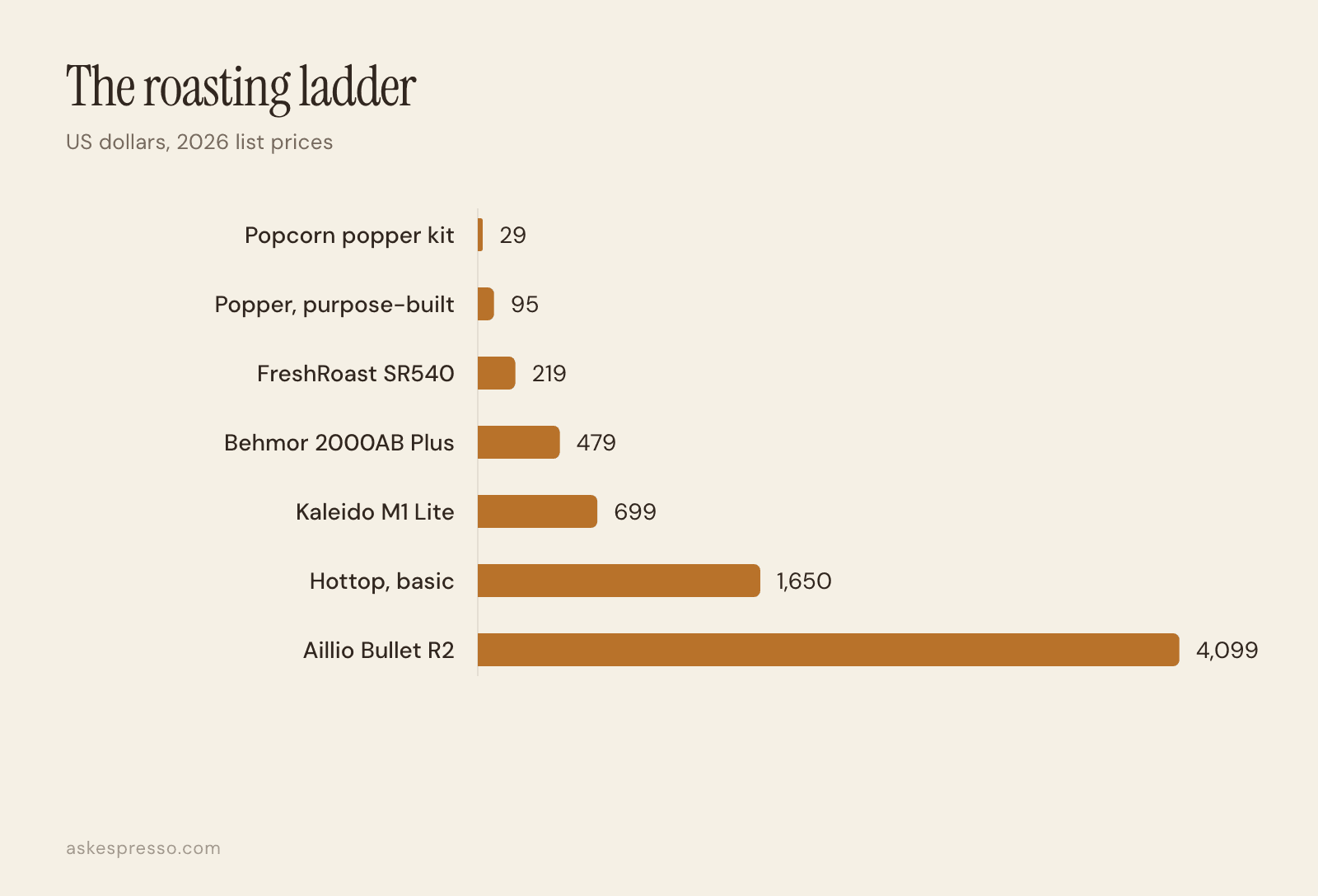
The ladder starts with a hot-air popcorn popper, a glass chimney and a plug-in meter so you can repeat the wattage, and climbs through a purpose-built popper and the small fluid-bed roasters most people buy as a first serious machine and a drum that takes a pound, to the first machine with a real profiling controller, recently cut in price and now the cheapest way to draw the curve properly, and at the top the serious drum roasters, which cost what a good used car costs.
Below the bottom rung there is free, a wok and a heat gun or a heavy cast-iron pan and a wooden spoon, six to ten minutes with the chaff blowing about like ash from a Holi bonfire and uneven results until you learn to keep every bean moving, and this is how most home roasters in India start, for reasons that are coming.
In the United States buying green coffee for the home is easy, and several retailers sell it by the pound with tasting notes and scores, in bags small enough for a hobby.
India grows its coffee under silver oak and pepper vines in the hills of Karnataka, and yet when I looked ahead to the kitchen I will have next year I checked ten specialty roasters, every one I could name, and none sells roasting-grade green coffee in retail bags, and the online listings for green coffee beans are mostly the weight-loss supplement, another product altogether. Indian home roasters buy through wholesale trade portals, in sacks of ten kilos and up with no cupping data, or write to an estate in Karnataka and buy a sack.
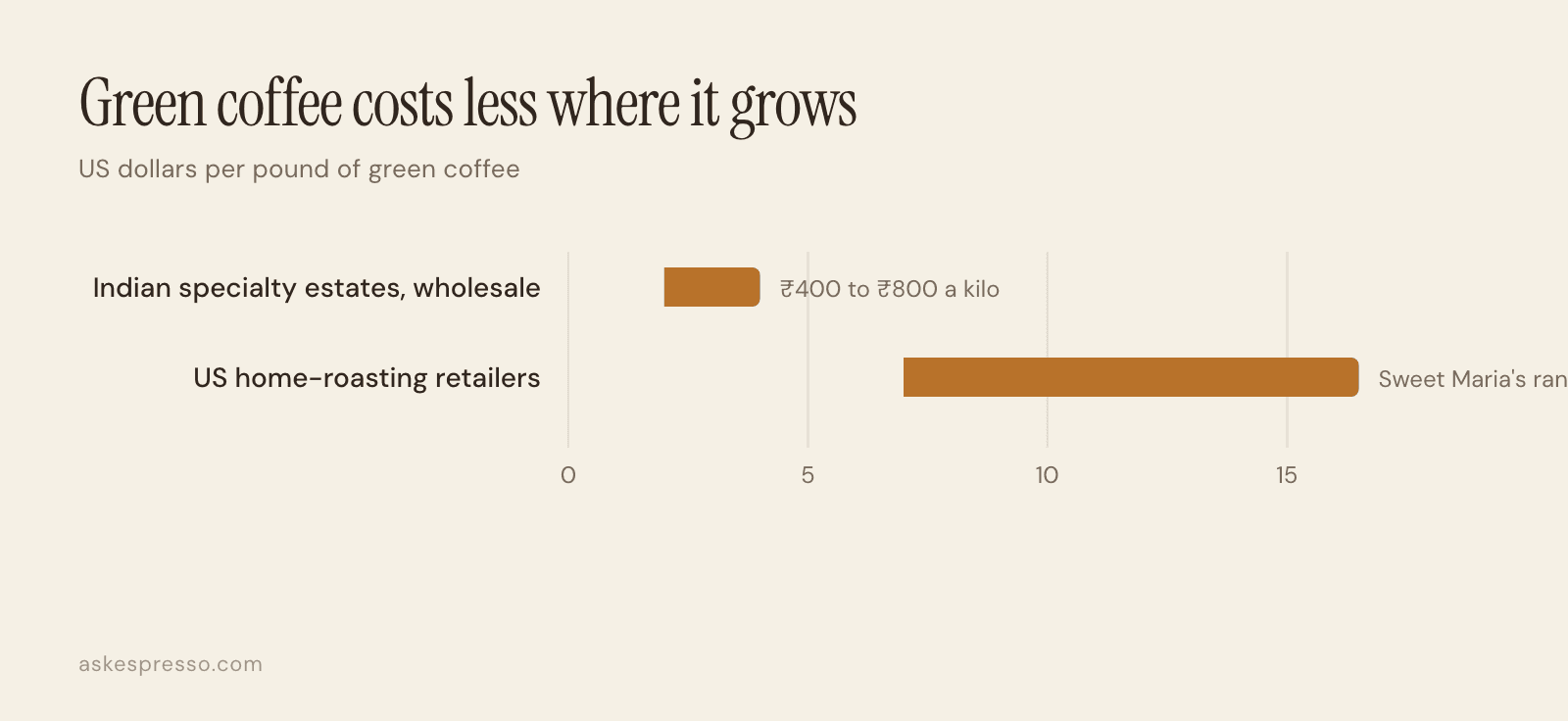
The number that ought to annoy an Indian reader into doing something is this: specialty-grade green coffee grown a couple of hundred kilometres from Bengaluru sells wholesale at a third to a half of what a hobbyist pays in the United States, and nobody sells it cupped and curated in small bags, and somebody should, and I write that down out of a habit, which the energy atlas sketch in my notebook also comes from, of writing down the things nobody has built yet.
Preheat the roaster properly.
Respect the batch size: too little scorches, too much stalls into wood and smoke.
Ventilate. Roasting makes a great deal of smoke, and the neighbours will think something is on fire.
Empty the chaff; it is a fire risk.
Never walk away.
Cool the beans fast. Within a few minutes you should be able to hold them, warm as a stone in the sun.
Bag them and rest them at least half a day before brewing, which is the subject of the next note.
The most widely used open-source program for computing the structure of materials, the kind of tool a chemist uses to work out how water minerals bind to coffee acids, is called Quantum ESPRESSO, an acronym and a joke at once, and the chemist in the water note uses exactly that class of tool, so the loop closes, which would please my father.
An entire branch of quantum computing began over a cup as well: a physicist at a university in California remembers that on a new colleague's first day, in the late nineties, they sat down for coffee and the colleague described a computer built from exotic particles that remember how they have been braided, and that conversation became a famous paper and then a field.
Those braided particles live in a strange middle country between the two families into which physics sorts every particle, and one family is named for a man from Calcutta: Satyendra Nath Bose, teaching then in Dacca, wrote a few pages in 1924 deriving Planck's law by a new way of counting identical quanta of light, and when a British journal would not print them he posted them to Einstein, who translated the paper into German himself, and out of that envelope came Bose statistics and, in time, the boson. On the porch, with the sky going the colour of apricots over the Flatirons, I take him as a reminder that India has sent core science into the world before, by ordinary post and under its own name, and that the century ahead will ask it of us again.
The first ten batches will be bad and you will drink every one of them, as I did, thin or scorched or grassy or fine for two days and then flat as a week-old soda.
The eleventh will be the first thing you have made with your hands in years that someone else asks you for, and mine was a small dark bag for Rob, at the edge of second crack, which he drank from his dented thermos and then, a week later, without looking up from his screen, asked for again, and there was none that week, and there has been ever since.
One thing to do this morning, if you own a popcorn popper:
Fifty grams of green coffee in the popper, on the back step.
Listen for first crack. You will know it when you hear it.
You will not know what to do next, and neither did I that first evening, standing in the smoke with a handful of beans the colour of cinnamon and my father's third arrow still looking for its way home.
Yes. A hot-air popcorn popper, a heavy pan, or a wok and a heat gun all work. Keep the beans moving the whole time, expect a lot of smoke and chaff, cool the beans quickly, and let them rest at least twelve hours before brewing.
The moment steam and gas burst the bean's cell walls, with a sound like snapping twigs, usually around 196 degrees Celsius and seven to nine minutes into a drum roast. The coffee is drinkable from here; how much longer you go decides the roast level.
Not from any of the specialty roasters, who do not sell green in retail bags. Home roasters buy wholesale sacks through trade portals or write directly to an estate in Karnataka. Beware online listings of green coffee that are the weight-loss supplement.
Thank you for spending a little time here.
Back to the journal ↗