The journal.
Things I notice. Things I am still learning.
Opening the journal…
The Askespresso app is on Google PlayFree shipping across India
Things I notice. Things I am still learning.
Opening the journal…
The Askespresso app is on Google PlayFree shipping across India
Opening the note…
The Askespresso app is on Google PlayFree shipping across India
Jul 19, 2020 / History / 13 min read
Stranded in Jaipur with a jar of instant coffee and a great deal of time, I read about coffee instead of drinking it: five hundred years, a few lies, a stone observatory, and the question of who writes a country's history.
Jaipur, July 2020
By Sayonsom Chanda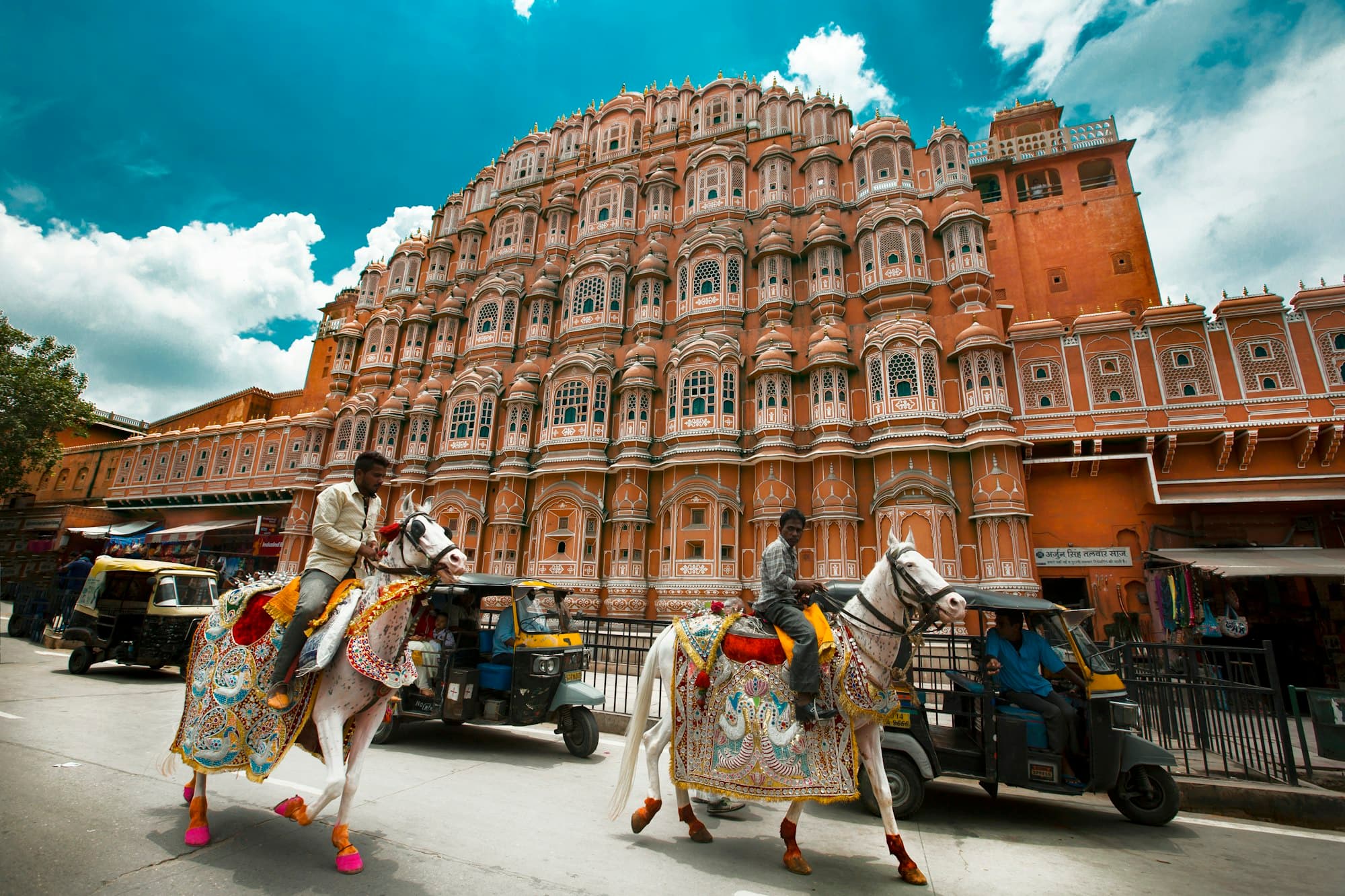
I am in Jaipur, where I was never supposed to be, because in March I flew out of the United States in the last week before the flights stopped, and it has been four months. My wife and our son are with me, and he will be two in the autumn, and he thinks a locked house with a courtyard is the finest thing ever built. The house is not ours, and it is pink like everything in this city, the pink of the inside of a shell, and when the monsoon comes it carries the smell of wet earth that the perfumers of Kannauj distil into attar, and there is a jar of instant coffee in the kitchen and nothing else, and a great deal of time.
So I have been reading about coffee instead of drinking it, and feeling guilty that this year, which is breaking so many people I know, has left me a laptop that still works and a boy who wakes me by pulling my ear and mornings that begin with a book and a cup of something brown that tastes like a memory of coffee described over a bad phone line. Last week a letter came from Alabama, from the Techstars accelerator for energy companies, taking into its next class the small company that two others and I have been sketching on video calls across three time zones, so the year that has shut so many doors has opened one, and the reading now has a deadline. From the roof I hear the bells of a temple down the lane and then, inside the same hour, the azaan from a mosque further off, the two laid over each other like ragas practised in neighbouring rooms, and nobody in this city finds that remarkable, and I love that nobody does.
Every country on earth is indoors this summer, and the strangeness of that has got under my skin more than the virus has, because I keep watching nations that spent a century trading and flying and quarrelling across their borders now shut inside them like families behind their own front doors, bidding against one another for masks and ventilators and the first vials of a vaccine that does not yet exist, and from a borrowed pink house I find myself wondering what international relations can even mean when everyone is trapped at home and the only thing still crossing every border freely is the virus. An engineer has no business with the question, and I have taken it up anyway, reading at night the way I once read circuit theory, with a pencil and too many questions in the margins, and the reading has left me a reflex, to ask of every page who wrote it, and for whom; it runs all day now like a ceiling fan nobody switches off, and this note is what it found, a history as unruly as every coffee history, where half the stories are untrue and some of the true ones are stranger than the lies.
Coffee grew wild in the highlands of southwestern Ethiopia, under a canopy of tall trees, and a version of it still does. The plant in your cup, arabica, is a natural hybrid of two other coffee species, and the geneticists reading its genome put the moment the two parents crossed anywhere from tens of thousands to hundreds of thousands of years ago, long before there were people to notice, and I trust their range over the wilder numbers in the press, because papers are where numbers should come from. So the coffee plant is an accident that happened in a forest, and for almost all of its life nobody cultivated anything.
Every history has the goatherd, Kaldi, an Ethiopian boy who notices his goats dancing after eating red berries and tries them himself, and there is Omar, a holy man exiled outside the walls of a port in Yemen, who survives on the bitter fruit and is welcomed back as a healer. Ask my new question of both, who wrote this and when, and the answer is centuries after the fact, and the stories survive because they are charming and easy to add to, like a family story that gains a detail at every wedding, so I tell them as legends, and would ask you to do the same.
The useful fact is quieter: the Oromo people of the Kefa region were pressing coffee leaves and fruit into a chewable cake, greasy with animal fat, roughly two thousand years ago, so that coffee was food before it was a drink, something to carry in a pocket on a long walk, and that seems to be as far back as the evidence goes.
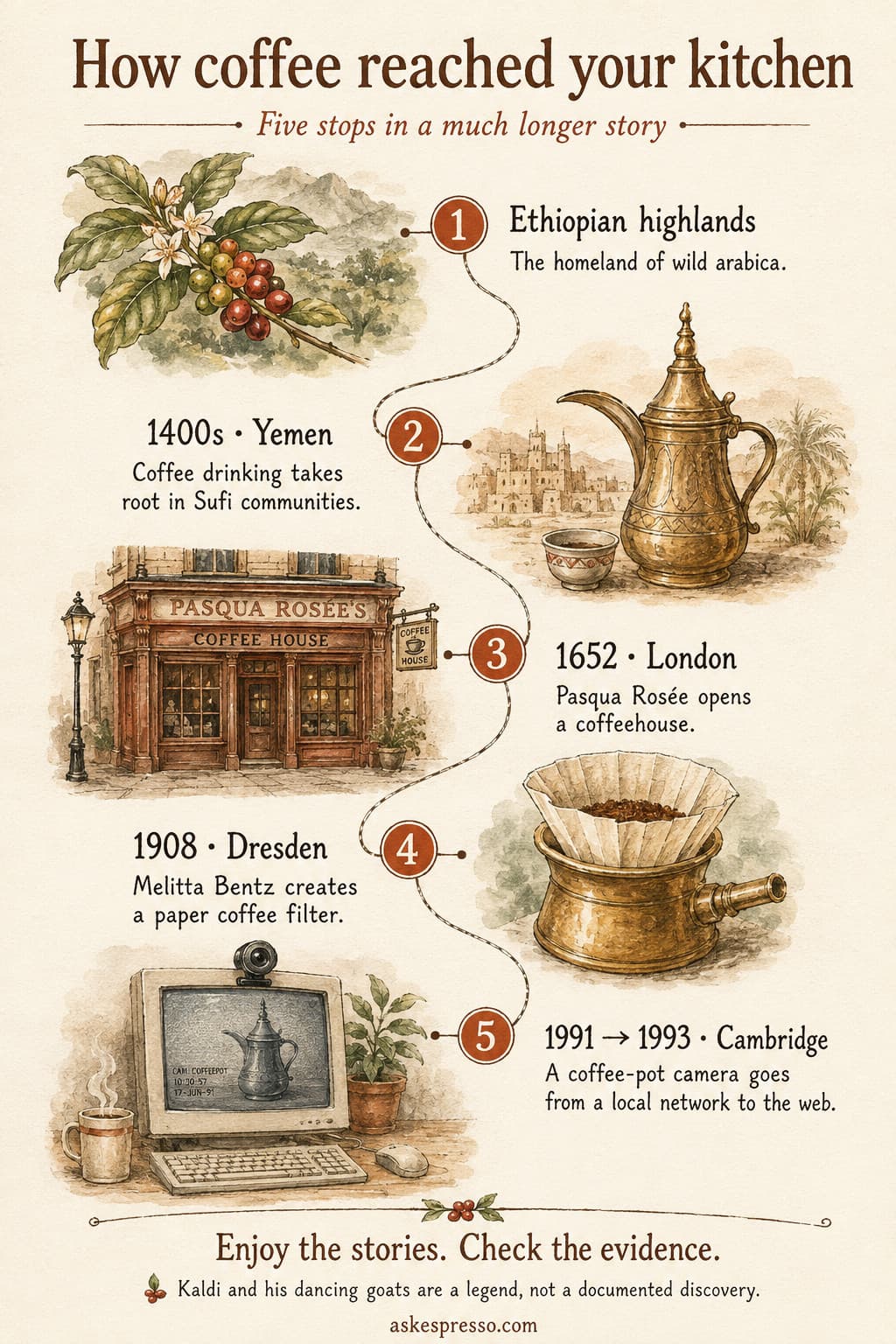
By the late fifteenth century coffee was established among Sufi communities in Yemen, who drank it to stay awake through nights of worship, and I can smell it in the lamp-lit cold before dawn; a scholar named Muhammad Ibn Said al-Dhabhani is credited with bringing it from Ethiopia, so coffee's first documented job was keeping people awake for prayer, which is not so far from its job in my kitchen.
And then there is the word, which in Arabic already existed as a poetic name for wine, traced by the old dictionaries to a root meaning to have no appetite, so that here was a dark drink that took away hunger and carried the name of wine, and you can see why it went to court.
I told the story of the bans in the first note, Mecca and Constantinople and the sultans, among them Murad IV, who shut the coffeehouses and drank coffee at home; by the middle of the seventeenth century the punishment for a second offence in the Ottoman capital was to be sewn into a leather bag and thrown into the Bosphorus, and every one of those punishments was aimed at the room, and at what people said in it when they were sober enough to remember.
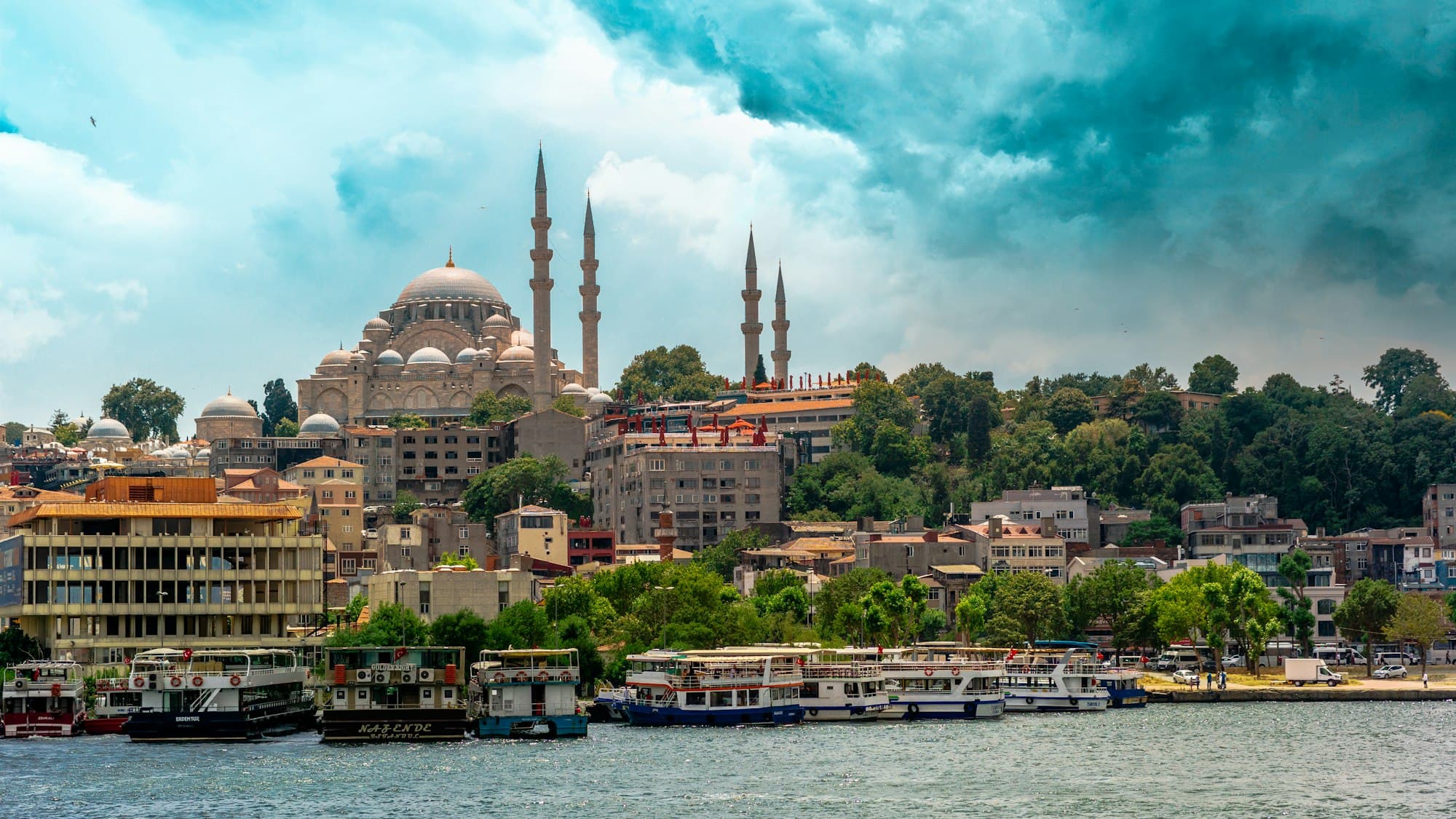
The book I finally read this year is Orhan Pamuk's My Name Is Red, which I had carried unopened across two continents for a decade, set in Istanbul at the end of the sixteenth century, a few decades after coffee arrived, where the coffeehouse is the novel's other institution, the stage for the storyteller and the wall for the forbidden pictures.
In one chapter a dog speaks, and quotes a preacher who says that coffee is a sin, that the Prophet avoided it because it dulls the mind, and that coffeehouses are where idle men sit knee to knee; and then the dog, in his own voice, tells the joke of the whole book, that men in these places get so drunk on coffee they will listen to what a dog has to say, so that the accusation and the answer come out of the same mouth. Later the zealots smash the coffeehouse and kill the storyteller, and the murder mystery is solved by the last page while the culture that room held is lost.
I went looking for the coffee quotations that circulate online under Pamuk's name and found none in his long interview with a literary magazine, where the word appears once, in the interviewer's description of the room; what he does say there is better, that for years he would say goodbye to his wife in the morning like a man going to work, walk around a few blocks, and come back to the house like a man arriving at the office, a coffeehouse argument with the coffee left out, and also, I am ashamed to say, the only discipline I have ever managed as a writer, for about a week at a time, and this year, with nowhere to walk, for longer.
An Italian doctor published the first drawing of the coffee plant in the 1590s, and London had coffeehouses by the 1650s, and a Paris café that opened near the end of the seventeenth century would later seat Voltaire and Rousseau, and then Franklin and Jefferson; and in July of 1789 a young man stood on a table outside another Paris café with a pistol in his hand and shouted for citizens to take up arms, and the Bastille fell two days later.
The coffee itself was terrible, boiled soot, as an English writer called it in 1661, and I have made boiled soot in my own kitchen more than once; some recipes of the time seasoned fresh water by boiling it first with old grounds, the way you might season a pan, and shops cleared their brew with egg white and fish bladder so that it shone in the cup like a varnished table. Four hundred years of people loving a drink they made very badly is the most reassuring fact in the whole history, so carry it with you when your own cup goes wrong, as mine did this morning, with the jar.
For a long time the Ottoman authorities would not let a living coffee seed leave their ports, and beans had to be scalded or parched before export, and the old accounts are explicit that the point was killing the seed, which is why every story of coffee escaping involves someone smuggling something alive against their skin.
The most famous is a French naval officer who, in 1720, carried a single seedling across the Atlantic to Martinique in a glass case on the deck, sharing his own water ration with it through storms and a shortage, a cupful at a time, and within a decade there were said to be millions of trees on the island; almost all the coffee grown commercially in the Americas today can be traced to one tree that once stood in a greenhouse in Paris, breathing the same air as the king.
In those same years, in this city, a king of another kind was doing something I find far more moving. Sawai Jai Singh II founded Jaipur in 1727, and through the 1720s and 1730s he raised here the stone observatory everyone now calls the Jantar Mantar, a courtyard of enormous instruments in masonry and marble, a sundial the height of a small tower whose shadow you can watch creep along its graduated arc, and bowls sunk into the earth to map the sky, built so large because he wanted readings finer than the brass instruments of his day could give. While Europe was smuggling a plant across an ocean in a glass box, Jaipur was measuring the heavens in stone, and I know which of the two the histories of the modern world remember, and which I would rather have been born into; this summer the great sundial goes on telling the time to a courtyard with almost nobody in it.
There is an Indian version of the smuggling story too, and it is better, and it belongs in the last note of the series.
At the end of the nineteenth century a German chemist named Emil Fischer named the family of molecules that caffeine belongs to, and then built caffeine in the laboratory from scratch, atom by atom, like a ship in a bottle, and a few years later the Nobel Prize in Chemistry came to him, partly for finding out what the molecule in your cup actually is.
In 1882, before the Brooklyn Bridge opened, a group of traders founded a coffee exchange in New York, and through a century of mergers it became part of the exchange that still sets the world price for arabica, in a contract that trades under the single letter C, and nearly all real coffee, from the farm in Karnataka that I would one day buy from to the bag on your counter, is priced as some amount above or below that number.
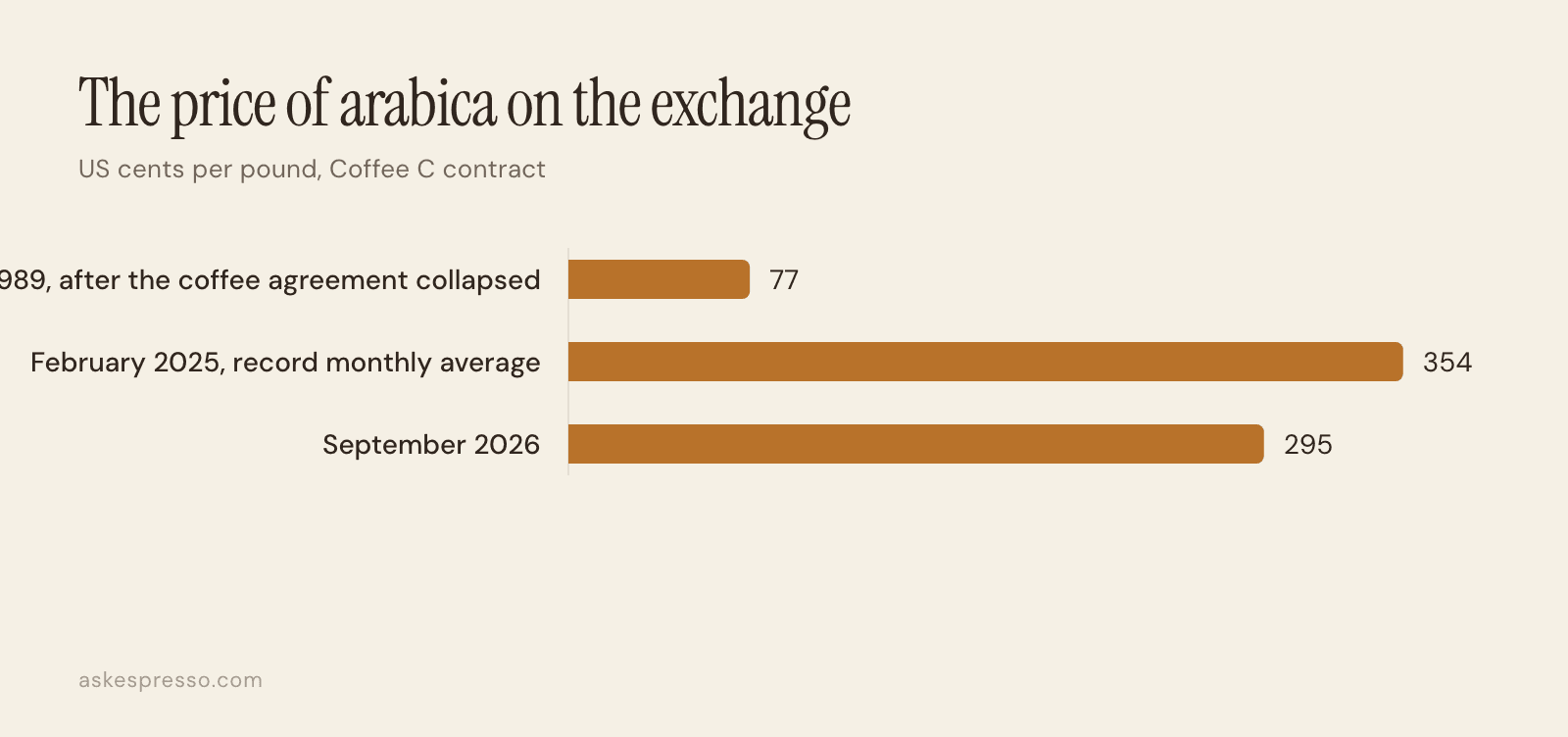
The number has had a wild life, and when the international agreement that once steadied prices collapsed at the end of the eighties, it fell below what it cost most farms to grow the coffee, and families walked away from their trees; last year it sank below a dollar a pound again, lower than it had been in more than a decade. What that number does to the bag in your hand is a question for the note on buying.
I have had the time this year, so I checked each of them against the oldest sources I could reach from a borrowed pink house.
Coffee is not the second most traded commodity in the world after oil. The real statistic was narrower and older, about exports from developing countries in a particular period, and the writer who spread it has corrected himself in print.
Voltaire did not drink forty cups a day. There is no primary source of any kind; that he sat in a Paris café is well attested, and the number is not.
Beethoven did not count sixty beans for every cup. The only source is a secretary who forged entries in Beethoven's notebooks after his death, and three of Beethoven's friends confirm that he made coffee at home and cared about it, and none mentions counting.
The slogan about a coffee being good to the last drop was not said by Theodore Roosevelt. It was already in advertising before the day he is supposed to have said it, and the company that used it never claimed he did.
The most expensive coffee in the world, the one that passes through a civet, is not something you should buy. The price has produced caged animals fed fruit of any ripeness, and a large trade in fakes, and I will not be gentle with anyone who serves it to me.
With that new reflex running, I kept noticing how much of what I know about my own country was written down by visitors. Al-Biruni came in the wake of Mahmud of Ghazni's armies in the eleventh century, learned Sanskrit, wrote the most careful book of his age about Indian science and belief, and complained in it that Indians paid little attention to the order of events and were careless about the succession of their kings; before and after him came the Chinese pilgrims and the Moroccan judge and the Portuguese traders, each setting down what he saw; and then the British surveyed us with chains and theodolites and counted us in censuses, and one of the most influential histories of British India was written by a Scotsman, James Mill, who never set foot here and read none of our languages and thought that this made him impartial. The rare exception is Kalhana, who in twelfth-century Kashmir wrote the Rajatarangini, the river of kings, a chronicle in Sanskrit verse that tried to set his valley's rulers in order and to weigh the sources he trusted.
A civilisation this old deserves more than one Kalhana in a thousand years, and a country that leaves others to write its history is remembered in their handwriting, rarely fairly; if India wants to be remembered as it was, it will have to pick up the pen itself, and I suspect these notes are one small, coffee-stained attempt at that.
I never did find good coffee in Jaipur this year, and the jar of instant is a little emptier, and I have learned to make it with hot milk and a pinch of cardamom, which turns it into a different drink that I need not be ashamed of, and the books are a little more read.
What I found was what coffee is, a forest accident and a Sufi vigil and a word for wine and a room that frightened kings and a seedling on a ship and a molecule with a prize and a number on a screen, a drink that kept Sufis awake for God and Ottomans for argument and Christian London for its money, at home in every faith it passed through the way the bells and the azaan are at home in the same hour on this street. That is a more durable thing to own than a good cup, and when the flights start again I will go and find the cup, and it will be dark, and I will drink it black.
Is there a version of this history that does not run through rooms full of people talking? I looked, in every book in this pink house, and I could not find one.
Arabica coffee grew wild in the highlands of southwestern Ethiopia. It is a natural hybrid of two other coffee species, and a 2024 genome study dates that hybrid to hundreds of thousands of years ago. People in the Kefa region ate it as a pressed cake long before anyone brewed it.
Nobody knows, and it was written down centuries after it supposedly happened. It is best told as a legend. The better-documented start is coffee in Yemen in the 1400s, where Sufi communities drank it to stay awake through night prayers.
No. The claim came from a garbled version of a narrower statistic about exports from developing countries between about 1970 and 2000, and the writer who spread it has corrected it in print.
Thank you for spending a little time here.
Back to the journal ↗